






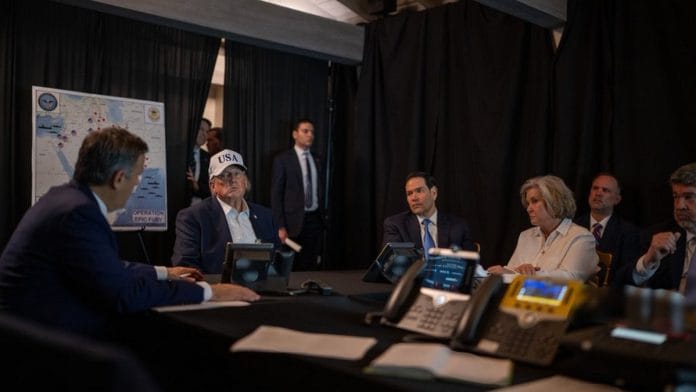


As US President Donald Trump, who campaigned on ending America’s costly wars, takes the United States back to the battlefields of West Asia, the fragile equilibrium shaped by the region’s persistent security dilemmas appears increasingly unsettled.
The consequences of great power wars extend far beyond the immediate combatants. They reshape the very architecture of regional and global order. At their core, international relations and geopolitics continue to revolve around a deceptively simple question: why do states go to war? The answers lie at multiple levels, ranging from individual leadership and decision-making to the predispositions of certain states toward conflict, as well as the structural condition of anarchy in the international system, where the absence of a central regulating authority creates enduring incentives for competition and war.
For all the talk of Trump’s ‘warmongering’ and the US Congress’s failure to rein him in, the current situation has well-established precedents, and invites a broader historical reflection.
It recalls a familiar trajectory: that of a rising Western power expanding beyond its geographical confines, projecting force across distant theatres, joining European allies in two world wars, entering a prolonged Cold War with the Soviet Union, waging proxy conflicts across regions, and later engaging in wars of regime change and counterterrorism.
In essence, the story is not new. It is an evolving continuum of great power behaviour, adapting to new contexts, but retaining its fundamental patterns.
Also Read: The new paradox of American hegemony under Trump — great strength, greater anxiety
The making of a global power through war
Across these wars, American presidents have led the United States into foreign conflicts, sometimes reluctantly, often decisively, and almost always with profound consequences for American power and the global order.
US involvement has revealed a recurring pattern: presidential initiative, congressional ambiguity, initial public support, prolonged engagement, and eventual war fatigue. Over time, these experiences have shaped not only how the US understands the use of force, but also how great powers in general manage military reverses, cope with economic overstretch, confront the limits of global leadership, and grapple with the difficulty of achieving clear political outcomes.
The story of US overseas military engagement arguably begins in 1898, when President William McKinley led the country into the Spanish-American War. What was couched as a humanitarian effort to liberate Cuba from Spanish rule quickly morphed into America’s first major ‘imperial’ venture abroad. In its aftermath, the United States acquired the Philippines, Guam, and Puerto Rico, marking its transition from a continental to a global power.
The declaration of war has long been a point of contention between the legislature and the executive. While, in principle, the US Congress holds greater authority and places formal constraints on such decisions, in practice the President’s prerogative powers have frequently prevailed in matters of foreign policy and the use of force abroad.
In the case of the 1898 war, Congress formally declared war, and public opinion was overwhelmingly supportive, driven by nationalist sentiment and sensationalist journalism. Yet even in victory, tensions surfaced. The subsequent Philippine-American War exposed the contradictions of American expansion, generated domestic opposition, and gave rise to the Anti-Imperialist League. The United States had won a war, but in doing so had also inherited the burdens of empire.
Such a pattern — of rapid entry, initial unity, and eventual domestic friction — would recur across US involvement in foreign wars throughout the 20th century and into the 21st. When President Woodrow Wilson took the United States into World War I in 1917, he cast it as a moral crusade to “make the world safe for democracy”. Congress declared war, and public opinion rallied decisively. Yet the aftermath bred disillusionment. The Senate did not ratify Wilson’s bid for the League of Nations, and the United States withdrew into a phase of strategic restraint, often described as the inter-war period of isolationism.
World War II was a decisive turning point. President Franklin D Roosevelt led the United States into direct involvement in the war after the Japanese attack on Pearl Harbour, with Congress offering near-unanimous approval and public support running overwhelmingly high. The war holds added significance because, by its end, the United States, already the most materially powerful country in the world, had shed any remaining restraint about its global role. It openly embraced the ambition of global leadership, reshaped the international system to its advantage, and spearheaded the institutionalisation of a global security and financial architecture, often described as the ‘rules-based order’.
Foreign wars in ‘Cold War’
The Korean War, the first Cold War theatre, was the initial test of America’s new global role. President Harry Truman committed US forces without a formal declaration of war, framing the intervention as a United Nations action. Congress largely acquiesced, setting a lasting precedent for expanded presidential war-making authority. Public support was strong at first, but waned as the conflict stalemated.
The Korean War also introduced the concept of ‘limited war’, where, unlike in ‘total wars’ such as World War II, objectives were restricted by the risk of escalation, exacerbated by the nuclear dynamic between the US and the Soviet Union.
Vietnam was the most dramatic illustration of this dynamic. Presidents from John F Kennedy to Lyndon B Johnson and Richard Nixon steadily escalated US involvement to support South Vietnam against the North. The Gulf of Tonkin Resolution in 1964 granted sweeping authority without a formal declaration of war. Congress and the public initially backed the effort, shaped by Cold War fears of communist expansion. But as casualties rose and victory remained elusive, opposition surged, fuelling protests, political divisions, and social unrest. In response, Congress passed the War Powers Resolution in 1973 to reclaim oversight. The US withdrawal and the fall of Saigon in 1975 marked a profound strategic and psychological setback, underscoring how prolonged wars can fracture domestic consensus and force recalibration.
From limited conflicts to ‘forever wars’
The impact of the Vietnam War was witnessed in the 1991 Gulf War under President George H W Bush, which reflected restraint and wariness of long-drawn wars. It had congressional authorisation, broad international backing, and a clear objective: expelling Iraqi forces from Kuwait. The swift victory restored American confidence and reinforced perceptions of military superiority. However, the complex dynamic in Iraq, and America’s strategic presence and objectives in West Asia, would generate strategic dilemmas that would reveal themselves in the years to come.
The terrorist attacks of 11 September 2001 ushered in a new era of American warfare. President George W Bush launched military operations in Afghanistan and later Iraq under broad congressional Authorizations for Use of Military Force. Public support was overwhelming initially, but both wars became prolonged and complex. Afghanistan evolved into the longest war in US history, while Iraq drew controversy over intelligence failures and strategic missteps. Over time, public opinion shifted, and these conflicts, dubbed America’s ‘forever wars’, came to symbolise the limits of nation-building and counterinsurgency. They also emerged as markers of ‘imperial overstretch’, fuelling debates on restraint in overseas commitments and the need to prioritise nation-building at home.
Subsequent presidents — Barack Obama, Donald Trump 1.0, and Joe Biden — sought to scale back US military commitments while preserving global influence. Even as large deployments declined, drone strikes, limited interventions, and security partnerships persisted. The 2021 withdrawal from Afghanistan symbolically ended two decades of war but raised questions about American credibility and strategic endurance. It brought into relief a recurring feature of great power behaviour: reframing disengagement from protracted conflicts as strategic recalibration rather than defeat.
Also Read: Who is winning and losing in the US-Israel war on Iran? Here’s a perception rating
Past is prologue
Fast forward to 2026 and the West Asian imbroglio. Senate Republicans have repeatedly blocked efforts to limit Donald Trump’s war authority in Iran as operations approach the 60-day threshold under the War Powers Resolution of 1973. The law requires presidents to end military action within 60 days, extendable by 30 more only through formal certification to ensure the safe withdrawal of troops, unless Congress authorises the use of force.
Much as in earlier wars, presidential decisions are driving escalation in the Iran conflict, while Congress remains divided and US public opinion skews negative.
The justifications offered for war — deterrence, credibility, regional stability — mirror past conflicts, even as the risks of escalation, economic strain, and prolonged engagement start stirring internal unrest.
At the core lies a structural tension: Congress holds the power to declare war, but presidents, as commanders-in-chief, often control its conduct.
Public opinion remains an influential, if not decisive, force. American wars, thus, tend to follow a familiar cycle: crisis-driven unity, early optimism, mounting frustration during prolonged engagement, and eventual withdrawal as support declines. While war fatigue may not trigger immediate policy shifts, it steadily constrains leadership. Military setbacks, rising costs, and casualties fuel calls for retrenchment within the American polity.
Great powers expand commitments to sustain influence but eventually face resource limits and domestic resistance.
The question today is not whether the United States will continue to engage abroad; history suggests it will. The question is how the US balances global ambition with domestic pressures. Military setbacks seldom end great power status, but force reassessment. Such reassessment and recalibration, resulting from political, economic, and strategic strains, will have consequences far beyond the war zones, altering the broader balance of power in the international system.
Monish Tourangbam is a Fellow at the Chintan Research Foundation (CRF), New Delhi. Views are personal.
(Edited by Asavari Singh)