



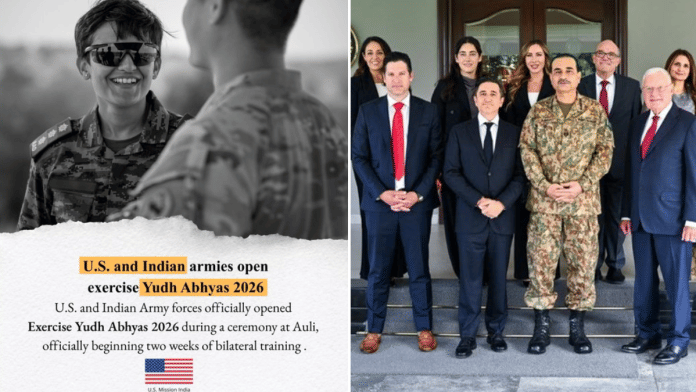
New Delhi: South Asia is seeing a balancing act by the US, with Washington strengthening defence ties with India through the two-week Yudh Abhyas exercise while finalising an interceptor drone deal with the Pakistan army.
On 15 September, the US embassy, through a social media post on X, announced the 22nd edition of the Yudh Abhyas (military exercise) between the two countries, focusing on readiness, interoperability and cooperation.
Yudh Abhyas is an annual bilateral military exercise empowering two countries to improve their abilities and cooperation across a range of military operations. This year, the emphasis will be on high-altitude operations, unmanned aerial systems, counter-unmanned aerial system operations, and integration of modern capabilities such as HIMARS and M-LIDS.
“Through field training, live-fire exercises, and the exchange of expertise and experiences, Yudh Abhyas 2026 aims to strengthen interoperability among our forces and address emerging challenges while further strengthening the U.S.-India defence partnership,” the post read.
From 9 September to 28 September, 600 military personnel from both sides would come together for training and also to further the aim of establishing a free and open Indo-Pacific. Yudh Abhyas, put in place since 2004, has been instrumental in the exchange of expertise and experience.
Three days later, in another social media post on X, the US Embassy in Islamabad announced the MoU signing on unmanned aerial systems.
According to Pakistani media outlet Dawn, the US drone maker has received an initial order, although Powerus co-founder Brett Velicovich refused to disclose the order value, citing confidentiality and security concerns.
“U.S. Chargé d’Affaires Natalie Baker and representatives of U.S.-based defence firm Powerus met with Field Marshal Asim Munir in Rawalpindi on September 16 to discuss avenues for cooperation in defence procurement and production,” the post read.
Powerus offers aerial and maritime drones for military and industrial use and is looking to potentially build technology in Pakistan, according to Dawn.
(Edited by Tony Rai)
Also Read: Why India needs deeper economic reforms to reset ties with the US amid trade tensions