



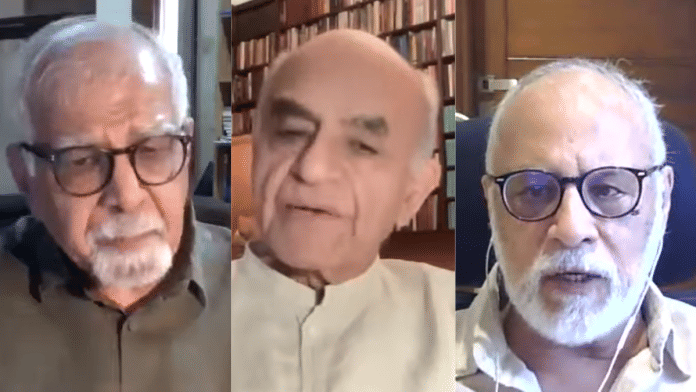

New Delhi: As India and the United States navigate growing strains over trade, tariffs and strategic expectations, experts at a discussion hosted by the Indo-American Friendship Association (IAFA) Thursday argued that the future of bilateral ties will depend as much on India’s internal economic reforms as on geopolitics.
Speakers at the IAFA event highlighted unresolved trade barriers, competing notions of strategic autonomy and the need for India to accelerate manufacturing and market reforms to strengthen ties with Washington.
Economist, columnist and former executive director for India at the International Monetary Fund, Dr Surjit Bhalla, traced the recent fault lines in the India-US relationship to India’s failure to strike a trade deal with Washington, rather than to its policy of strategic autonomy.
“The choice is not made by the Indian government or diplomats,” he said. Bhalla referred to a “deep state” in India—industrialists financing political parties—“who are not in the room, but are effectively present”.
According to Bhalla, sectors such as agriculture, medicine and dairy are routinely excluded from trade negotiations because of these entrenched interests. “Only policy can deliver prosperity,” he said at the IAFA event.
Defining strategic autonomy in terms of sovereignty, Bhalla argued that it has increasingly come to mean not “committing to anything”. He also challenged India’s claim of being the world’s fastest-growing economy, saying that by US metrics, India ranks as only the “16th fastest-growing economy”. Stressing the need to open Indian markets, he said Donald Trump could become a catalyst for such reforms.
Echoing the sentiment at the IAFA event, author Gurucharan Das said: “Trump is our best friend, who is forcing us to bring internal change.”
Das argued that India needed a “change in mindset”, adding that both the Left and the Right had historically prevented India and the US from coming closer. Such a shift, he said, was essential for India’s economic rise.
“There are two games in town—the short game and the long game. One is T20 and the other is Test cricket,” he said, pointing to Pakistan as an example of a country that has managed to maintain ties with both China and the US.
Das argued that unlike other developed economies, India skipped the middle phase of manufacturing-led growth and moved directly from the Green Revolution to the Digital Revolution. He stressed the need for an “export-led industrial revolution” and said that if India could raise its growth rate by one percentage point annually until 2047, it could pull millions of families out of economic anxiety.
He said the conditions for such growth were stronger today, citing improved access to industrial technology, reduced friction in the economy, and the Goods and Services Tax (GST) as a step towards “one nation, one market”. However, he added that a change in bureaucratic mindset could only come through political leadership.
Ambassador Jawed Ashraf, chairman of the India Trade Promotion Organisation (ITPO) and former High Commissioner to Singapore and Ambassador to France, said the same trade chokepoints in India-US relations had persisted since the Obama administration.
Ashraf also pointed to changing trends in foreign direct investment (FDI), noting that nearly three-fourths of FDI is now directed towards artificial intelligence and related sectors. On defence cooperation, he said India should not “set a low bar” for itself.
Former ambassador to Germany and the US, Meera Shankar, stressed the importance of sustained engagement in artificial intelligence, quantum technology, biotechnology and space cooperation.
Noting that the US no longer makes a clear distinction between allies and adversaries, she said India should avoid rushing into premature agreements until there is greater clarity on tariffs. She also underlined the need to expand the bilateral trade basket.
Manoj Joshi, columnist, commentator and distinguished fellow at the Observer Research Foundation, said developments in 2025-26 had exposed deep fault lines in the India-US relationship. He traced much of the bitterness between the two countries to the India-Pakistan conflict of May 2025.
(Edited by Viny Mishra)
Also read: Terror to trade, Rubio & Jaishankar push broader India-US strategic partnership on security, energy
Our Green Revolution itself was not done correctly.
The MSP policy has caused a massive imbalance of rice/sugarcane overproduction, fertilizer wastage, while decreasing the production of pulses and oilseeds which fix nitrogen and avoid the need of urea.
For heaven’s sake, stop govt controlled policies. Liberalize agriculture. Brong back the 3 farm laws.