



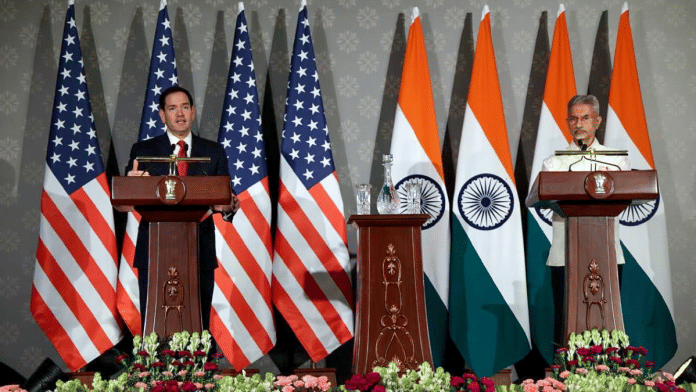
New Delhi: India-US strategic partnership remains strong and capable of shaping global developments, US Secretary of State Marco Rubio said at a joint press briefing in Delhi Sunday.
The briefing focused on responses to global crises, counterterrorism cooperation, growing trade ties and the future of multilateral diplomacy. Rubio also sought to reassure India amid concerns over trade disputes and Washington’s renewed engagement with Pakistan.
“The US-India relationship has not lost momentum,” Rubio said, arguing that President Donald Trump’s trade recalibration was part of a broader global effort to rebalance American economic relationships rather than a policy directed specifically at India. “We are on the verge,” Rubio said, “of making tremendous progress” towards a new bilateral trade agreement.
Rubio, who is on a four-day state visit to India, stressed that terrorism remained a defining point of convergence between Washington and New Delhi.
“Terrorism is one of the great challenges of the 21st century and we are strategically aligned on that topic. Both our countries have suffered, directly and indirectly, because of global terrorist networks,” Rubio said at Hyderabad House after delegation-level talks.
External Affairs Minister S. Jaishankar said India appreciated the “strong cooperation between concerned agencies” and particularly recognised the extradition to India last year of Tahawwur Rana, a key accused in the 26/11 Mumbai terror attacks.
In reference to Washington’s growing ties with Pakistan, Rubio, without naming any country, said, “But I don’t view our relation with any country in the world as coming at the expense of our strategic alliance with India.”
Rubio framed the India-US partnership as extending far beyond regional concerns. “Our standpoint is not limited to a regional one,” he said, adding that the US and India were coordinating on issues stretching from the Western Hemisphere to the Strait of Hormuz.
“We have a lot of alignment, whether it is our mutual interest in what is happening currently in the Strait of Hormuz and beyond,” Rubio said.
His remarks reflected a broader shift in how both governments describe the relationship—not merely as a counterweight to China in Asia, but as a strategic partnership between two globally influential powers.
“There are only a handful of countries in the world that have both the economic and diplomatic power to influence strategic issues globally,” Rubio said. “India is one of them.”
“We have a strategic alliance between the United States and India. It is a strategic alliance between two countries with global influence and the ability to shape world events,” he added.
Rubio also emphasised a shared commitment to maritime freedom and international commerce, remarks that appeared aimed at wider anxieties over contested waterways.
“We share the strategic principle that no international waterway or airspace should ever be controlled or nationalised by any country,” he said.
The comments came as Washington and New Delhi stressed the importance of secure maritime trade routes and stable global energy markets amid escalating tensions in West Asia.
Jaishankar said India’s energy strategy was increasingly shaped by “de-risking” and diversification, describing the United States as “a very significant and reliable source of energy”.
“For our energy security, it is important that we have multiple large, affordable and dependable sources,” Jaishankar said.
For Jaishankar, the central theme was India’s policy of “multi-alignment” in an era marked by overlapping conflicts.
“India is one of the very few countries that has strong relations with the United States, Israel and Iran,” Jaishankar said. “We do not look at it as a zero-sum game.”
Responding to a question on multi-alignment, he described India’s challenge as maintaining partnerships across competing blocs while advancing its own strategic and economic interests.
“The question is how you manage them all,” he said, referring to India’s ties with Russia, Europe, Ukraine and the US amid the continuing war in Ukraine.
“In that sense, yes, it is multi-alignment because today’s India has a range of interests that requires us to manage multiple relationships,” he added.
Jaishankar also outlined the practical concerns driving India’s diplomacy in West Asia: Regional stability, energy security, diaspora welfare and uninterrupted trade routes.
“We want peace and stability in the region,” he said. “The welfare and well-being of the diaspora are crucial.”
India, one of the world’s largest energy importers, was also closely monitoring the impact of regional instability on oil markets. “We want to see energy prices come down because we are a major importer, and much of our energy comes from that region,” Jaishankar said. He added that India wanted “safe and unimpeded maritime commerce” and open markets in the region.
Rubio also addressed immigration, a politically contentious issue in the US, while seeking to reassure Indian audiences about future opportunities for skilled migration.
“We had a migration crisis in the United States,” Rubio said. “This is not because of India, but broadly because over 20 million people entered the United States illegally over the last few years.”
He said Washington was “modernising the US immigration system for the 21st century” and suggested the eventual system could prove “even more beneficial” for skilled Indian workers seeking opportunities in the US.
Asked about racist remarks targeting Indians in the US and allegations that Trump had encouraged such sentiments, Rubio dismissed them, saying there were “stupid people who make dumb remarks” in both countries but that such comments did not define bilateral ties.
Rubio also hinted at a possible diplomatic breakthrough in the West Asia conflict, though he declined to provide details. His remarks came shortly after Trump said Sunday that Washington was nearing an agreement with Iran to extend the current ceasefire by another 60 days.
“The president’s preference has always been to solve these problems diplomatically,” Rubio said. “He would much rather see the Department of State resolve this issue than have it handled through military conflict.”
He added that over the past two days, the US had worked closely with partners in the Gulf region and made progress towards a possible agreement that could ensure open shipping lanes through the Strait of Hormuz while addressing concerns over Iran’s nuclear ambitions.
Rubio concluded by expressing hope that Prime Minister Narendra Modi would visit Washington later this year, describing India as one of America’s “most important strategic partners in the world.”
(Edited by Viny Mishra)
Also read: Trade & QUAD in focus as Rubio meets PM Modi, says India cornerstone of US’s Indo-Pacific policy