



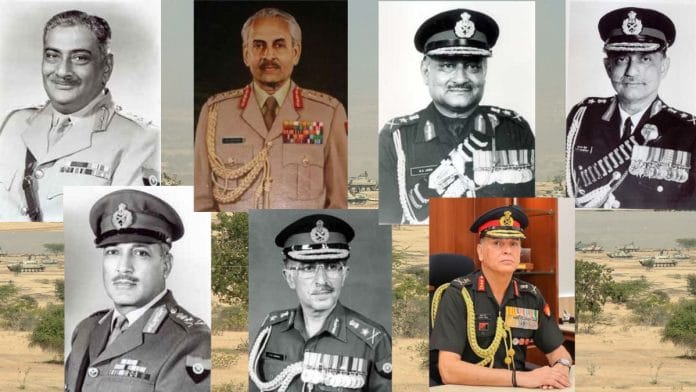
New Delhi: On the afternoon of 30 June, the Indian Army will get its 31st Chief of Army Staff (COAS) when Lt Gen Dhiraj Seth takes over. He will be the 7th officer from the Armoured Corps to rise to the top post, two of whom became COAS because the post suddenly fell vacant.
Incidentally, he will be the first Armoured Corps officer to rise to the top after 1997. In between, another Armoured Corps officer, Lt Gen Praveen Bakshi, was superseded by his junior, late chief of Defence Staff Bipin Rawat, to the post of COAS.
In all, there have been five Army chiefs from the Corps of Artillery and one from the Engineers. The rest have all come from the Infantry.
ThePrint takes a look at the careers of the six Armoured Corps Army chiefs.
Also Read: Western theatre against Pakistan to be headed by IAF, Northern theatre under Army to focus on China
General Maharaj Shri Rajendrasinhji Jadeja
Even though Gen K M Cariappa was the first Indian officer to head the Army from 15 January 1949 to 14 January 1953, he held the dual designation of Chief of Army Staff and Commander in Chief.
Gen Jadeja of the 2nd Lancers also held the dual post till it was changed to Chief of Army Staff on 1 April 1955. He held the new post for 43 days before his retirement.
General Jayanto Nath Chaudhuri
Gen Chaudhuri, of the 16 Light Cavalry, was the 6th COAS who served from 20 November 1962 to 7 June 1966.
Even though he became the Army chief because his predecessor Gen Pran Nath Thapar resigned after the 1962 War debacle, his tenure is seen as one of the most significant periods in the Army’s journey to where it is today.
His achievements span World War II, the integration of princely states, military modernisation and the 1965 India-Pakistan War.
As commander of the 1st Armoured Division, he played a decisive role in Operation Polo, which integrated the Hyderabad State into the Indian Union and personally accepted the surrender of Major General Syed Ahmed El Edroos, commander of the Hyderabad State Forces.
He was also appointed as the Military Governor of Hyderabad between 1948 and 1949.
He was the director of Military Operations and Intelligence at the Army headquarters during the 1947-48 Kashmir war and helped organise the military response to Pakistan’s attack.
As COAS, he led the major modernisation effort and reorganisation of the Army with renewed focus on training and increasing morale.
He was the Army chief during the 1965 war when India trounced the plans of the Pakistan Army, leading two spectacular tank warfare battles—the Battle of Asal Uttar and the Battle of Phillora.
General Arun Shridhar Vaidya
Gen Arun Shridhar Vaidya, from the Deccan Horse (9 Horse) served as the 12th COAS from 1 August 1983 to 31 January 1986. He is one of the most decorated officers of the Indian Army and is the only Army Chief to have been awarded the Maha Vir Chakra twice.
He was awarded his first Maha Vir Chakra for his role in the 1965 war when Deccan Horse, commanded by him, inflicted heavy damage to the Pakistan Army’s 1st Armoured Division. His regiment won 22 gallantry awards and Lt Col Vaidya, as the Commandant, was awarded the Maha Vir Chakra.
His second Maha Vir Chakra came for his role in the 1971 war when he led his Brigade in the battle of Chakra and Dehira besides the battle of Basantar.
On 31 July 1983, Vaidya became the 13th Chief of Army Staff. Incidentally, he superseded Lt Gen S K Sinha who was the senior most to take over from Gen K V Krishna Rao.
Prime Minister Indira Gandhi later said that he was chosen because of his operational experience. Lt Gen Sinha resigned from service over this.
As Army chief, Gen Vaidya planned and supervised Operation Blue Star, the military operation to remove armed militants from the Golden Temple complex in Amritsar in June 1984.
Following his retirement on 31 January, 1986, he moved to Pune and settled down. However, on 10 August 1986, he was shot dead in his car while driving home from the market.
The Khalistan Commando Force claimed responsibility for the killing which they said was in retaliation to Operation Blue Star.
General Vishwanath Sharma
Gen Sharma of the 16th light Cavalry was the 14th COAS of the Indian Army. Incidentally, he was the first President’s commissioned officer to lead the Army, having been commissioned in June 1950.
He took over from Gen Krishnaswamy Sundarji who had introduced several reforms including the creation of the Mechanised Infantry.
Gen Sharma came from an illustrious military family. His brother Major Somnath Sharma was India’s first Param Vir Chakra awardee and his father was also a retired Major General. His other brother Surindra Nath Sharma retired as a Lt Gen while his sister Kamla Tewari was a Major in the Army Medical Corps.
His tenure was largely about carrying forward the reorganisation initiated by Gen Sundarji.
However, the toughest part of his tenure was the challenging Indian Peace Keeping Force (IPKF) campaign in Sri Lanka.
He also oversaw the Army’s counter militancy operation in Punjab and the Northeast.
General Bipin Chandra Joshi
Gen Joshi from the 64th Cavalry was the 16th chief from 1 July 1993 till his death on 19 November, 1994. He is the only Army chief to have died in harness.
He led the Indian Army’s transition into a counter-insurgency role in Kashmir. Prior to becoming Army chief, he had set up the Rashtriya Rifles (RR), designed as a dedicated counter-insurgency force.
He died of a heart attack, a year before his due retirement.
General Shankar Roychowdhury
Gen Roychowdhury took over as 17th COAS following the sudden death of his predecessor Gen Joshi.
The 20th Lancers officer took over on 20 November 1994 and remained COAS till his retirement on 30 September 1997.
Before becoming the Army chief, he commanded the strategically important 16 Corps in Jammu & Kashmir in 1991–92, when militancy was escalating rapidly.
As Army Chief, he oversaw the force’s counter-insurgency campaign in Kashmir during some of its most difficult years.
While Gen Joshi created the RR, Gen Roychowdhury expanded the organisation and nurtured it to maturity.
(Edited by Gitanjali Das)
Also Read: India working on lowering military reaction time to hostilities, boosting use of AI—CDS Gen Chauhan