



New Delhi: A Washington Post report this week said that US President Donald Trump secretly flew out of Turkey in July aboard a military aircraft over concerns about “credible” assassination threats from Iran. On 8 July, when Trump was in Ankara for a NATO summit, he first boarded the blue-and-white Air Force One in front of television cameras. Minutes later, he was secretly transferred to an Air Force C-32A using an airport catering truck typically used to load supplies onto aircraft.
But he isn’t the only US president to have done so.
Bill Clinton had pulled the same move 26 years ago, while travelling to Pakistan from Mumbai airport.
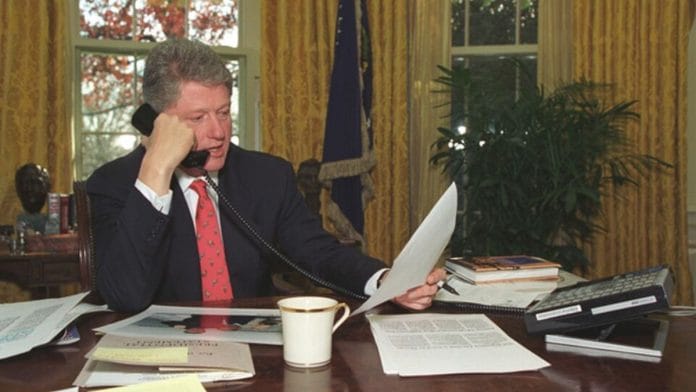
In March 2000, then President Clinton left India for Pakistan for a visit aboard an unmarked aircraft that followed a decoy plane bearing markings of the Air Force One. The deception was not revealed until Clinton emerged from the second aircraft after landing in Islamabad, where he was to spend six hours under extraordinary security.
But there was one important difference between the two secret flights.
The White House press corps was not entirely kept in the dark back in 2000. USA Today reporter Susan Page was briefed secretly, though she chose to speak up only this past Tuesday.
“Before we left Bombay, White House officials took me aside for an off-the-record conversation to discuss the extraordinary security precautions being taken. We also discussed concerns about the safety of the small group of journalists aboard the familiar Air Force One and the larger group traveling on the chartered press plane, which landed in Islamabad in advance of the White House planes,” Page revealed, adding that she was the only journalist who was aware of the president’s plane switch.
Also Read: The Mecca pact repeats America’s failed Cold War bet on Pakistan
A cover-up streamed live
At the Bombay airport, Clinton appeared to be heading toward a large US Air Force C-17 aircraft. Instead, he walked around its nose and turned toward two smaller Gulfstream jets parked out of sight on the other side.
One had American markings and an American flag; the other was an entirely unmarked white aircraft. Clinton boarded the unmarked jet, while Secret Service personnel took their places aboard the marked aircraft, and the two planes departed separately for Pakistan.
The departure was carried live on Indian television, but the C-17 largely blocked the cameras’ view of the smaller jets. As a result, none of the journalists and television viewers watching the scene realised that Clinton had quietly slipped onto the unmarked aircraft.
When Clinton landed in Islamabad was when the theatre began. The aircraft bearing the Air Force One markings arrived first. Then the journalists waited for the president to come out. He did not.
Instead, a Secret Service agent who bore a striking resemblance to Clinton appeared from the aircraft, helping sustain the illusion that the president was aboard. Then a smaller white aircraft appeared with no presidential markings.
That was the one the president was in.
Clinton came out of the aircraft and was immediately moved to a black limousine parked between him and the waiting journalists. He was then driven away in a motorcade of five identical black cars, making it difficult to determine which one had the president. American officials wanted anyone watching to have no clue about where Clinton was — which aircraft was his, which vehicle was his and, ultimately, where he was going. The ruse had been rehearsed for weeks and had been executed perfectly.
Clinton had arrived at the end of a week-long journey through South Asia, a trip that had already taken him through India and Bangladesh. Ominously, a trip to a Bangladeshi village had already been cancelled over security threats.
He was meanwhile, whisked off to meet General Pervez Musharraf, who had come to power in a military coup in October 1999 against Pakistan Muslim League (N) chief Nawaz Sharif. The Clinton visit came six months after; Pakistan was dangerous enough to warrant it.
Clinton was about to become the first sitting American president in more than three decades to visit Pakistan and the first to visit two years after Pakistan had tested its nuclear missiles. Clinton had come to Pakistan with an unusually difficult message.
He wanted the military government to restore democracy. He wanted Pakistan to reduce its nuclear arsenal. He wanted it to fight terrorism. And he wanted Islamabad and New Delhi to seek a peaceful solution to Kashmir.
In a 15-minute televised address to the Pakistani people quoting Iqbal and Jinnah, Clinton offered friendship and lessons in democracy, but also a warning. Pakistan, he said, was spending too much of its strength and resources on confrontation with India and too little on the needs of its people. Then he delivered the sentence that would become the defining line of the visit: “This era does not reward people who struggle in vain to redraw borders with blood.”
He then added: “It belongs to those with the vision to look beyond borders, for partners and commerce and trade. It does not favor nations where governments claim all the power to solve every problem. Instead, it favors nations where the people have the freedom and responsibility to shape their own destiny.”
He had made the same remarks to Musharraf, though his private message was more direct in his two-hour meeting.
Musharraf however, gave a markedly more cheerful account after Clinton’s departure, describing the meeting as “very harmonious and congenial.” He even noted that the two men had compared notes on their golf games, Washington Post had then reported.
The Clinton caveat
That was not the first time that a Clinton served a warning to Pakistan. More than a decade later in 2011, his wife would return to a related problem, using a very different metaphor in the same place, under a different government. Sharif’s PMLN was back in power.
It was the post Bin-Laden era and Hillary Clinton had gone to Pakistan as US Secretary of State six months after to manage the diplomatic fallout between the two countries after the US raid in Abbottabad that killed Laden and to put pressure on the coalition government then led by Yousaf Raza Gillani of the PMLN to stop providing a safe haven to Tehreek-e-Taliban Pakistan militants.
In a joint press briefing, she stood beside Pakistan’s then foreign minister, Hina Rabbani Khar, and spoke about the Haqqani network, terrorist safe havens and militants operating across the Afghanistan-Pakistan border. The problem, she said, was not confined to one side of the frontier.
Pakistan and the United States had to confront the safe havens that allowed militant groups to operate and launch attacks.
Then came the image that would become one of the most memorable American descriptions of Pakistan’s dilemma: “You can’t keep snakes in your backyard and expect them only to bite your neighbors.”
She was asked to comment on whether US looked at Pakistanis as “scapegoats”, and she answered: “With respect to the Haqqanis, we both agreed that terrorism coming from any source is a threat to all of us. We expressed very clearly our concerns about safe havens on both sides of the border. And we asked very specifically for greater cooperation from the Pakistani side to squeeze the Haqqani Network and other terrorists, because we know that trying to eliminate terrorists and safe havens on one side of the border is not going to work. It’s like that old story; you can’t keep snakes in your backyard and expect them only to bite your neighbors. Eventually, those snakes are going to turn on whoever has them in the backyard. We know that – on both sides of the border.”
A decade apart, both captured the same problem: violence that appears useful when directed outward can eventually come home. And while US-Pakistan relations seem to be on the mend today under a president who pulled the same move as Clinton in the country of Pakistan’s foremost ally and defence partner, Islamabad is yet to learn its lessons or heed to warnings.
(Edited by Nardeep Singh Dahiya)
Also Read: Three countries, no common enemy—why the Mecca defence pact is weaker than it looks