



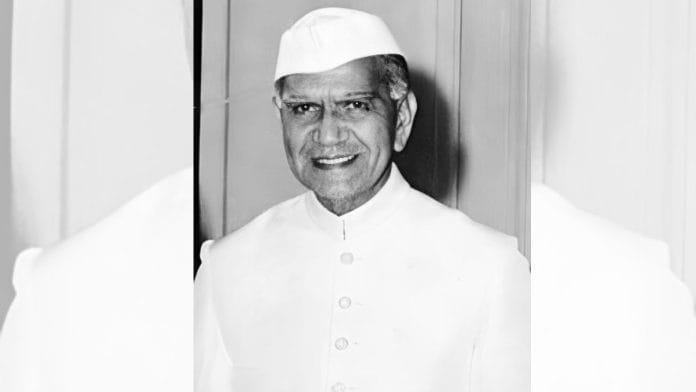
During the 1975 Emergency, Abu Abraham defined the legacy of Fakhruddin Ali Ahmed with a cartoon. It showed the president lounging in a bathtub, casually signing yet another ordinance while saying, “If there are any more ordinances, just ask them to wait.”
The satire was unforgettable.
Behind the joke is one of the most consequential nights in Indian history. As Indira Gandhi imposed the Emergency on 25 June 1975, Ahmed’s signature gave it a constitutional go-ahead at midnight. And it outlived anything and everything that brought him to that moment—reformist minister, sportsman, constitutional insider, and a politician.
Born on 13 May 1905, in Delhi’s Hauz Qazi, Ahmed entered the national independence movement and politics after he met Jawaharlal Nehru in 1925 in England. Impressed by Nehru’s progressive ideas, whom he considered a friend, Ahmed joined Congress in 1931 after returning to India.
And soon, he became an active participant in India’s freedom struggle. In 1940, he took part in the individual Satyagraha campaign against British rule and was sent to prison for a year. He was arrested again during the Quit India Movement in August 1942, shortly after attending the landmark All India Congress Committee (AICC) meeting in Bombay, and remained behind bars until April 1945.
Ahmed proved his prowess as an able administrator during his stint in Assam’s provincial Congress government led by Gopinath Bordoloi in the early 1930s. As Minister for Finance, Revenue and Labour, he introduced India’s first agricultural income tax bill on tea estates and backed workers during a labour strike at the British-owned Assam Oil Company in Digboi.
His decisions angered British planters and business interests, but Ahmed refused to back down, and his measures won widespread public support for both him and the Bordoloi government.
After losing the 1946 election to Muslim League candidate Moulvi Abdul Hye, Ahmed returned to legal and administrative work, eventually serving as Advocate General of Assam in 1953. He later re-entered government under Bimala Prasad Chaliha between 1957 and 1966.
During that time, Ahmed held several portfolios that included finance, law, community development, panchayat, and local self-government.
He was among the few leaders who resisted early proposals for large-scale migrant deportations in Assam, partly out of concern that such moves would alienate Muslim voters and destabilise the state politically.
In 1966, Ahmed left regional politics and entered the Rajya Sabha, and was appointed Union Minister of Irrigation and Power and then subsequently was also given the Education portfolio.
He was elected to the Lok Sabha from the Barpeta constituency in 1971.
Stain of Emergency
When Indira Gandhi nominated Ahmed as her presidential candidate in 1974 over leaders such as Basappa Danappa(BD) Jatti, the move was widely seen as a reward for his loyalty to the Gandhi family after Nehru’s death and the Congress split of 1969.
Ahmed went on to win nearly 80 per cent of the electoral college vote and was sworn in as India’s second Muslim president on 24 August 1974 by Chief Justice AN Ray.
And even though critics often dismissed him as a “rubber stamp president” because of his closeness to the Gandhi family, the reality behind the scenes was far more complex.
Ahmed initially hesitated to sign Indira Gandhi’s proposed proclamation of Emergency on the night of 25 June 1975.
Historian Gyan Prakash, in his book Emergency Chronicles, and Ahmed’s close aide and biographer, FAA Rehmaney, both argue that Ahmed’s hesitation was not an act of political rebellion.
Instead, Ahmed’s concerns were rooted in his effort to seek greater legal and constitutional clarity before making a decision. This pause was brief—lasting hours—as he consulted his aides before ultimately signing around midnight, enabling the declaration without prior Cabinet approval.
However, the weight of the decision appears to have deeply troubled Ahmed. As Prakash wrote, “the president swallowed a tranquilizer and went to bed.”
At first, Ahmed reportedly viewed the Emergency as a temporary corrective phase meant to restore discipline and order. But as months passed, he is said to have grown increasingly uneasy with the excesses unfolding around him.
By 1976, during the Emergency, signs of unease became obvious even within the highest offices of power.
“Fakhruddin is concerned that the PM and her son are pushing too hard on the political and Constitutional system of India,” stated a US Embassy cable from New Delhi dated 6 August 1976, sent to the US Department of State in Washington, DC., and later released via WikiLeaks.
He also reportedly expressed concern when Gandhi considered reshuffling her cabinet by removing several senior Congress leaders, fearing it could damage party unity.
The strain appeared to deepen over Sanjay Gandhi’s growing influence. The US Embassy cable claimed Sanjay had asked Ahmed for an official message—likely a supportive note—for the launch of his magazine Surya. The President declined, calling it inappropriate. Sanjay was not impressed with this denial and lashed back at Ahmed with unkind words.
“We have reason to believe…Fakhruddin indeed does seem to be uncomfortable with some of Mrs Gandhi’s actions and certainly with those of her son,” the cable said.
But what happened between Indira Gandhi and Ahmed during the time of Emergency remained a mystery. Almost a month before Indira Gandhi lifted the Emergency, and a month after dissolving Parliament, Ahmed died of a heart attack inside Rashtrapati Bhavan on 11 February 1977.
Also read: Munawwar Rana stripped Urdu poetry of elitism, brought it closer to everyday speech
Behind the scenes & on field
People who knew Ahmed often remembered him less as a distant statesman and more as someone with an unusually warm and personal way of dealing with others. Politician Begum Abida Begum described him as a humble man, one who was approachable even at the height of his popularity.
“With every person — whether a peon, a driver, or a clerk — he had his own way of meeting them, speaking to them, and dealing with them. It was entirely distinct. There was absolutely no arrogance in him,” former Home Secretary of India, SMH Burney, said about Ahmed in a documentary titled “Fakhruddin Ali Ahmed”. The documentary was released by Prasar Bharti Archives five years ago.
And long before Assam politics, Rashtrapati Bhavan, and the stain of Emergency, Ahmed used to be a sports enthusiast.
During his years at the University of Cambridge, he played hockey as a centre-half for the Combined Universities team. And even when he returned to India, that passion stayed with him. In Assam, he threw himself into local sporting institutions, leading the Football Association and the Assam Cricket Association. He also helped to revive the Shillong Golf Club.
In 1967, Ahmed was elected as the President of the All India Cricket Association, besides being a member of the Delhi Golf Club and the Delhi Gymkhana Club since 1961.
He also launched the President’s Polo Cup in 1975, restored the mini-golf course inside Rashtrapati Bhavan, served as vice-chairman of the Assam Sports Council and later headed the All India Lawn Tennis Federation.
(Edited by Ratan Priya)