





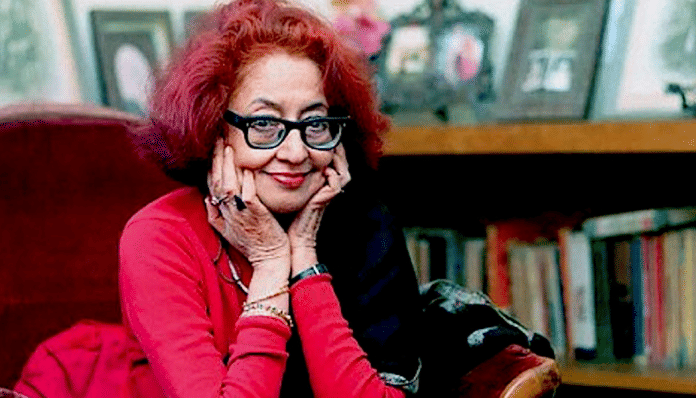

For 19 years, associate professor Mujeeb Ahmad Khan at Kirori Mal College has regretted being unable to publish Qurratulain Hyder’s journalistic work. After her death in 2007, Khan entrusted Hyder’s cousin with the writer’s diaries and asked for permission to publish them. However, the cousin passed away a few months after Hyder, and the diaries are now “missing.”
Khan worked closely with Hyder, affectionately called “Ainee Apa,” as an assistant editor on several of her books.
“Those two diaries contain Hyder’s film reviews and news articles. I regret giving them to her cousin. We would have had her two new works now,” he said.
One of the most celebrated Indian writers of the 20th century, Hyder was famous for her Urdu short stories and novels. Her magnum opus Aag Ka Darya (1959) remains one of the subcontinent’s best novels and is often taught in colleges.
Hyder’s artistic style was unlike that of her contemporaries; known for her fearless approach, she helped shape the early development of the Urdu novel. The Aligarh-born novelist remains a distinctive and influential voice, introducing new perspectives and styles to Indian fiction.
With a literary career spanning over seven decades, Hyder authored twelve novels, four short story collections, and translated several classics.
Meet Ainee Apa
But it wasn’t just her unique voice that interested the masses. Her personality was also multifaceted. Raised in a family that valued both British and Indian cultures, the influence is evident in her work, often attracting widespread criticism.
In an interview with DD National, Hyder can be seen in her trademark dark rectangular glasses and her short reddish-orange hair. Seated with her hands clasped near her chest, she sheds light on her writing.
“Mera jo poora tradition hai, usmein aapko ek qism ka jo humanism milta hai wo sufi parampara ki den hai (The kind of humanism found in my entire tradition is a contribution of the Sufi tradition),” she revealed.
A recipient of the Padma Bhushan in 2005, Hyder also held several other coveted literary honours, including the Jnanpith Award in 1989 for Aakhir-e-Shab Ke Humsafar. In 1994, she was elected a Permanent Fellow of the Sahitya Akademi.
Also Read: Munawwar Rana stripped Urdu poetry of elitism, brought it closer to everyday speech
Carrying the wounds of 1947
Hyder’s talents, however, did not stop at writing. She expanded her horizons and invested her time in photography, journalism, and filmmaking. Trained in Indian classical music from an early age, she was also a superb sitar player.
After her father died in 1943, Hyder, along with her mother and brother, migrated to Pakistan during the Partition. In Lahore, she published her first novel, Mere Bhi Sanamkhane (My Temples, Too), at the age of 19, making waves in the literary circles. Written in 1949 the novel dealt with the trauma of the Partition.
Hyder once again confronted the terrors of 1947 in Aag Ka Darya. Spanning 3,000 years of Indian civilisation, the novel demonstrates her ability to capture life with exceptional breadth and depth. Throughout the novel, she offers a rare vision and a universal perspective.
“Hyder’s contemporary relevance surpasses that of other fiction writers. The further back she reaches into the past, the further forward her vision extends. In her writing, the past ceases to be merely the past; it transforms into the present moment,” said Abbas Raza Nayyar, head of department of Urdu at the University of Lucknow.
But according to Khan, Hyder drew on real-life experiences for her novels. She wrote Chai ke Bagaan (1965) and Chandni Begum (1990) after spending significant time in the locations she depicted. This familiarity, Khan argues, lends her work a strong sense of realism and authenticity.
“She did not write about real life while sitting in a drawing room; she would personally survey the area and spend months there,” he said.
Arjumand Ara, professor at Delhi University, explained Hyder’s writing techniques, saying that she introduced a new approach to the Urdu novel by exploring her characters’ inner thoughts in greater depth. While earlier writers often used the “sapaat”(straightforward) style, depicting characters as simply good or bad with clear moral values, Hyder developed more nuanced characters and provided a deeper perspective on society.
“The way she portrays tehzeeb (culture) itself encompasses philosophy, history, and much more. Her descriptions are remarkable. Given the period in which Hyder was writing, I find it unnecessary to look for literary techniques, because the way she describes everything in such detail is simply enchanting,” Ara added.
A reluctant feminist
In 1991, Khan, then an MPhil student, met her at his supervisor’s suggestion. He initially expected her to be short-tempered and unapproachable. However, during his visit to her Zakir Bagh home, he found her to be an elegant woman in her seventies with hennaed hair and a pleasant demeanour. Khan believes that Hyder was often misrepresented in media.
“She used to say, ‘If I don’t want to meet anyone, then why should anyone force me to meet? I don’t have time to meet everyone. I want to keep myself fresh’,” he recalls.
But Ara offers that misunderstanding a historical perspective on the social constraints faced by women. As an upper-middle-class Muslim woman in that era, Hyder attracted significant attention, with many wanting to meet her.
“She was very conscious about her femininity,” she added.
Hyder is recognised as a leading figure in feminist literature. Her novel, along with Agle janam Mohe bitiya na Kijo (1963) and Akhir-e-Shab ke Humsafar (1998), exemplified the female voice in South Asia.
One reading of Hyder’s 1998 novel shows how nationalist movements in twentieth-century South Asia used women as symbols but limited their real agency within patriarchal systems.
“She never claimed to be a feminist. And neither did she claim to be progressive,” says Ara.
In Hyder’s stories, most characters are women from the elite class, but despite their status, they remain lonely.
“They don’t have a lover. They don’t have love. They don’t have intimacy with people. And she appears to be standing alone. She is an intellectual woman,” she added.
Also Read: Poet Jan Nisar Akhtar wrote 150 film songs. His great love story survives in 500 letters
A writer of the people?
However, many scholars and progressive circles found Hyder’s class consciousness, colonialism, and social isolation difficult to accept. Hyder asserts that she represents different communities in her writing, a claim contested by many.
“Hyder is unable to move beyond the bourgeois class. She has a capitalist approach. The sorrows, hardships, and issues of the common people are rarely reflected in her fiction,” Nayyar said.
However, for Khan, it was the progressive community that ignored her, a view that the author also agreed with.
“The progressive community did not accept women writers like her, and consequently, a vast chasm developed between the two,” he added.
Hyder was deeply concerned about the socio-political climate of her time. She advocated challenging entrenched stereotypes and mindsets that had been reinforced about communities. She considered that constant news of bloodshed, devastation, and death had made people less shocked or saddened by such events, and that television played a significant role in it.
“Every sensitive writer frets over the condition of the world. But a person should not be hopeless. I will keep writing,” Hyder said to DD.
“I believe I am a little bird that foolishly lifts its claws upward, hoping to save the sky from falling.”
(Edited by Insha Jalil Waziri)