



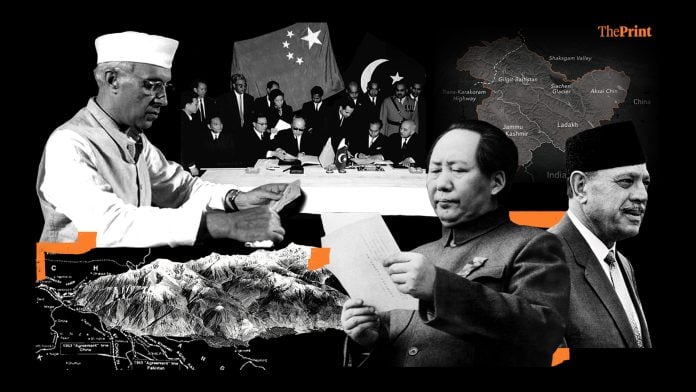
New Delhi: India’s two neighbours that don’t share a border just set up a commission to manage the boundary between them, a move New Delhi rejected instantly, as it had done in 1963 when China and Pakistan announced their first boundary agreement.
On 16 September, the Ministry of External Affairs (MEA) rejected the Boundary Joint Commission (BJC) announced by Pakistan and China, saying there is no boundary between them. India also reiterated that it has never recognised the “so-called” China-Pakistan Boundary Agreement of 1963, the pact under which the two countries set up a commission to demarcate the “boundary” between them.
The Boundary Joint Commission stems from the 2013 China-Pakistan Agreement on Boundary Management System, envisaged to manage the boundary demarcated under the 1963 agreement.
The inaugural session of the BJC was held in Islamabad from September 16-17, marking its formal launch.
Pakistan’s Foreign Office described the BJC’s establishment as a vital milestone in strengthening the Pakistan-China “All-Weather Strategic Cooperative Partnership”, and that the next meeting would be held in China.
Such an objection from India over the ‘boundary agreement’ between its two neighbours is not new. It goes back even before the 1963 agreement was formally signed on 2 March in Peking, now Beijing.
Also read: Is the China-Pakistan arms nexus exporting authoritarianism? The case of the JF-17
A timeline of China-Pakistan agreements
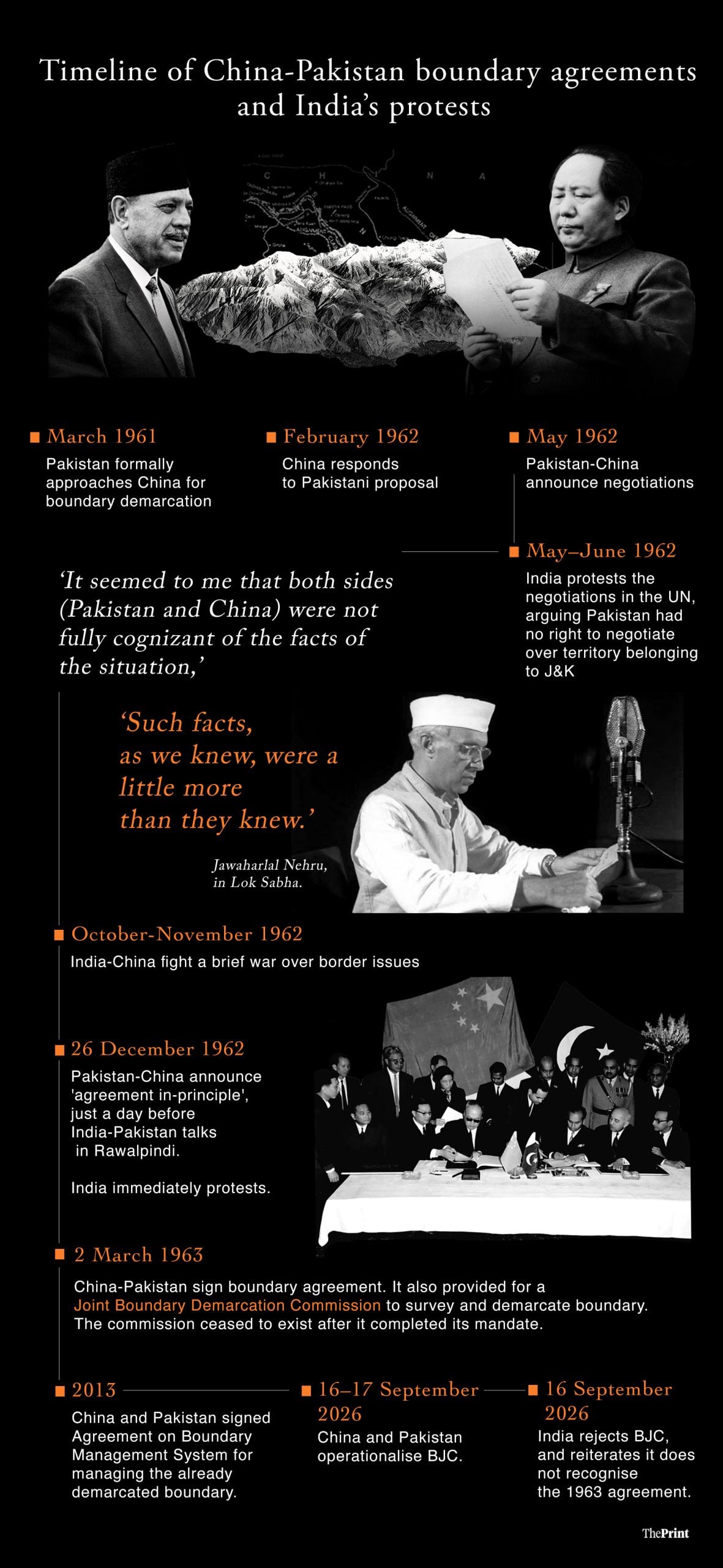
Pakistan first informally sounded China its wish to demarcate the boundary a couple of years before sending a formal note in March 1961. The Chinese government took a year to reply, responding only in February 1962.
In his memoir Friends Not Masters, then Pakistani president Ayub Khan recounts how he got a reluctant China to come to the table, since the Chinese, he felt, did not want another argument with India.
In July 1961, the Chinese ambassador called on Khan, seeking Pakistan’s support for China’s seat at the United Nations. Ayub Khan seized the moment to remind him about his proposal to demarcate the border.
The ambassador said it was a complicated matter, to which the President riposted: so was the issue of the UN seat. Ayub Khan suggested that the two things should be looked at on “merit” regardless of whether they were “simple or complicated”.
By 3 May 1962, Pakistan and China issued a joint communiqué in which they agreed to conduct negotiations on the matter.
A few days later, Jawaharlal Nehru was asked to address the issue in the Lok Sabha. He said he had already raised with Ayub Khan the question of Chinese encroachment into parts of Jammu and Kashmir under Pakistan’s illegal occupation, and asked him how Islamabad intended to deal with it.
In particular, Nehru brought up the area of Hunza, which the Mir of Hunza claimed, protesting to the Pakistani government that the Chinese had occupied grazing areas belonging to his original state, Hunza, which is part of Kashmir.
“It seemed to me that both sides (Pakistan and China) were not fully cognizant of the facts of the situation”, Nehru said. “Such facts, as we knew, were a little more than they knew”.
A few days later, in a letter dated 10 May 1962 to Pakistan’s High Commission in India, the MEA wrote, “Despite numerous reports in the press…India had all this time been disinclined to believe that the Government of Pakistan would in fact enter into negotiations with China in respect of the territory of the state of Jammu and Kashmir which forms an integral part of the Indian Union”.
Between May and June of 1962, India’s representative at the UN Security Council, V.K. Krishna Menon—also the country’s defense minister who was forced to quit in the aftermath of India’s loss to China in the October-November war that year—delivered a series of speeches, criticising the ongoing efforts by Pakistan and China.
Pakistan, having illegally occupied Kashmir, he argued, had no right to barter away or gift any part of Indian territory, and any such transfer would be in clear violation of international law. Menon said Pakistan was doing this for “nuisance value” and as an “instrument to pressurize” India.
Then, on the eve of the Indo-Pakistani talks on 27 December 1962 at Rawalpindi to discuss Kashmir and other related matters, China and Pakistan announced an “agreement in principle” on the alignment of the border between Sinkiang and that part of Kashmir under Pakistan’s illegal occupation.
India’s then Minister of External Affairs Sardar Swaran Singh, the leader of the Indian delegation, immediately made Delhi’s position clear to president Ayub Khan and foreign minister Zulfikar Ali Bhutto in Rawalpindi, and did so again to Bhutto when the Indo-Pakistan talks resumed in Delhi in January.
India lodged multiple protests with both China and Pakistan thereafter.
A deal is struck
Be that as it may, the foreign ministers of Pakistan and China went ahead and signed the agreement on 2 March 1963. Article 6 alludes to the ‘provisional’ nature of the agreement.
“The two parties have agreed that after the settlement of the Kashmir dispute between Pakistan and India, the sovereign authority concerned will reopen negotiations with the Government of the People’s Republic of China on the boundary…to sign a formal boundary treaty to replace the present Agreement”.
It further adds, “In the event of that sovereign authority being Pakistan, the provisions of the Agreement and of the aforesaid Protocol shall be maintained in the formal Boundary Treaty to be signed between the People’s Republic of China and Pakistan”.
Pakistan and China’s subsequent conduct, however, pointed against the ‘provisional’ character.
‘China…is directly interfering in Indo-Pakistan relations. By doing this, China is seeking to exploit differences between India & Pakistan on Kashmir question to further its own expansionist policy,’ Prime Minister Jawaharlal Nehru, days after 1963 China-Pakistan pact.
A few days after the agreement was inked, Nehru was again called upon to address the Lok Sabha. He said, “The agreement claims to be provisional, and yet so much haste has been shown in concluding it”.
Nehru concluded, “…China, in spite of its professions that it has never involved itself in the dispute over Kashmir or its absurd claim that the boundary negotiations have promoted friendship between the Chinese and Pakistani peoples…is directly interfering in Indo-Pakistan relations. By doing this, China is seeking to exploit differences between India and Pakistan on the Kashmir question to further its own expansionist policy”.
Even China’s Ministry of Foreign Affairs wrote to the Indian embassy in Beijing on 25 March 1963, stating that it is “crystal clear” the agreement is provisional and has nothing to do with the Chinese coming to terms with Pakistan on the “ownership of Kashmir”.
India even took it up to the UN Security Council. In a letter dated 16 March 1963, it pointed out how Pakistan’s own past statements undercut its present position.
Three years earlier, on 3 December 1959, Pakistan’s Permanent Representative to the UN had written to the Security Council – invoking Chinese aggression in Ladakh – to declare that “no positions taken or adjustments made by either of the parties to the present controversy between India and China… shall be valid or affect the status of the territory of Jammu and Kashmir.” He reiterated as much in a follow-up letter dated 25 March 1960.
Now, India argued, Pakistan had done exactly what it once condemned: signing an agreement with China that violated both the status of Jammu and Kashmir and the Security Council’s resolution of 17 January 1948, accepted by both New Delhi and Islamabad.
In a separate letter to China’s embassy in India, dated 30 September 1963, the MEA accused Pakistan and China of misleading world opinion and masking their collusion in aggression on Indian territory behind the fig leaf of “provisionality”.
The insincerity of that claim, India argued, was evident from Article 4 itself – the appointment of a boundary commission, setting up of border markers and drawing up of protocols were arrangements typical of ‘permanent’ demarcation of the international frontier.
The visit of Chinese Boundary Commission delegates to Gilgit, Nagar and Hunza, and the announcement that boundary demarcation teams of both sides have reached agreement on ground survey, aerial photography and erection of boundary markers along the border was further proof that Pakistan and China did not intend the agreement to be temporary, said the letter.
‘Under so-called China-Pakistan ‘Boundary Agreement’ signed in 1963, Pakistan illegally ceded 5,180 sq. kms. of Indian territory in Shaksgam Valley from areas illegally occupied by Pakistan in the UT of Ladakh to China,’ MoS MEA V Muraleedharan in Lok Sabha in 2022.
Further insight into India’s protest and China’s response can be gauged from MEA’s White Paper No. IX titled ‘Notes, Memoranda and Letters Exchanged Between the Governments of India and China: January 1963-July 1963’.
What did Pakistan cede
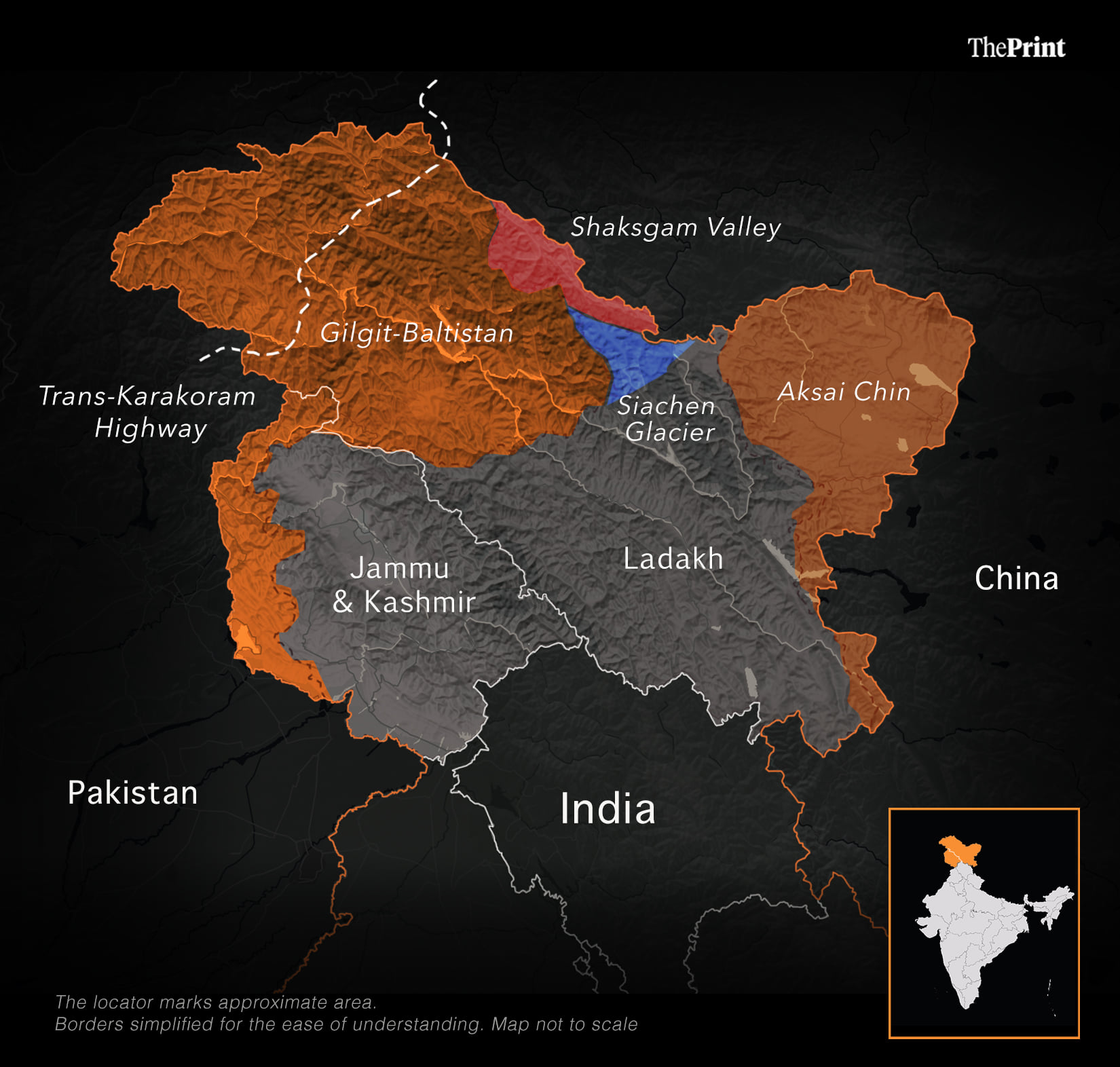
Pakistan ceded the Shaksgam Valley or the Trans-Karakoram Tract, in favour of China, while China gave up claims on Hunza, which Pakistan considered valuable enough to fight for.
This can be seen from Ayub Khan’s conversation with Duncan Sandys, the then UK Minister for Commonwealth Relations & W. Averell Harriman, Assistant Secretary of State for Far Eastern Affairs, in which he talked about his visit to the Hunza area and expressed “hope” that he could come to an agreement with Peiping (old name for Beijing) over the boundary, but would insist on retaining the Hunza grazing areas.
Ayub’s memoir also offers some insights: “We raised the question of the grazing ground which covered several hundred square miles on the other side of the Shamshal Pass. We proved to the Chinese representative that this area had been traditionally under the use of the people of Shamshal and that if they were denied access to the area it would cause them great hardship. The Chinese said they would check with the people of Sinkiang but agreed, in principle, that the matter be resolved on merit. They finally agreed to let us have the area”.
He had also mentioned that the inhabitants of Shamshal would get salt, a rare and valuable commodity, from the soil in the area where the Chinese had established a couple of posts.
While Pakistan retained Hunza, China got a bigger and better deal.
In 2022, then Minister of State in the MEA, V Muraleedharan, told the Lok Sabha, “China continues to be in illegal occupation of approximately 38,000 sq. kms. of Indian territory in the Union Territory of Ladakh for the last six decades. Further, under the so-called China-Pakistan ‘Boundary Agreement’ signed in 1963, Pakistan illegally ceded 5,180 sq. kms. of Indian territory in Shaksgam Valley from areas illegally occupied by Pakistan in the Union Territory of Ladakh to China”.
India has long maintained this position. Accordingly, it has opposed China’s infrastructure development and China-Pakistan Economic Corridor projects that cut through regions India considers to be under Pakistan and China’s illegal occupation.
(Edited by Ajeet Tiwari)
Also read: India rejects Pakistan-China’s ‘so-called’ boundary commission—‘no boundary between them’