



New Delhi: India Wednesday rejected the establishment of a joint boundary commission between Pakistan and China, underlining that there is “no boundary” between the two countries, and that Islamabad has no “locus standi” to enter into arrangements with third countries on the Union Territories of Jammu and Kashmir and Ladakh.
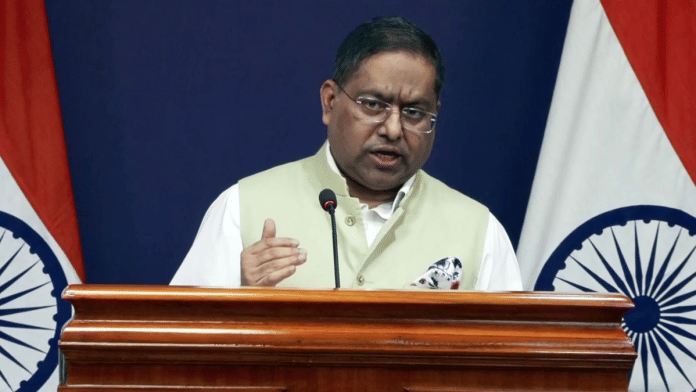
“Our position on this matter is clear and consistent. There is no boundary between Pakistan and China. We reject the so-called Joint Commission, which is without any legal basis,” Randhir Jaiswal, the spokesperson for the Union Ministry of External Affairs said in a statement. “The entire Union Territories of Jammu & Kashmir and Ladakh have been, are and will always remain integral and inalienable parts of India. Pakistan has no locus standi to enter into arrangements concerning Indian territory under its illegal and forcible occupation.”
India has never recognised the “so-called” 1963 boundary agreement between Pakistan and China. The so-called agreement signed by Pakistan ceded the Shaksgam tract to China. India has consistently maintained that the agreement between the two countries is “illegal and invalid”, said Jaiswal.
“We resolutely oppose and reject any attempts to alter the status of these occupied territories or legitimise illegal occupation, impinging on India’s sovereignty and territorial integrity. Any so-called boundary cooperation between China and Pakistan concerning Indian territories would be completely unacceptable and would have no bearing whatsoever on India’s sovereignty over these territories,” the spokesperson added.
Earlier Wednesday, Islamabad announced the formation of a joint boundary commission with China, with the Pakistani Foreign Ministry asserting that the new body sets the stage “for enhanced cooperation in border management, joint border surveys, trade flows and people to people connectivity”.
Pakistan maintains no border with China, except in the territories of J&K it continues to illegally occupy. India has maintained its territorial claim over the occupied territories. Jaiswal called on Pakistan to “immediately vacate from areas under its illegal on forcible occupation”, and to stop engaging “in such theatrics”.
The Sino-Pakistan agreement was negotiated by Pakistani President Ayub Khan between 1959 and 1963, and was signed by then foreign ministers of the two countries. India has highlighted that roughly 5,800 square kilometres of Indian territory were illegally ceded to China by Pakistan.
The issue of India’s sovereignty over Pakistan-occupied Kashmir is one of the major reasons for its differences with China over the Belt and Road Initiative (BRI). The China-led infrastructure project envisions connectivity between Islamabad and Beijing through occupied territory.
The China-Pakistan Economic Corridor (CPEC) launched over a decade earlier, which has cost Beijing some $54 billion, envisions a road highway connecting Kashgar in the Xinjiang province with Gwadar in Balochistan, via Gilgit Baltistan in Pakistan-occupied Kashmir.
Without the link on occupied territories, the Chinese vision of a land route from Gwadar to its West cannot operate. The highway passes into occupied territory at Khunjerab Pass, before entering Pakistan close to Islamabad, and eventually reaching Gwadar to the south of the country.