





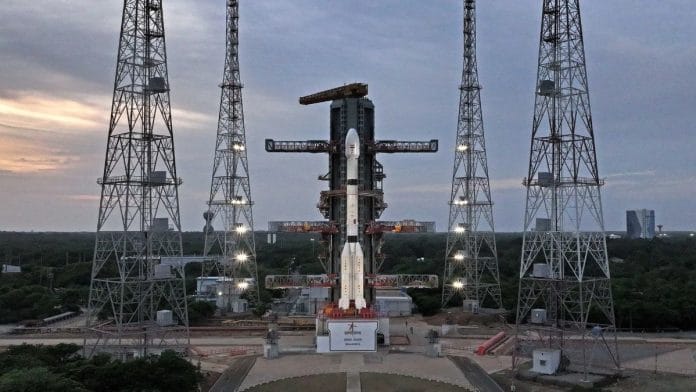

New Delhi: ISRO’s eight-month-long lull came to an end on Friday after the Geosynchronous Satellite Launch Vehicle, or GSLV Mk-II, precisely injected the EOS-05 satellite into the intended orbit. The rocket rose to the occasion, rightly shedding its initial name—‘Naughty Boy’.
ISRO chairperson V Narayanan said the GSLV-F17 mission outperformed expectations, placing the satellite at an apogee—the highest point in an orbit around the Earth—of 31,026 kms, nearly 2,100 kms higher than initial expectations.
“This will add at least three years to the satellite’s (EOS-05) life, if everything else goes well in the mission,” Narayanan told ThePrint. The EOS-05 satellite is India’s first-ever imaging satellite designed to operate from a geosynchronous orbit.
ThePrint explains why the Indian space agency chose the GSLV Mk-II rocket this time to place an Earth observation satellite into orbit instead of its trusted Polar Satellite Launch Vehicle (PSLV), which is usually assigned such tasks.
A different orbit
Unlike other low Earth orbit satellites that pass over a set location periodically, the EOS-05 satellite will be placed at a vantage point of about 36,000 kms above the Earth’s surface in a geosynchronous orbit.
A traditional Earth observation satellite usually operates at a lower orbit, with altitude ranging from 160 kms to 2,000 kms. This provides a consistent view of India’s territory and its surrounding areas.
The new EOS’s modified orbital requirements are the reason why ISRO opted for the GSLV over PSLV. The rocket needed to provide greater orbital energy to place the satellite in a higher orbit.
Also read: ISRO’s ‘Naughty Boy’ performs better than expected; what it means for the EOS-05 satellite
PSLV, India’s workhorse
ISRO developed the PSLV in the 1980s, with its maiden flight taking place on 20 September 1993. Its original purpose was to launch India’s remote-sensing satellites into polar and Sun-synchronous orbit.
It is a four-stage rocket, with alternating solid and liquid propellant stages, and depending on the mission, ISRO has used different PSLV configurations. These include variants with six, four or two strap-on motors, or a core-alone configuration.
This flexibility made PSLV one of India’s most versatile and trusted launch vehicles.
A senior ISRO official told ThePrint that the PSLV can also place a satellite in geosynchronous orbit. In fact, modified versions of the PSLV have been used for big missions, including Chandrayaan-1, the Mars Orbiter Mission, and even the Aditya-L1 mission to send India’s satellite to the L1 point (Lagrange 1 point).
“A lot of factors go into deciding the launcher for a mission. This required a different combination of payload mass and orbital energy, and that is why the GSLV was a better fit,” the official added.
Despite a stellar track record, PSLV’s reputation has suffered recently after a series of back-to-back failures in 2025 and 2026. On 18 May last year, the PSLV-C61 mission carrying the EOS-09 satellite failed. Again, on 12 January this year, PSLV-C62 carrying EOS-N1 also faced an anomaly.
Incidentally, in both missions, the rocket’s problem occurred in the third stage. According to the space agency, however, the issues were unrelated.
The last two missions pushed ISRO to temporarily pause PSLV launches while conducting a complete assessment of the launch vehicles.
In April this year, the Centre’s Department of Space told the Parliament that a National Level Expert Committee has been constituted following the failure of the PSLV-C62 mission, stating that the launch vehicle would return to flight after corrective measures were implemented.
“The factors that led to the recent deferments in scheduled ISRO launches for the missions planned under the PSLV (are) purely due to technical reasons,” Union Minister of Science and Technology and Space, Jitendra Singh, said in a written response in Lok Sabha.
“In view of the failure observed in the PSLV-C62 mission, a National Level Expert Committee has been constituted to review the reason for anomaly in the PSLV vehicle and recommend corrective measures. PSLV will return to flight after implementing the corrective actions,” he added in the response.
But scientists insisted that this was only a “temporary pause”. PSLV will return “soon” with more missions. ISRO also plans to expand the infrastructure around the rocket’s mass production.
NewSpace India Limited (NSIL), the commercial arm of ISRO, will now be the nodal agency for PSLV production through private industry, taking a consortium route. This means that an industry consortium will now be responsible for producing, assembling and integrating the launch vehicle.
Also read: ISRO to end its 8-month launch slump with GSLV-F17 mission early Friday
GSLV, the Naughty Boy
Compared to the PSLV, ISRO’s GSLV rocket was developed to launch heavier spacecraft toward geosynchronous transfer orbit, the highly elliptical orbit used as an intermediate step for satellites ultimately destined for geostationary or geosynchronous missions.
GSLV Mk-II is a three-stage vehicle with four liquid strap-on motors and an indigenous cryogenic upper stage. The cryogenic engine burns liquid hydrogen and liquid oxygen, which allow the upper stage to produce high efficiency, crucial when a rocket has to impart enormous amounts of energy.
Despite the rocket’s success on Friday, it was not the most reliable in the ISRO books. GSLV, in fact, earned the nickname ‘Naughty Boy’ because of its series of early failures.
According to ISRO records, its first developmental flight–GSLV-D1 in April 2001 with GSAT-1–was a failure. Its subsequent flights, including the GSLV-F02, also known as the INSAT-4C, in 2006, also failed to place the satellite in orbit.
In 2010, after two more failed flights, ISRO withdrew the launcher for modifications. ISRO developed an indigenous cryogenic upper stage for the rocket and tested it in January 2014.
Records indicate that things have turned up for the launch vehicle since then. With GSLV, ISRO has successfully launched GSAT-14, GSAT-6, GSAT-9, G-SAT7A, NVS-01 satellites and even the NASA-ISRO partnered NISAR satellite.
A senior ISRO official told ThePrint that both PSLV and GSLV Mk-2 will remain at the centre of India’s future missions.
“Our plan is to increase the launches in the coming years. Some big missions are also in the pipeline. More launches mean you will need these trusted rockets to launch,” the official said.
(Edited by Saptak Datta)