





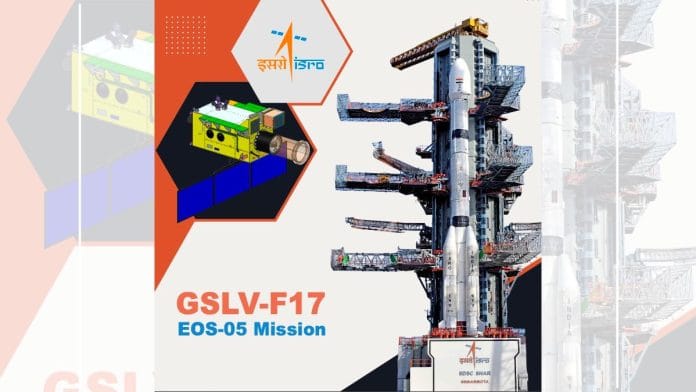

New Delhi: At 2.55 am early Friday, the Indian Space Research Organisation will launch its Earth Observation Satellite-05 — EOS-05, also known as GISAT-1A — aboard the GSLV-F17 rocket. The mission is expected to end the Indian space agency’s eight-month-long lull following the failure of its EOS-N1 in January this year. ISRO has not attempted another launch since then.
“The GSLV-F17 vehicle will place the EOS-05 satellite into a sub-geosynchronous transfer orbit (sub-GTO). Launch is planned from the second launch pad at the Satish Dhawan Space Centre in Sriharikota,” ISRO said in a statement ahead of the launch.
The EOS-05 mission
The EOS-05 satellite is India’s first imaging satellite designed to operate from a geosynchronous orbit. Unlike most low Earth orbit satellites, which pass over a set location periodically, ISRO’s EOS-05 has been designed to continuously monitor Indian territory and the surrounding regions from a vantage point of nearly 36,000 km above Earth.
It would ensure closer, more consistent observation of Indian territory and go a long way towards providing critical information about weather systems, disasters, infrastructure monitoring and general surveillance of the territory.
The GSLV-F17 rocket
While often referred to as the ‘Naughty Boy’ because of its initial failures, ISRO’s GSLV has now been reworked into a reliable launch vehicle. It is 51.7 metres tall and weighs about 420.5 tonnes at liftoff. GSLV-F17 consists of three stages—the first stage combines a solid core motor with four liquid-fuel strap-on boosters, the second uses liquid propulsion, and the third stage features the indigenous cryogenic upper stage.
GSLV Mk-II also successfully carried the NASA-ISRO jointly developed NISAR, the world’s most expensive civilian Earth-imaging satellite, into orbit.
ISRO’s recent failures
The September 4 mission will be particularly significant because of the recent slew of failures by ISRO.
The failures included the NVS-02 navigation satellite, launched on January 29 last year; the EOS-09 mission, launched on May 18, 2025; and finally, the EOS-N1 mission, launched on January 12 this year.
Incidentally, all three missions were carrying strategic satellites.
ISRO has categorised its NVS-02 mission as a “partial failure”, even though the launch vehicle could not place the satellite, which was part of India’s NavIC constellation, in its intended geostationary orbit (GEO). The space agency confirmed that the satellite is only partially operational.
(Edited by Prashant Dixit)