





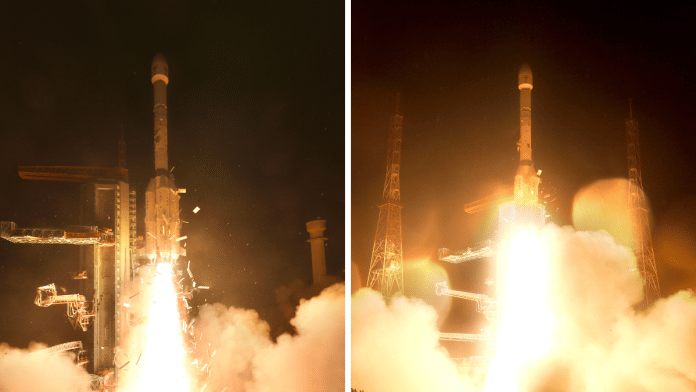

New Delhi: The Indian Space Research Organisation successfully launched the GSLV-F17 rocket from Sriharikota early on 4 September, placing the much-awaited EOS-05 earth observation satellite into its intended orbit.
The GSLV rocket, often referred to as the “Naughty Boy” because of its initial string of failures, rose to the occasion and performed better than expected in its third stage, injecting the satellite into a geosynchronous transfer orbit with a nominal perigee of 171 kms, an apogee of 31026 kms and an inclination of 19.28 degrees. Perigee and apogee are the closest and furthest points in an object’s elliptical orbit around the Earth.
According to ISRO’s mission document, EOS-05 was to be initially placed in an orbit of 171 km x 28934 km, after which the satellite would perform its orbit-raising manoeuvre to an altitude of 36,000 km.
The EOS-05 satellite is India’s first-ever imaging satellite designed to operate from a geosynchronous orbit. Unlike other low Earth orbit satellites that pass over a set location periodically, the EOS-05 satellite is designed to maintain a continuous monitoring of Indian territory and the surrounding regions from a vantage point nearly 36,000 km above Earth.
It would ensure a closer and consistent observation of the Indian territory and go a long way in providing critical information about weather systems, disasters, infrastructure monitoring and the general surveillance of the region.
What does this mean for EOS-05?
The GSLV-F17 rocket gave EOS-05 more orbital energy than planned. Its highest point above Earth is about 2,092 kms higher than the expected target.
This is good news for the satellite because the spacecraft now has less work to do with its own propulsion system to reach its eventual geosynchronous operating orbit.
To attain its final geosynchronous altitude of about 36,000 kms above the equator, EOS-05 will use its onboard propulsion to raise its orbit from a sub-GTO and circularise it at that altitude.
Senior ISRO officials, on the condition of anonymity, told ThePrint that since the satellite has saved some of its onboard propellant, it can be used later, potentially increasing the satellite’s operational life.
“The mission life of an earth observation satellite is anywhere between five to seven years. But when you attain better than nominal conditions, you can extend the satellite’s life,” the official said.
Also Read: NASA wants ISRO on its Moon base. India must consider the risks
Success after a lull
Friday’s launch was particularly significant. It marked ISRO’s comeback after a lull of nearly eight months. Ironically, the satellite was also the space agency’s first successful launch of 2026.
“Yet another outstanding achievement by ISRO and a proud moment for our nation. The successful launch of GSLV-F17 carrying EOS-05, India’s first-ever imaging satellite from Geosynchronous orbit is a reflection of the excellence, innovation and growing capabilities that define India’s space sector,” Prime Minister Narendra Modi posted on X.
The post added, “The growing partnership between ISRO and Indian industry is adding new strength and scale to our space programme and expanding India’s capabilities across the entire space ecosystem.”
(Edited by Insha Jalil Waziri)