






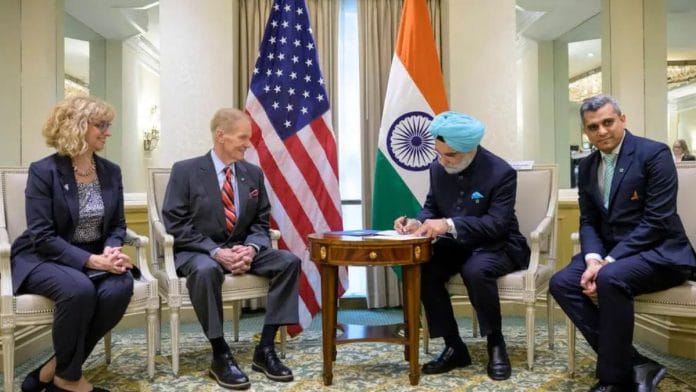


The ninth meeting of the India-US Civil Space Joint Working Group was hosted by India on 5-6 August 2026. The meeting advanced civil and commercial space cooperation under the US-India ‘Transforming the Relationship Utilizing Strategic Technology’ (TRUST) Initiative. As a next step to expand this partnership, NASA invited ISRO to join its Moon Base programme under the Artemis Accords. The two sides also agreed to advance discussions for cooperation on open scientific data.
In recent times, one shining example of the ISRO-NASA space partnership is the launch of the NISAR satellite on 30 July 2025. This Earth-observation mission supports disaster management, agriculture, and climate monitoring. This is a unique mission that uses dual-frequency radar (L-band and S-band) from a single platform, with advanced microwave imaging capabilities.
As per NASA, their Moon base agenda (along with partner states) is about developing humanity’s first lunar outpost, a place where astronauts will live, work, and explore near the Moon’s South Pole. The plan is to undertake a series of crewed and uncrewed missions to build the infrastructure needed to support an enduring human presence on the lunar surface while advancing science, technology and exploration for the benefit of all.
Domain of competition
In 2008, India’s maiden lunar probe, Chandrayaan-1, successfully mapped the lunar surface and provided conclusive evidence of water molecules. Since then, India has undertaken two more lunar missions and achieved a historic soft landing near the lunar South Pole in 2023. India is now planning its fourth lunar mission (2027), which is an ambitious robotic sample-return mission planned to collect lunar samples and safely bring them back to Earth.
In addition, India and Japan are planning a joint lunar mission (2028), under which ISRO and JAXA would undertake drilling on the lunar surface and explore water-ice deposits in the permanently shadowed regions near the lunar poles. India has also articulated a long-term vision of landing Indian astronauts on the Moon by 2040.
Given ISRO’s impressive track record and clearly defined plans for lunar exploration, it is understandable that NASA sees value in collaboration. However, as India has already established itself as an important actor in lunar exploration, it must carefully assess any such international collaboration to ensure that such engagement does not compromise its strategic autonomy in the domain of Moon exploration.
At present, lunar exploration is increasingly emerging as a domain of strategic, technological and commercial competition. India, therefore, needs to carefully examine whether joining the US-led lunar programme is compatible with the existing UN-based architecture for outer space governance. More importantly, would such collaboration allow India to preserve sufficient policy space to independently pursue its scientific, commercial and strategic interests on the Moon?
The Artemis Accords (2020) are a non-binding set of principles for outer space exploration and development, established through a series of bilateral agreements between the US and partner states. India signed the Artemis Accords in 2023 and to date, around 70 countries have signed the document. India becoming part of this system is viewed as an important ‘peak’ in the Indo-US strategic partnership. This collaboration of the two democracies in the space domain is viewed as an important step through the prism of geopolitics.
The Accords provide a framework of common principles, guidelines, and best practices for countries participating in the US-led Artemis programme for lunar exploration and future missions to Mars and beyond. They are voluntary and signed at the national level. The US presents them as a means of building international consensus and establishing common norms for future planetary missions.
To be a part of the Artemis programme, the collaborating states are required to first sign the Artemis Accords, which India has already done. By doing this, India has given only a non-binding, high-level political commitment. Now, if India joins the US-led Moon base programme, then India would be required to sign a separate, project-specific bilateral implementing agreement. Hence, this would be an opportune time for India to look beyond geopolitics and assess such initiatives from the broader perspectives of space sustainability and security.
It is interesting that during the recent CSJWG, the US has reaffirmed its commitment to advancing the United Nations Committee on the Peaceful Uses of Outer Space (COPUOS) guidelines on the long-term sustainability of outer space activities. But the US is also promoting the Artemis Accords, which are breaking the UN-centred system of space governance by developing a parallel, coalition-based set of norms for undertaking missions to the Moon and Mars.
COPUOS provides the principal multilateral forum through which states negotiate and develop principles governing the peaceful exploration and use of outer space. Though the Artemis Accords are a voluntary, non-binding arrangement, they are developed outside the UN negotiating process. Particularly in relation to space-resource activities, they pose a risk of bypassing COPUOS mandate, thereby weakening the central role of the UN structures. Obviously, India’s participation deserves careful scrutiny because New Delhi has traditionally emphasised strategic autonomy and a rules-based, multilateral approach to outer-space governance.
Also read: Skyroot’s Vikram-1 success shows it’s time for ISRO to redefine its role
Who gets the resources?
It is important to recognise that the emerging space race is not simply about reaching the Moon or Mars. It is increasingly about securing access to the strategically valuable resources they contain. Some predict that a big cargo aircraft load of Helium-3 mined from the Moon’s surface could cater for the global energy needs for more than a decade’s period. An asteroid named 16 Psyche is known to have gold and other minerals worth $700 quintillion (a number equal to 1 followed by 18 zeros). Against this backdrop, the US position needs to be analysed.
The 2015 US Commercial Space Launch Competitiveness Act is one of the key legislative precedents that informs the approach to space-resource utilisation reflected in the Artemis Accords. This act distinguishes between owning extracted resources and claiming sovereignty over celestial bodies. This interpretation is internationally contested, particularly because the 1979 Moon Agreement treats lunar resources as the ‘common heritage of mankind’. The 2015 act sought to promote a US space-resource utilisation industry by facilitating private exploration, extraction and commercial use of extraterrestrial resources. Although international space law prohibits national appropriation of celestial bodies, the US framework distinguishes between claiming sovereignty over a celestial body and owning resources extracted from it. It therefore permits US private entities to undertake activities such as asteroid mining, transport the extracted resources to Earth, and commercially profit from them.
The Artemis Accords broadly support established principles of peaceful space exploration, but some provisions warrant closer scrutiny. Section 5 of this act, on interoperability, could favour US-led technological standards and create challenges for countries such as India with different technological trajectories, which are mostly based on Russian designs. It is important to note that Section 8 primarily envisages the sharing of scientific data among participating states (which India and the US have agreed to) and does not fully extend this commitment to private actors.
Given NASA’s growing reliance on commercial partners, this limitation could mean that a significant portion of data generated by future lunar missions may not necessarily be available for broader sharing at the bilateral level. More importantly, Sections 10 and 11 on space resources and safety zones raise questions about the future governance of lunar activities. Resource utilisation could favour commercially capable states, while safety zones could allow technologically advanced actors to establish de facto advantages around strategically valuable locations. Thus, the Accords risk creating asymmetries in access to lunar resources and operational space.
For India, the issue is not whether to cooperate, but whether such cooperation could constrain its policy choices by embedding norms not yet universally negotiated through the UN system. While the Artemis framework offers technological and scientific opportunities, India should ensure that any engagement remains consistent with UN-articulated space structures, preserves its strategic autonomy and safeguards the country’s scientific, commercial and strategic interests in lunar exploration.
As a leading voice among the emerging economies, India needs to advocate for a lunar governance framework that is equitable, inclusive and universally applicable, rather than one that risks becoming fragmented or disproportionately favouring technologically advanced states.
Ajey Lele is deputy director general at the Manohar Parrikar Institute for Defence Studies and Analyses (MP-IDSA). Views are personal.
(Edited by Ratan Priya)