


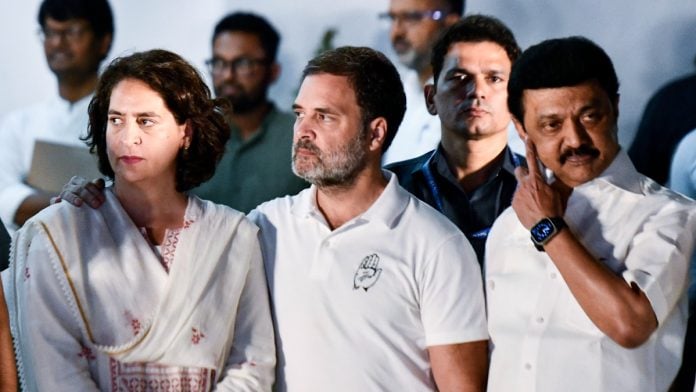
Chennai: Dravida Munnetra Kazhagam (DMK) chief M.K. Stalin avoided a phone call from Congress leader Rahul Gandhi inviting him to the launch of Sonia Gandhi’s memoir in New Delhi, sending greetings to her instead.
The incident highlights a rift that has emerged between Rahul and Stalin after the Congress ended their alliance right after the Tamil Nadu Assembly elections earlier this year.
Rahul Gandhi’s office reached out to Stalin ahead of the 16 November book launch event, but Stalin declined to take the call, citing other engagements.
Responding to the controversy Wednesday, Stalin told the media, “My secretary received the call, and I sent a letter wishing Congress leader Sonia Gandhi on the launch of her memoir.”
Vijay attended the book launch held at ITC Maurya in New Delhi and was seated in the front row alongside Rahul Gandhi.
The episode comes roughly six months after the Congress unilaterally exited the DMK-led Secular Progressive Alliance (SPA) following the 2026 Tamil Nadu Assembly elections, extending support to actor-turned-Chief Minister C. Joseph Vijay’s Tamilaga Vettri Kazhagam (TVK), which had emerged as the single largest party in a hung House. The Congress’s decision, which helped the TVK form the government, was described by DMK leaders at the time as “backstabbing”.
In June, DMK spokesperson T.K.S. Elangovan had told reporters in Chennai that the DMK is no longer part of the INDIA bloc.
Also Read: Is AIADMK staring at irrelevance? Two Tamil Nadu bypolls, one warning
Alliance patchwork
Alliance politics in Tamil Nadu has long been fluid, with both the DMK and Congress periodically choosing each other’s rivals when calculations demanded. The Congress has partnered with the AIADMK in the past and, earlier still, with the DMK.
The first formal alliance of the DMK and the Congress came in 1971 after the Congress split, when Indira Gandhi’s faction partnered with M. Karunanidhi’s DMK for simultaneous Lok Sabha and Assembly polls. Then Congress aligned with the AIADMK in 1977 after M.G. Ramachandran’s party came to power, and the partnership was renewed in 1984. The DMK joined the Bharatiya Janata Party-led National Democratic Alliance (NDA) in 1999 and remained part of it until late 2003, when it withdrew support ahead of the 2004 Lok Sabha elections and switched to the Congress-led United Progressive Alliance (UPA).
The DMK-Congress partnership remained largely stable since 2004. The first major break came in 2013 when the DMK pulled out of the UPA government.
It pointed to what it termed as New Delhi’s soft stand on the persecution of Sri Lankan Tamils, and growing tensions over the 2G spectrum cases as the reasons. As a result, the two parties contested the 2014 Lok Sabha elections separately. The Congress was wiped out in Tamil Nadu.
They came together again before the 2016 Assembly elections. After that, they stayed as partners in the 2019 and 2024 Lok Sabha elections and the 2021 Assembly elections under the banner of the Secular Progressive Alliance.
The alliance remained strong until Congress decided to switch to TVK, which the DMK called a ‘betrayal’.
Brotherly love?
The personal equation between Stalin and Rahul Gandhi had already changed in the run-up to the polls. The two leaders, who once publicly referred to each other as ‘brother’, saw their closeness erode during tough seat-sharing negotiations. Stalin had called Rahul Gandhi multiple times before finalising the seats for the Congress but did not receive a response.
Although the parties formalised the alliance and ultimately contested together, there was no joint campaign involving Rahul Gandhi and then chief minister Stalin. DMK leaders also see Rahul’s lack of engagement during the election campaign and the pre-poll attitude of party leaders in Tamil Nadu as another reason for the differences.
State deputy secretary of the DMK media relations wing, S.A.S. Hafeezullah, said that the Congress not only switched alliances but also rewarded individuals who tried to break the alliance.
“Praveen Chakravarty was given an MP seat for making efforts for the Congress to join TVK even before the elections. Rahul Gandhi wanted the SPA alliance but made no effort to campaign or ensure the alliance won. The Congress disappointed DMK with its actions even before the elections. From 2004 to 2014, UPA sustained by two major parties, DMK and Rashtriya Janata Dal and Congress betrayed both of them in the recent elections,” he told ThePrint.
Stalin’s refusal even to speak to Rahul Gandhi, while still extending formal courtesy to Sonia Gandhi, signals that the “brotherly” bond has been replaced by a colder distance rooted in the sense of betrayal after the results.
DMK parliamentarian P. Wilson said major differences stem not just from the shift in the alliance, but also from a lack of courtesy.
“The Congress party’s conduct after elections, switching alliances without a word and the sense of betrayal conveyed by Congress leaders has affected our leader. Even after the government formed, some Congress leaders use unparliamentary language and lack decorum, worsening the situation.
“Meanwhile, our leader Stalin has conveyed his wishes to Sonia Gandhi on the launch of her book,” Wilson told ThePrint.
(Edited by Nardeep Singh Dahiya)
Also Read: As Vijay & allies join INDIA bloc’s anti-CEC protest, VCK blames SIR for Stalin’s defeat in Kolathur