





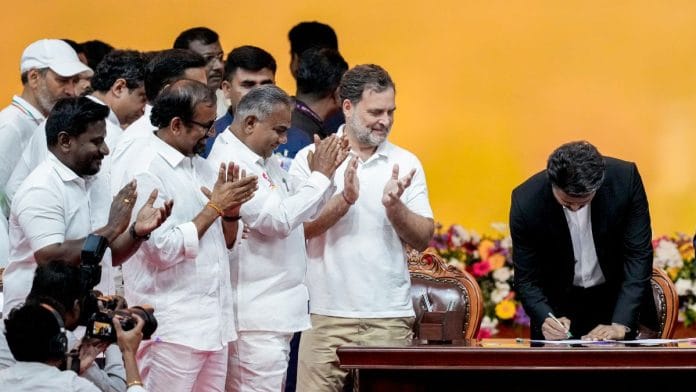

Chennai: As C. Joseph Vijay took oath Sunday as Tamil Nadu’s new chief minister, Prime Minister Narendra Modi lashed out at the Congress for supporting the Tamilaga Vetri Kazhagam (TVK), after it emerged as the largest party in the assembly but fell short of the majority mark.
Modi said that the Congress’s pre-poll alliance with the Dravida Munnetra Kazhagam (DMK) had repeatedly pulled it out of crisis, but it still “betrayed the party (DMK) the moment the political winds shifted”.
“Now, Congress requires yet another party, one on whose back it can ride, to remain politically relevant…” Modi said.
The Prime Minister’s comments are political rhetoric—the BJP’s own history in Tamil Nadu is characterised by a revolving door of alliances, with at least seven switches.
But the Congress has switched alliances at least eight times since 1967 to optimise seats or remain relevant in Tamil Nadu politics. Earlier, it partnered with the Dravidian giants, either the DMK or the AIADMK. But this time, just like the people of Tamil Nadu, it chose a third option.
The writing was on the wall, evident during the seat-sharing negotiations between the Congress and the DMK, ahead of the 2026 assembly polls. Faced with the BJP’s aggressive campaigning, the Congress was especially assertive in demanding more seats this time, and some leaders also called for power-sharing.
Since 1967, either the DMK or the AIADMK has reigned over Tamil Nadu. And, neither of these two Dravidian parties has shared power with its allies. This time, the Congress expects to share power with the TVK.
On Sunday, nine TVK MLAs, along with Vijay, took the oath as ministers in the new Tamil Nadu government, which will include five MLAs from the Congress. Regarding the new alliance, Congress MP Sasikanth Senthil told ThePrint, “We agreed on two ministries, and we also discussed local body elections with TVK. It is part of their policy that they will share power with their alliance parties, and the details will be out in a few days as we present our candidates and portfolios.”
According to political analyst Ravindran Thuraisamy, the Congress has “no ideological stances” when entering an alliance with regional parties; rather, the decision was based on what the regional parties had to offer. “Congress negotiated seat-sharing with the DMK, presenting TVK as an option. After winning five seats as part of the DMK alliance, they have now bargained with TVK for power-sharing. Even in the past, the Congress has stood with strong regional parties that could help it secure power in states,” he said.
Senthil, however, said that any party would want to share power and be part of governance. Pointing out that Congress could have partnered with TVK pre-poll, he asserted, “Our stance was anti-BJP, and we wanted to stay with the DMK-led SPA alliance for that reason.”
However, the scene changed once the election results came out, as the TVK needed 10 seats to form a secular government. “Our idea is to be part of a secular government, and if they come to us, we would like to join them before they go to the other side. We cannot let communal forces enter Tamil Nadu, and we will stick to our ideology. Accusation of opportunism is immature,” Senthil added.
DMK spokesperson Saravanan Annadurai told ThePrint that the Congress’s current stand made its ideology questionable and reflected opportunism. “When Rahul Gandhi calls people traitors for switching parties, what should they (Congress leaders) be called now? What kind of image of the Congress party does this give to other parties in other states? How will Samajwadi Party leader Akhilesh Yadav and the people of Uttar Pradesh perceive this? Alliance parties won’t find the Congress trustworthy,” Annadurai said.
Also Read: White paper on Tamil Nadu’s fiscal health soon, says CM Vijay, slams DMK for leaving treasury empty
Congress’s alliances
The Congress has repeatedly broken and reformed its alliance in Tamil Nadu. While critics label this approach as opportunism, defenders see it as pragmatic survival in a landscape where standalone contests have consistently led to marginalisation.
Congress enjoyed unchallenged dominance in Tamil Nadu from Independence until the 1967 assembly elections. Under leaders like K. Kamaraj, the party held power by a comfortable margin. However, since the DMK’s victory in 1967, the Congress has not had an opportunity to form a government on its own in the state and has only operated as a junior partner.
This shift began in 1971, when the Congress forged an alliance in Tamil Nadu for the first time. Led by Indira Gandhi, the party allied with the DMK to secure its position at the Centre.
With the Congress stepping out of the competition for assembly seats, Karunanidhi’s DMK won 184 of 234 seats alone in the state polls. On the other hand, the DMK, which earlier opposed the Congress’s dominance at the Centre, gave up its claim to some seats during the Lok Sabha polls, helping Indira’s party secure a majority at the national level.
In 1977, following the Emergency and amid the Janata Party’s expanding presence in the country, the DMK won only 48 seats in the Tamil Nadu assembly. The AIADMK, emerging victorious, formed the government. The Congress was placed third. Unlike the assembly elections, which the Congress fought solo, the party allied with the M.G. Ramachandran (MGR)-led AIADMK for the Lok Sabha elections.
In 1980, however, the DMK and Congress came together again to win 68 assembly seats in the State. The AIADMK, however, still retained power.
In 1984, Karunanidhi opted for an anti-Congress front amid a pro-Congress sympathy wave over Indira Gandhi’s assassination. While the DMK partnered up with the Communist Party of India, the Communist Party of India (Marxist), the Janata Party, and Tamil Nadu Congress (K), the Congress allied with the AIADMK. The AIADMK-led alliance won 37 of 39 Lok Sabha seats and 195 assembly seats.
The Congress thereafter remained allied with AIADMK through the late 1980s and 1990s, while contesting separately in 1989. This partnership, which began in 1984 under MGR, continued under Jayalalithaa from 1989 to 1996. It helped the Congress secure Lok Sabha seats, while the AIADMK dominated state politics.
The Congress terminated the alliance mid-term before 1996, when Jayalalithaa faced backlash over corruption charges. However, right before the 1996 assembly elections, Congress again partnered with the AIADMK. A faction of the Congress led by G. K. Moopanar—Tamil Maanila Congress—broke away. The alliance secured only 12 seats that election, and the Congress was reduced to 0. Meanwhile, the DMK alone won 173 seats.
The Congress continued with the AIADMK through 2001, with the alliance going on to regain face by displacing the DMK-led government. This was followed by a series of events that completely changed the political landscape.
In late 2003, the DMK left the NDA government, and Jayalalithaa, soon after, chose to partner with the BJP. Later in 2004, the Congress shifted to an alliance with the DMK, under the United Progressive Alliance (UPA), forming one of its longest partnerships. Initially, Congress insisted on power-sharing but later agreed to remain in the partnership without it.
This alliance continued during the Lok Sabha and assembly elections of 2004, 2006, and 2009. It allowed the Congress to secure seats in Tamil Nadu, where it played a supporting role, while holding onto power at the Centre.
In 2014, the DMK unilaterally ended the alliance, but the parties came together again in 2016. There were internal dissents and strains, seat-sharing disputes, and occasional breakdowns, but in recent cycles, including 2021 and the lead-up to 2026, THE Congress has stayed within the DMK-led Secular Progressive Alliance (SPA).
This long-standing alliance ended, as the Congress decided to go with the TVK, after Vijay’s phenomenal success in the 2026 state elections.
Political observers believe coalition-building remains the only viable path for a national party in a strongly regional state. Besides, the Congress is no longer the only national party fighting for space in a landscape crowded with regional parties. The BJP’s vote share, in 2024, stood at more than 11 percent, up from 3.66 percent in 2019.
Speaking on Congress’s move to ally with TVK, political analyst A. Ramasamy told ThePrint, “The Congress cannot survive alone, and it will maintain the status quo. We have seen that in the past, when it comes to seat sharing, as well. The alliance with TVK will not bring a vote bank boost, but the party always plays a numbers’ game. They need a winning horse to bet on, especially for the parliamentary elections.”
However, the Congress leaders defended the alliance decisions. The alliance with the DMK lasted for a long time, Congress MP Jothimani said, adding that any alliance is bound to see ups and downs.
“In politics, alliances forming and breaking are only natural. Even the DMK, just a week before announcing the 2014 parliamentary elections, expelled the Congress party from a long-standing alliance. We were suddenly pushed into contesting alone. For that, we didn’t harshly criticise the DMK. We understood it as a political stance. Now, the Congress party is compelled to take a political stance. Therefore, it’s best for us to part ways from the alliance with mutual respect,” she wrote on X.
(Edited by Madhurita Goswami)
Also Read: Beyond Brand Modi, BJP’s organisational machine is driving poll dominance. Bengal, Assam & counting