





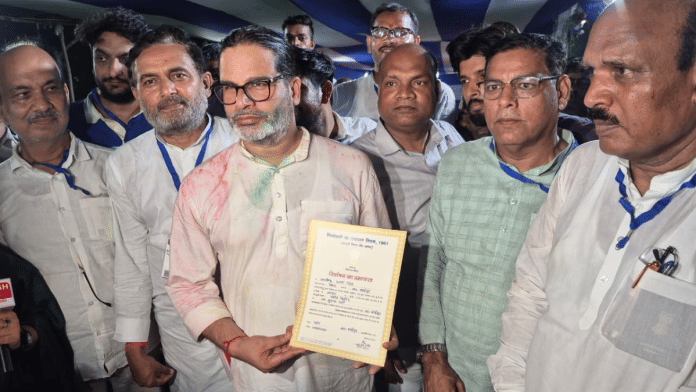


New Delhi: Soon after he was announced as the Jan Suraaj Party (JSP) candidate for the Bankipur bypolls, JSP founder Prashant Kishor termed the polls a referendum on Bihar Chief Minister Samrat Chaudhary’s leadership. He also urged voters to use the election to send a message to the Bharatiya Janata Party (BJP).
On Monday, Kishor dealt a massive blow to the ruling party as he clinched Bankipur, a BJP stronghold and represented by its national president Nitin Nabin and in the past by his father Kishore Prasad Singa, who won multiple times from 1995 until his demise in 2006.
For the BJP, the results come in the backdrop of the student protests spearheaded by the Cockroach Janta Party (CJP). Experts say it will have an impact in narrative building. They also point out that Kishor was able to garner the support of the youth as well as the middle class who have been rallying behind the BJP. In addition, they say the results should also raise an alarm bell for the Rashtriya Janata Dal (RJD) as Kishor dented the Muslim-Yadav votebank.
Kishor bagged 64,151 votes, followed by Sinha 44,827 votes in the high-stakes battle. RJD’s Rekha Gupta was the distant third with 14,273 votes. There are a total 3.79 lakh voters in the constituency.
ThePrint looks at the factors that helped Kishor post a shock win in Bankipur.
Dent in RJD votebank
Kishor got 64,151 votes and a large chunk of it came not only from the RJD but the BJP too. For instance, Rekha Kumari had got 46,363 votes in the 2025 Bihar polls (29.83 percent) as compared to 14,273 votes on Monday. Similarly, Nabin had got 98,299 votes (63.25 percent) as compared to Sinha’s 44,827 votes.
“One can easily see that Muslim and Yadav vote bank shifted from the RJD to Prashant Kishor. Kishor was able to garner the support of the Muslim population and has cast a dent to the M-Y formula. Muslims constitute around 10 percent of the voters and Yadavs 8 percent,” said Law Kumar Mishra, a Patna-based senior journalist with over four decades of experience.
At the same time, he asserted that the dent was more in the case of Muslims. “Kishor got the majority of the Muslim vote bank’s support, although there was a slight shift among Yadavs too.”
There was a feeling amongst the Yadavs and Muslims that RJD leader Tejashwi Yadav was not campaigning effectively, according to him.
“He went on a two-day roadshow, but spent most of the time abroad. He was also completely absent from the Monsoon session of the Legislative Assembly. A large section of the Yadav community came to believe that it was ‘Jan Suraaj’, not the RJD, that was truly challenging the BJP. This is precisely why a section of the Yadav vote bank shifted towards Jan Suraaj.”
A JSP functionary pointed out that there was already resentment among the Muslims regarding Tejashwi.
“During the assembly elections, the Mahagathbandhan projected Extremely Backward Class (EBC) leader Mukesh Sahani as a Deputy Chief Ministerial candidate but failed to announce a Muslim face for the role. The community had not forgotten that. Jan Suraaj worked hard in areas like Sabzibagh and succeeded in winning over a significant portion of the Muslim votes,” he explained.
A senior BJP leader pointed out that a section of the Muslim voters felt that voting for the RJD would be ‘a waste’ as it was not in a position to win. “They also felt that voting for the RJD would be a wasted vote; they believed that if the BJP was to be stopped, they had to vote for Jan Suraaj. The fact that PK consistently targeted the BJP rather than Tejashwi also played a crucial role.”
The leader added that barring Kushwahas and Kayasthas, all castes voted in large numbers to the JSP. More than 15 percent of voters in the constituency are Kayasthas, a community to which Nabin belongs. The constituency also has a sizable upper-caste mix of Bhumihars.
Also Read: Prashant Kishor’s Jan Suraaj sees an opening with bypoll in Bankipur seat vacated by BJP’s Nabin
Kurmi voters & the Nitish impact
According to experts and political leaders, resentment grew within the Kurmi vote bank due to the manner in which the BJP removed Nitish Kumar from the Chief Minister’s post and sent him to the Rajya Sabha.
“For many, the election was a way to display their anger to the BJP that they were unhappy with how Nitish Kumar was removed especially after contesting the elections in his name,” said a JSP leader.
Kishor and JSP had highlighted this fact several times that the BJP had won the elections on Nitish’s name and discarded him soon after coming to power. He held several election rallies and made it a point to target the BJP more than the RJD and launched fierce attacks on Samrat Chaudhary.
His usual refrain was that for the sake of their children people need to bring about a change in government. “He managed to cultivate the narrative that a victory for his side would force the BJP to replace the Chief Minister in Bihar,” said a BJP leader.
Professor Rakesh Ranjan, Department of Political Science at Patna University, said the Bankipur verdict is crucial in several respects because it was held after Janata Dal (United) chief Nitish Kumar stepped down as Chief Minister and since then, Bihar politics has been going through a transition.
“The results show that Samrat Choudhary’s level of acceptance isn’t quite there yet; it is still in the process of being established. So, to fill this political vacuum, Prashant Kishor stepped in. He is a seasoned veteran—certainly not a newcomer to the game. While this was his first time entering electoral politics directly, his organisation had been active previously in this area, which is considered a BJP stronghold,” said Ranjan.
He, however, steered clear of terming the results a referendum on the BJP or the CM pointing out that Bankipur doesn’t represent all of Bihar—it is an urban area, not semi-urban.
Mishra, meanwhile, said that the Bhumihars were upset because they felt it was not treated fairly by the BJP. Also, senior BJP leader Vijay Sinha was dropped as Deputy CM, which also caused division within the community.
“A resolution was passed by the community at Gandhi Maidan stating they would not vote for the BJP in the bypolls. Apart from them, the Brahmin vote also went to Kishor due to his own background as well as because of the Bharat Tiwari episode,” Mishra added.
“However, this was the first election held without Nitish Kumar in the picture; it was the first time an election took place in his absence. Nitish had a distinct identity across all sections of society. While one might not necessarily label this a setback for the BJP as a whole, it is certainly a setback for leaders like Samrat Choudhary and Nitin Nabin,” he added.
Bharat Tiwari encounter
Kishor and the JSP also targeted CM Samrat Choudhary over the alleged fake police encounter of 28-year-old Bharat Bhushan Tiwari. He had warned that if action was not taken against the guilty, his workers would demonstrate outside Choudhary’s Patna residence within 15 days.
The JSP founder visited Tiwari’s residence, expressed solidarity, and blamed the Bihar home department—a portfolio handled by the CM—for the alleged encounter. Even within the BJP, several upper-caste leaders, MLAs and even ministers had spoken publicly about the encounter putting Choudhary in a difficult position.
At the local level, Ranjan said, the Bharat Tiwari police encounter incident significantly impacted the existing voter base. Mishra also pointed out that Tiwari’s parents had met the CM days before the voting and there was palpable anger amongst the Brahmins.
Impact of students protests & CJP
The Bankipur loss, according to the experts, will affect narrative building too. The seat, considered high-profile, is a BJP stronghold. It was earlier known as the Patna West assembly constituency.
“I think in the game of narratives, there is going to be chatter or question marks against, you know, the inexperience of BJP president Nitin Nabin or Samrat Chaudhary’s ability to manage, diverge, social coalition or contradictory coalitions that the BJP-JDU alliance brings together. Of course, like, you know, some people would say that this might be the beginning or end of BJP’s dominance, all those kinds of conversations will happen,” Rahul Verma of CSDS told ThePrint.
“However, what is more likely to happen in the game of narratives, since this is a BJP’s pocketborough. The party president comes from it, it’s an urban seat, almost 100% urban constituency, and this by-poll defeat will come in the aftermath of youth protest and the BJP also losing Datia. I think, like, in the game of narratives, it will be seen as or basically be pushed as sort of, like, rising sentiments against BJP.”
Ranjan said the results are also significant as they come in the backdrop of the student protests and pointed out that a major protest took place in Patna, too. He cited two key factors explaining this sudden shift from the BJP to the JSP.
“First, Bankipur is an urban area with a significant number of residents whose children live elsewhere, working or studying in other cities. Consequently, it is a middle-class constituency. While the middle class has traditionally been the BJP’s strongest support base, the CJP agitation caused some resentment among the youth. You may recall that after Delhi, the largest CJP protest against the paper leak issue took place in Patna. It was a massive demonstration, leading to the arrest of numerous youths and activists.”
Ranjan said in this context, Kishor found an opening and capitalised on it as he sought to connect with the middle class and the youth by recognising the limitations of the prevailing caste-based politics.
“He believed that by introducing a fresh perspective—focusing on youth and employment—he could achieve success. There was also a sense of fragmentation within the opposition.”
Echoing Ranjan’s sentiments, Mishra pointed out that the youth demonstration in Patna wherein protesters marched towards the Raj Bhavan and the CM House also played a crucial role in the overall voting pattern.
“There was anger not only amongst the students who were detained but their parents and guardians too. Many of them would have voted for Kishor,” he added.
A senior BJP leader said that while the party focused on its ‘votebank’, Kishor managed to reach out to the youth, especially by raising the issues of unemployment and education, moving beyond the traditional caste-based politics.
“The way the BJP initially dealt with the protesters and their issues led to resentment among the youth. Kishor overall supported the students’ movement. Young people who want to move beyond caste-based politics in that sense chose Jan Suraaj in the hope of change,” said a JSP functionary.
“The impact of the revised University Grants Commission (UGC) regulations in January, especially on the upper caste sections of the society, cannot be counted out,” said a BJP leader.
Space for new opposition?
Experts also point out that the results also create space for the opposition. “We had long been wondering who exactly constitutes the opposition—while the RJD and Congress have been around for a long time, the Jan Suraaj Party is now stepping in to fill this space. Prashant Kishor seems to be pursuing a unilateral approach, but if he intends to engage in Bihar politics for the long haul, he will inevitably have to enter into a coalition,” said an expert.
Verma pointed out that it would be interesting to note if Kishor can rebuild his party. The JSP had drawn a blank in the last year’s Bihar elections in which all 238 candidates lost. Its vote share was just 3.4 percent.
“I think, like the third point to me and which is more important—does this mean anything, like, in Prashant Kishor’s ability now, after a year of that massive defeat in 2025, can he now slowly rebuild his party? And what kind of partners can he get in that journey to become a relevant player for 2030?”
Political analyst Sayantan Ghosh said the significance of Kishor’s victory is not that it transforms Bihar’s politics overnight, but that it signals the emergence of a credible political alternative.
“Winning a constituency represented by the BJP’s national president—the leader of India’s largest political party—gives the result significance beyond a single seat. This reflects a broader trend in Indian politics. In Tamil Nadu, Vijay entered politics as a complete outsider with no established political background, yet went on to form the government. His rise showed that when voters seek an alternative, they are willing to move beyond traditional political formations.”
Ghosh said Bankipur may be just one constituency, but it suggests that voters are willing to back a new political alternative. “Whether that evolves into a larger movement remains to be seen, but such moments often mark the beginning of political change.”
(Edited by Tony Rai)
Also Read: Why Prashant Kishor’s Bankipur victory in Bihar should ring alarm bells for Modi-Shah’s BJP