




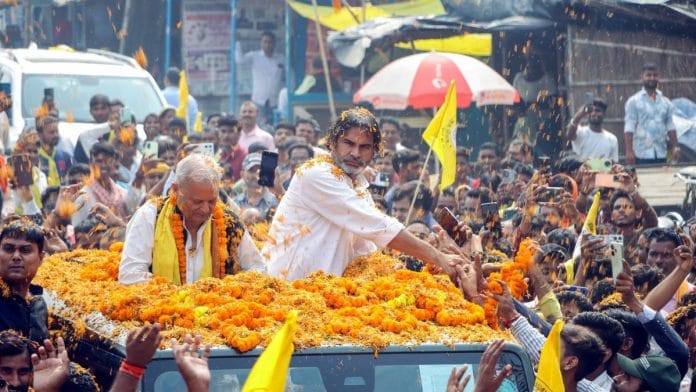

Never has an Assembly bypoll said so much about state and national politics. Prashant Kishor’s victory in the Bankipur Assembly bypoll opens up many possibilities in Bihar. On paper, the Jan Suraaj Party founder has defeated BJP’s Neeraj Kumar, an electoral debutant. However, in reality, he has defeated BJP national president Nitin Nabin, who won this seat—known as Patna West prior to 2010—for five consecutive terms before resigning to join the Rajya Sabha.
With an estimated 1.6 lakh of 3.79 lakh voters being upper caste Hindus, Bankipur has been a BJP fort for three decades, with Nabin’s father also winning it four consecutive terms. PK, as the former poll strategist is fondly called, has breached this fort decisively. It’s the first sign of Bihar finally warming to his alternative politics centred on development, not caste or religion.
A giant-killer that PK has become after virtually defeating the BJP national president, he and his JSP can potentially emerge as the principal opposition voice at the cost of Lalu-Tejashwi Yadav’s Rashtriya Janata Dal (RJD) in the coming months and years. Tejashwi hasn’t shown the will to fight. A serious politician wouldn’t holiday abroad for three weeks in the middle of the Bankipur poll campaign, the first electoral test of the Samrat Choudhary government.
Alarm bells in BJP camp
PK’s victory in Bankipur should sound alarm bells in the BJP camp. Not because of what it says about Nabin or Chief Minister Samrat Choudhary or even PK. What must worry the BJP more is that its core voters, the upper castes, seem to be getting disillusioned and drifting away. On the face of it, these results may or may not necessarily be the outcome of the Gen Z protests in Patna or elsewhere.
As PK’s fellow poll consultant Naresh Arora of the DesignBoxed said at a webinar hosted by The Hindu, Gen Z is the first generation that should be treated as a constituency based on mindset rather than caste or religious identity. Protesting students and youth were not all affected by the NEET-UG paper leak. They were voicing their cumulative grievances about the state of affairs. To that extent, the Bankipur bypoll result could be seen in the context of the Gen Z protests.
Not that the BJP is unmindful of the growing restlessness among its core voters, including the students and youth who had propelled it to power in 2014. Prime Minister Narendra Modi let go of then Education Minister Dharmendra Pradhan, his confidant and one of the very few ministers who have survived in his government since 2014. There are barely half a dozen others who have achieved this feat—Rajnath Singh, Nitin Gadkari, Piyush Goyal, Nirmala Sitharaman, Rao Inderjit Singh and Jitendra Singh. Others just fell by the wayside.
The government ‘sacrificed’ Pradhan to mollify the cockroaches and send them home from Jantar Mantar. His party seems to have realised now that it made a mistake by yielding to the cockroaches. Look at how the BJP has changed its approach towards them since his ouster. No more kid-gloves treatment. It’s time for the hammer.
When party MP Kangana Ranaut came out condemning the girls of the ‘generation gutter’ who can’t even become ‘homemakers’, the general perception was that she was crossing the line as the Modi government was going out of the way to please the protesting students and youth.
The BJP’s silence about her diatribe against those protesting girls came as an endorsement. When Uttar Pradesh governor Anandiben Patel, a Modi confidante for long, spoke about the language of the protesters bringing ‘shame’ to the entire society, it again seemed like another isolated voice that wasn’t in sync with the government’s or the party’s attempt to reach out to the disgruntled students and youth.
Then PM Modi’s Instagram video came Friday night. He looked anguished as he spoke of how the ‘mischievous children’ had used ‘crass abuses’ against him and his late mother and how society was “indignant” about the “cultural shock” about “our daughters” using such foul language.
While the PM said he ‘forgave’ them for their abuses, he virtually endorsed what Ranaut and Patel had said.
These remarks give an inkling of the BJP’s new narrative about the Jantar Mantar protests. It’s not about political accountability any more. Nor is it about the youth’s larger grievances about the failures of this government. The Gen Z protests are now being sought to be projected as an act of insolence by ‘mischievous children’. In PM Modi’s forgiveness lies the BJP’s counter-strategy to define the entire students’ movement by the expletives used by some ‘mischievous’ girls about the country’s Prime Minister.
The movement is sought to be projected as a symbol of the erosion of our social and cultural values and bad parenting. The central issue of governance failures has been subsumed under the perceived indignation over the insult to PM Modi and his late mother—something the Opposition has been made to pay for in one election after another.
Also read: Students’ battle over paper leaks is becoming a caste war
A worrying trend
Is it helping the BJP, though? A snap survey by the CVoter suggests otherwise. To a question whether the police should take action against protesters who used abusive language and posted objectionable content on social media, 54.2 per cent said ‘yes’. More than half of the respondents wanting action against the reprehensible and condemnable abuses against the Prime Minister is no surprise. What’s surprising is that almost 46 per cent of the respondents either said ‘no’ or ‘don’t know’.
Let’s look at another question: “According to you, what was the main reason behind the growing support for the CJP movement? At least 27.6 per cent of respondents said it was because of students’ anger over paper leaks. Another 39.5 per cent said it was due to the anti-incumbency among the youth.
What may worry the government were the responses to another question: “Are you likely to support CJP on other issues as well?” Only 29.4 per cent said ‘no’. What may worry the ruling party the most are the responses to this question: “Who is the most popular leader among the youth today?” Around 39.8 per cent said Narendra Modi, 27.9 per cent said Rahul Gandhi and 12.6 per cent said CJP. Only two out of five respondents finding PM Modi the most popular leader comes as another surprise.
There are issues with the CVoter snap survey, of course. Because the sample size is just 1,349. However scientific the methodology, it’s a minuscule sample. But that’s the only survey any credible agency has conducted on this issue so far.
There has to be a reason for the BJP to go on an offensive against the protesting students. Many party leaders believe that it’s a small bunch of urban youth who are protesting and these reel-making cockroaches don’t have the stamina for real-world fights—from police stations to courts. Anyway, they can’t be allowed to destroy the aura of invincibility around the BJP and the Modi government.
This aura is their core strength. It’s because of this that many institutions tend to bend before the political executive. That’s why leaders, MLAs and MPs from other parties find so many real and imagined reasons to switch their loyalty to be on the safe side of the fence. The same works for current and prospective allies. Any sign of vulnerability may trigger the centrifuge.
At the core of this perceived invincibility is the Modi-versus-who question. Rahul is not seen as a match to PM Modi, and there are so many surveys to back this perception. Nor is the Congress seen as a party that can take on an election juggernaut such as the BJP. So, what’s Gen Z’s option? The CJP has already clarified that it would remain a pressure group and not take a political plunge. There is a flaw in this argument, though.
Look at India’s post-Independence political history. Be it in 1977, 1989, 2004 or 2014, people primarily voted to dislodge the unpopular governments. Leaders such as JP or VP Singh or Narendra Modi came in at the right time to tap into anti-incumbency sentiments. The BJP can’t, therefore, afford to depend entirely on Rahul and the Congress to remain in power.
As PK says, opposition parties or leaders might be weak, but the opposition space is always strong. After the Bankipur bypoll result, the BJP may want to listen to him.
DK Singh is Political Editor at ThePrint. He tweets @dksingh73. Views are personal.
(Edited by Saptak Datta)
Nine Years, Made Possible by Readers
In 2017, Shekhar Gupta started ThePrint with a simple belief: Indian readers want journalism that asks why and what next, not just what. And that enough of them would be willing to pay for good journalism.
Nine years on, that belief has held.
And, in these nine years, we’ve stayed true to our mission. We’ve been asking the follow-up questions, going beyond the headlines and explaining what’s actually happening. We’ve travelled across the country to bring you in-depth, visually-compelling stories from the ground.
It’s been nine years of readers choosing to make this possible. If you’d like to be one of them:
DK Singh used to be a very perceptive journalist who managed to capture the mood of the public and could precisely point the way political winds are flowing. Nowadays, he is just a pale shadow of himself.
His coverage of the West Bengal polls was disastrous. He kept insisting that Suvendu Adhikari is simply no match for Mamata Banerjee. That he would have a hard time even winning his own Nandigram seat.
Turns out he beat Mamata Banerjee with a handsome margin on her own turf Bhawanipore. And has been [erforming rather well over the last three months as the new CM of West Bengal.
In the run up to the election, he consistently portrayed the TMC as having an upper hand and likely to sweep the election. The results were just the opposite. So much for his political understanding and erudition!
You fail to mention that they literally changed the candidate last moment ? You think that’s not a major factor ?Interesting.
He wanted to legalize alcohol so that the government can generate revenue from it. I actually support it because banning alcohol only creates a black market which means the market is flooded with adulterated alcohol.
So far he has not opposed any economic reforms or any FTA. So I think it’s fair to give him a chance. I hope he is not another rahul gandhi. The left deserves better. Bihar deserves better. The current CM doesn’t have that mass appeal which Nitish Kumar holds. That’s a big factor for me.
BJP is ruling the country without applying its mind. Common sense eludes it and also new ideas. Defeat in next general election is certain while only the margin of defeat is up for speculation. Most of the schemes it runs are utter flop like smart cities mission. Bad ideas appear good for the party now.