


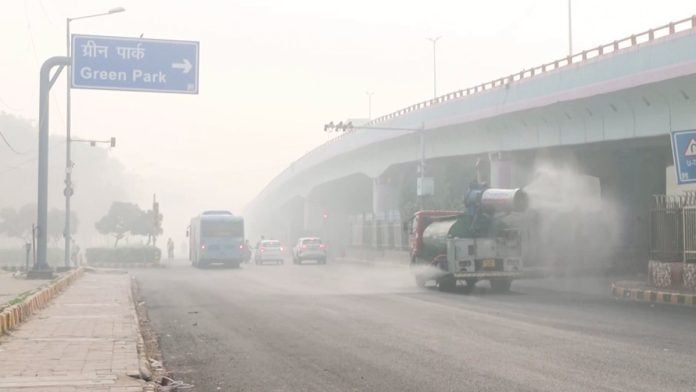
New Delhi: A day after Diwali, the Opposition has stepped up its attacks on the Modi government over hazardous air pollution levels in Delhi-NCR.
Congress Rajya Sabha MP Jairam Ramesh cited a report estimating that around two million deaths in India in 2023 were “attributable to air pollution”. AAP Rajya Sabha MP Sanjay Singh, too, attacked the Centre over India’s pollution record.
“The Modi Govt has long been in denial on the impacts of air pollution on mortality in the country. It has rejected, both in Parliament and outside, a number of studies on the grounds that they are not India-specific and that the impacts are not direct and uniquely attributable,” Ramesh wrote at X, citing a FICCI-EY report.
“This is yet another wakeup call for the somnolent Modi Govt. Ease of doing business is fine but ease of breathing is even more fundamental. PM2.5 has become a decided killer across many parts of India,” he added.
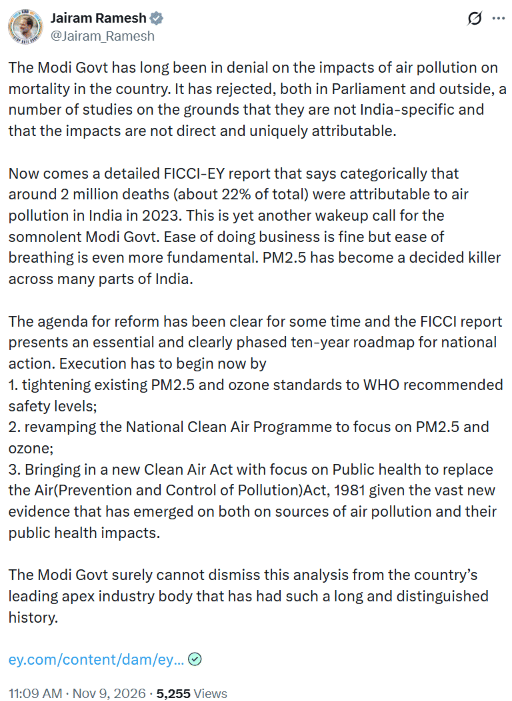
Jairam went further to say that the agenda for reform has been clear for some time, and the report presents an “essential and clearly phased ten-year roadmap for national action”.
“Execution has to begin now by tightening existing PM2.5 and ozone standards to WHO recommended safety levels; revamping the National Clean Air Programme to focus on PM2.5 and ozone; and bringing in a new Clean Air Act with focus on Public health to replace the Air (Prevention and Control of Pollution) Act, 1981 given the vast new evidence that has emerged on both on sources of air pollution and their public health impacts,” wrote Ramesh.
Adding, “The Modi Govt surely cannot dismiss this analysis from the country’s leading apex industry body that has had such a long and distinguished history.”
Congress leader Ajay Maken, who has been running a sustained campaign on rising air pollution levels in Delhi, flagged the absence of PM2.5 readings at 25 of the capital’s 39 monitoring stations between 2 am and 3 am on the night of November 8 and 9.
According to CPCB data cited by Maken, no readings were recorded at Anand Vihar, Ashok Vihar, Aya Nagar, Bawana, CRRI Mathura Road, Chandni Chowk, Dwarka Sector 8, IMD Lodhi Road, ITO, Jawaharlal Nehru Stadium, Mandir Marg, Mundka, NSIT Dwarka, Najafgarh, Narela, Nehru Nagar, North Campus DU, Okhla Phase 2, Punjabi Bagh, Pusa, RK Puram, Shadipur, Sirifort, Sri Aurobindo Marg and Wazirpur.
At the nine stations which recorded readings over the Diwali weekend, average PM2.5 stood at 576 micrograms per cubic metre, against 562 during this hour last Diwali, an increase of 2.5 percent. Maken said the reading was 38.4 times the 24-hour limit prescribed by the World Health Organization (WHO).
Hourly figures showed PM2.5 averaging 141 micrograms per cubic metre at 6 pm, against 107 last Diwali; 181 at 7 pm against 146; 265 at 8 pm against 222; and 403 at 9 pm against 354. The average rose to 506 at 10 pm and 515 at 11 pm, peaked at 610 at midnight, and stood at 597 at 1 am and 576 at 2 am.
“Done, done, done—India has become the world guru. Two million people die from pollution in India every year—that’s more than the population of many countries. Modi worked 36 hours in 24 and made India the world’s ‘No. 1 polluted country’. 99 of the world’s 100 most polluted cities are in India alone.” Sanjay Singh wrote on X.
Delhi minister Kapil Mishra, however, claimed that pollution levelshad declined in the pre- and post-Diwali comparison for the first time.
“The pre-Diwali and post-Diwali figures are out. Pollution rose by 43.33 percent in 2023 and by about 10% in 2024. This time, for the first time, pollution was -1.33 percent between pre-Diwali and post-Diwali. This happened despite all of Kejriwal’s conspiracies and lies, despite fires being set in Punjab, despite fires being set in fields at 1,200 locations on the evening of the 7th. This happened because people had good intentions and the public and the government worked hard together,” he wrote on X.
(Edited by Amrtansh Arora)
Also Read: Delhi’s pollution is not just outdoors. How dirty air enters your home