






Gurugram: It was Zero Hour on the last day of the Monsoon Session, and Mulana legislator Pooja had just one point to make in the Haryana Assembly Tuesday, that her community’s identity was not up for negotiation. “We are followers of Sant Ravidas Ji,” the Congress legislator, who goes only by her first name in official records, told the House. “The name of our caste should not be changed to Meghwal. We have made no such demand.”
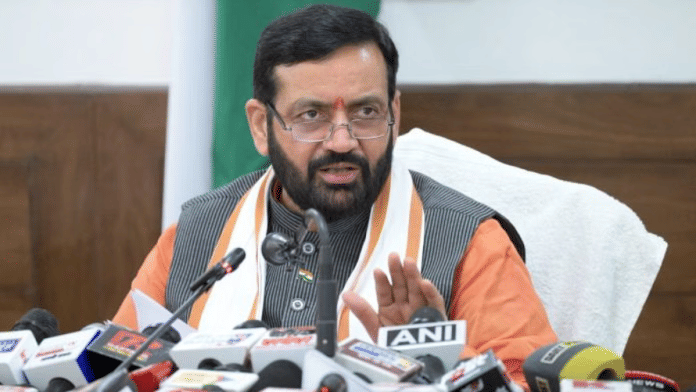
Development and Panchayat Minister Krishan Lal Panwar rose to reply that Chief Minister Nayab Singh Saini was doing nothing of the sort, and had already ruled out any such move.
That answer sits awkwardly with what Saini himself said just over a week earlier. Addressing a gathering at Bawal in Rewari district on 23 August, the chief minister told the audience his government would recommend to the Centre that members of the Meghwal community be allowed to write ‘Meghwal’ instead of ‘Chamar’ on their caste certificates.
“We will be recommending to the Centre that members of the community be given the choice to use the word ‘Meghwal’ in their caste certificates, if they wish so,” Saini had said.
The announcement came in response to one of 10 demands placed before him by the Meghwal Utthan Samiti at a Samrasta Sammelan and Pratibha Samman Samaroh—all of which Saini accepted on the spot, along with a grant of Rs 31 lakh for the organisation.
‘Chamar’ is a Scheduled Caste category under which the community is officially listed in Haryana, though members have long argued the term carries social stigma.
Speaking to ThePrint after the Assembly session, Pooja said her community had been on edge since that Bawal announcement. She identifies as Ravidassia, among the sub-groups within the ‘Chamar’ caste, and said people from her community do not want a single sub-caste name imposed on caste certificates meant for all of them.
What struck her as strange, she said, was that Saini made the announcement at an open rally, with videos still circulating online, yet has not personally clarified or contradicted newspaper reports since, leaving it to Panwar, himself from the community, to issue denials on his behalf.
Also Read: Saini govt to monitor all pregnancies through SAMRIDDHI portal as Haryana sex ratio at birth slips
Identity issue
Pooja’s husband, the Member of Parliament from Ambala, Varun Chaudhry, has taken the objection further. In a 28 August letter to Saini, Chaudhry wrote that the Chamar community had never sought a change in nomenclature and considers the name central to its identity, noting that Guru Ravidas himself used the term for his own identity in his Bani.
Chaudhry also pressed the contradiction directly: if Panwar’s denial was accurate, he asked why no newspaper that reported the Bawal announcement had received a corrigendum notice from the Chief Minister’s office. He asked Saini not to recommend any change to the Union government.
Jhajjar legislator Gita Bhukkal, who also belongs to the community, went a step further and questioned the legal basis of the announcement itself. “The authority of classifying castes as Scheduled Castes vests with the Centre and the states have no role in it,” she said. “I don’t know under which authority the chief minister accepted the demand to issue caste certificates with Meghwal written on them instead of Chamar.” Bhukkal noted that Chamar is a caste and Meghwal one sub-caste among several, Ravidassia and Jatav among others, and that the announcement had stirred resentment across the other sub-groups.
She pointed out that the word ‘Chamar’ appears in Guru Ravidas’s own Wani, in the line Kahe Ravidas Chamara, to argue the term is scriptural rather than a slur. Ashok Chhabra, Media Coordinator to the Chief Minister, told ThePrint that Panwar had already clarified the government has no intention of recommending the Meghwal changeover.
Panwar did not respond to calls from ThePrint.
At a press conference in Chandigarh, however, he had explained that at the Bawal event, organisers placed a charter of demands before Saini, the first of which was to write Meghwal on caste certificates, and that the chief minister made no commitment on it. Panwar put the state’s Chamar population at 30 lakh, of which nearly 80,000 are Meghwals.
Political scientists reading the reversal see it as less about law and more about arithmetic ahead of two crucial elections. Jyoti Mishra, who teaches Political Science at Amity University, Mohali, said the Bawal announcement looked like it was made in haste, without factoring in the electoral cost. “We have elections in Punjab and Uttar Pradesh next year. Both states are very important for the BJP. Punjab has the highest percentage, 32 per cent, of SCs in the country. Of this, one-third are Ravidassias.”
She added: “Prime Minister Narendra Modi himself visited Sachkhand Dera of the Ravidasia to woo the community. He has also announced the 650th anniversary of Saint Ravi Das. Similarly, Jatavs are in good numbers in Uttar Pradesh while Meghwals are largely in Rajasthan. To annoy Ravidassias and Jatavs at the expense of the Meghwals would have been a politically suicidal move for the BJP.”
Mishra’s point tracks with the scale of the party’s outreach this year. The Modi government had already moved on a long-pending Ravidassia demand on 17 July, when the Prime Minister flagged off the Sant Ravidas Express, India’s second Vande Bharat Sleeper service, from Jalandhar Cantt, giving Punjab’s Doaba region its first direct train to Varanasi, the saint’s birthplace.
Twelve days later, the BJP formally launched its seven-month ‘Samrasta Sankalp Abhiyan’ from Varanasi itself, the prime minister’s own Lok Sabha constituency, on July 29, timed to the 650th birth anniversary of Guru Ravidas.
National president Nitin Nabin flagged off that campaign alongside Uttar Pradesh Chief Minister Yogi Adityanath and the head of the Sachkhand Ballan Dera, with sacred soil from the saint’s birthplace despatched to 21,000 locations nationwide.
Punjab’s Ravidassia population and Uttar Pradesh’s Jatav voters are both central to that outreach, which is what makes Haryana’s Meghwal misstep, coming from a party otherwise courting the wider Ravidas-following community, politically costly enough to warrant a swift walk-back.
(Edited by Nardeep Singh Dahiya)