





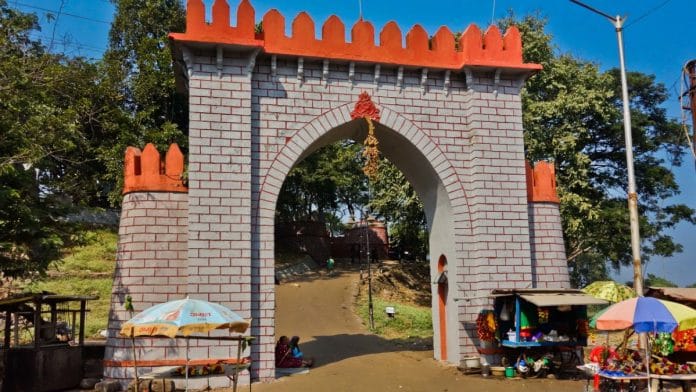


Mumbai: The Durgadi fort in Kalyan, a satellite town in Maharashtra, has been an integral part of Shiv Sena’s politics for over five decades. But, this time around, it has brought both Shiv Senas together—a rare feat given the friction that followed the split in 2022.
On Thursday, workers of both Shiv Sena factions, along with those of the Bharatiya Janata Party (BJP), demanded entry into the fort, which was restricted owing to Bakri Eid prayers.
Rival Shiv Sena factions held a ‘Ghanta Naad’ protest, demanding entry into the fort that has both a mosque and a temple.
The Durgadi fort, about 60 km northeast of Mumbai, is located near Kalyan Creek and the Ulhas river, and was built after Maratha forces conquered the region in the 1660s. Kalyan was an important province, gaining prominence during the Mughal and Maratha periods.
The fortification of Kalyan began during the Mughal period; that is when the Durgadi fort was built sometime in the late sixteenth century at the northeastern corner of the city.
It had a tomb, a place where prayers were offered, and a mosque, according to the records from the Gazetteer of the Bombay Presidency: Thana.
“At the northeast corner of the enclosed 70 acres area on high ground of the river bank was a fort. In the northwest corner of the fort rose a small flat-topped mound about thirty feet high, which has the prayer wall or Idgah, 64 feet long, 13 feet high and 7 feet thick and near the east crest of the mound was the mosque—20 feet long and 22 feet high,” the Gazetteer, as seen by ThePrint, reads.
When the Marathas took over in 1760, “a small wooden temple of Durgadevi was built behind the mosque and they called the fort Durgadi Killa, in honour of the Goddess and the name that it still bears. They also changed the Jama mosque into Ramji’s temple,” it adds.
Then, the British took over in 1818. The Gazetteer notes that the fort stopped being a place of worship since 1876 when the “image of the goddess was stolen”.
Also Read: Amid tensions over Bakri Eid in Maharashtra, why Pandharpur stands out for a decades-old tradition
Bal Thackeray enters the picture
The tensions between Hindus and Muslims over ownership of the fort can be traced back to the 1960s. The moot question was who would control the fort, as Muslims claimed that they had been offering prayers at this site for centuries, while the Hindus also sought equal rights of prayer and worship on the premises.
In 1966, the Maharashtra government said the site belonged to the State and decided to make a public park there, triggering more protests, this time from the Muslim side. The state government relented, allowing Muslims to offer Eid prayers at the site twice a year.
The issue escalated in 1968 when Bal Thackeray went to the fort and unfurled a saffron flag, famously saying that a Durga idol would be installed inside there. The Hindu side also claimed that they would celebrate Navratri there. In 1976, Muslims filed a petition in the Kalyan civil court, challenging the Maharashtra government’s ownership of the structure.
That legal battle continued till 2024 in the civil court.
Meanwhile, Muslims continued to offer Eid prayers at the fort twice a year while Hindus continued celebrating Navratri there.
In December 2024, the court ruled in favour of the state government. The Muslim side immediately appealed in the Additional District and Sessions Court, which issued a stay order, directing that status quo be maintained at the fort while the case is heard.
The latest flashpoint
Just like every year, during Eid prayers, offered along the road as well as the Idgah wall, temple entry was restricted. However, leaders from both Shiv Senas and the BJP objected, and demanded that temple entry be allowed despite the prayers that were going on.
They held a ‘Ghanta Naad’ protest and also threatened the police that they would recite the Hanuman Chalisa loudly if entry was not permitted. Workers from the three political parties even climbed the barricade and tried to disrupt the security.
The police later detained BJP corporator Mahesh Patil.
The ‘Ghanta Naad’ protest was started by the late Shiv Sena leader from Thane, Anand Dighe, in 1986 on the instructions of Bal Thackeray. Dighe used it to mobilise Shiv Sainiks to march to the fort every year on Eid to demand uninterrupted entry for Hindus. This involved hundreds of workers going to the fort, ringing bells, and performing maha-aarti.
Besides, Dighe was also instrumental in establishing Navratri on a large scale at the Durgadi fort.
Additional Commissioner of Thane Police Sanjay Jadhav told the media that this protest was not new, and that namaz has been offered at the Durgadi Killa for the last 30-40 years even as political workers from Hindu organisations have been coming here. Security is adequately beefed up, he said.
(Edited by Nardeep Singh Dahiya)
Also Read: A Maharashtra village went viral for cleanliness. Now, others want to copy its model