





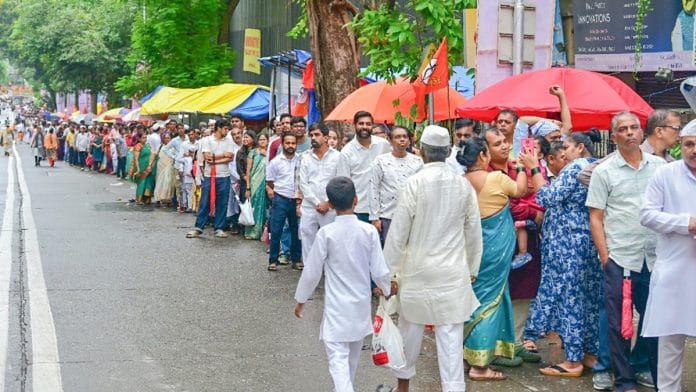


Mumbai: At a time when communal tensions have flared up in the state over Bakri Eid, Pandharpur, a temple town in Maharashtra, stands out for its decades-old tradition of Muslims putting off the traditional sacrificial killing of goats every time it coincides with the Hindu Ekadashi, as is happening this year.
This year too, the Muslim community of Pandharpur has decided to not offer Qurbani (the sacrificial killing of goats) on Thursday, the day of Bakri Eid, and instead celebrate Eid a few days later as it clashes with Ekadashi as per the Hindu calendar.
Ekadashi is the eleventh lunar day of the Hindu calendar and is marked by fasting, prayer and self-discipline to purify the mind and body.
“Every three years, there is an auspicious adhik Maas (extra month as per the Hindu calendar), lakhs of devotees come to Pandharpur. There will be no Qurbani on the day of Ekadashi. We will push Qurbani to another day and have our namaz tomorrow. Pandharpur is a town of different communities and we live peacefully. We want to respect everyone’s devotion,” Ibrahim Bohri, a resident of Pandharpur, told reporters Wednesday.
Pandharpur is home to the Vitthal-Rukmini temple where thousands of devotees from the Warkari sect make their way every Ekadashi. The Warkaris, a community that traces its roots to the Bhakti movement, do not subscribe to any particular caste or religion, and claim to be apolitical, united only in their devotion towards Marathi saints Tukaram, Dnyaneshwar, Namdeo, Eknath and Muktabai.
The temple town has a population of about 4.42 lakh, according to the 2011 census. About 5 percent of them are Muslims.
Ahead of Bakri Eid this year, communal tensions flared up in Mira Road, a satellite town of Mumbai, and in Mumbai’s Ghatkopar and Goregaon.
Earlier this week, there was tension between Hindu and Muslim residents of a housing society in Mira Road when Muslim residents kept some sacrificial goats tied in a shed in the society and some Hindu residents took objection to it. Activists of the Bajrang Dal and other Hindutva outfits also got involved and the matter escalated when they got a pig in the society saying if goats can be kept in the society, even pigs should be permitted. In Islam, pigs are classified as ‘impure’.
In Mumbai’s Ghatkopar and Goregaon too, friction between the two communities led to the police removing goats from inside housing societies after some residents protested. In Goregaon’s Gokuldam area, the Mumbai civic body revoked its permission for slaughter during Bakri Eid after opposition from some residents, and the intervention of BJP corporator Priti Satam who assured that Qurbani should not be allowed inside the complex.
This year Bakri Eid has also become a political flashpoint in Maharashtra with BJP leaders including Nitesh Rane and Kirit Somaiya making contentious comments. Rane said Bakri Eid should be celebrated virtually with a photo of a goat on the computer, and that if Hindus are asked to celebrate festivals in an environmentally and socially-friendly manner, Muslims should too. Somaiya had visited Mira Road after Tuesday’s clashes and said some Muslim leaders were trying to create a “new Pakistan”.
Also Read: Where Warkaris see devotion, politicians see ‘marketing’ — following annual ‘Wari’ pilgrimage
The Muslims of Pandharpur
According to a former member of the Vitthal Rukmini Temple Trust, the Muslims of Pandharpur said the tradition of postponing Bakri Eid celebrations has been going on for decades, and also stems from the fact that the Muslims in Pandharpur are also devotees of Lord Vitthal.
“Some of them follow Ekadashi, they observe a fast on the day. They identify with the members of the Warkari sect. During the Wari (annual pilgrimage of the Warkaris to Pandharpur), many open their doors for the Warkaris to live with them, eat with them,” he said.
Speaking to reporters in Pandharpur Wednesday, Sikandar Hakim said, “We also believe in the auspiciousness of the adhik Maas (extra month of the Hindu calendar). We are also devotees of Pandurang (another name for Lord Vitthal).”
The above-mentioned former member of the temple trust said several Muslims in Pandharpur are actively involved in the temple economy as well, making kumkum, selling flowers and so on.
(Edited by Amrtansh Arora)
Also Read: Is ‘Vithal’ Shiva or Krishna? A Sant settled it & started 700-yr-old pilgrimage to Pandharpur