



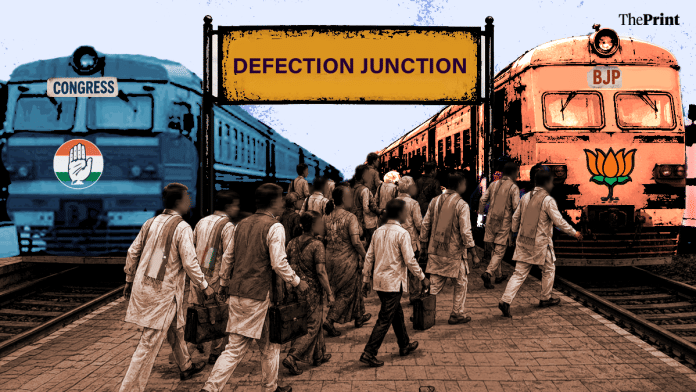
New Delhi: Last week, former Punjab Chief Minister Amarinder Singh raised many eyebrows and curiosity in political circles with his disclosure about his exchange of messages with Rahul Gandhi.
The Bharatiya Janata Party (BJP) leader sounded almost nostalgic as he revealed that Rahul wished him on his birthday and also sent a message to condole his brother’s death—something no BJP leader did.
That appreciation came as a surprise, as Rahul was instrumental in Amarinder’s resignation as the CM in September 2021 and his exit from the Congress a few weeks later. A year later, he joined the BJP and merged his party, the Punjab Lok Congress, with it.
A couple of days before this disclosure, Amarinder had publicly disapproved the BJP’s choice of ex-Congressman and another Jat Sikh leader Kewal Singh Dhillon as its Punjab unit chief. Complaining that the party didn’t even bother to seek his advice, Singh questioned Dhillon’s abilities. The BJP’s message behind choosing a Jatt Sikh as its face in Punjab just months before the election wasn’t lost on Amarinder.
As talks of Amarinder’s uneasiness gained ground, Union Home Minister and BJP’s chief trouble-shooter Amit Shah called Amarinder to his Delhi residence. The two hugged each other in front of the shutterbugs to convey a sense of ‘all is well’
Nevertheless, the former Punjab CM may find himself in the same boat that his former colleague, the late S.M. Krishna, landed in before retiring from politics in 2023. After almost 50 years in the Congress, Krishna joined the BJP in 2017. The former Karnataka CM was 84 then, the same age as Amarinder now.
Krishna went into political wilderness right after joining the BJP, which made much noise about the defection from the Congress but found the Vokkaliga leader of little political use later. Six months after Krishna joined the BJP, there were multiple income tax raids on the premises linked with his businessman son-in-law V.G. Siddhartha.
Another former Congress colleague, Ravneet Singh Bittu, may be in a dilemma as well. A Rahul Gandhi lieutenant, Bittu had jumped ship and joined the BJP weeks before the 2024 Lok Sabha elections. He was rewarded with a ministerial berth.
In February, the 50-year-old leader from Punjab was in the news when Rahul hurled a ‘traitor’ barb at him inside the Parliament premises. Any hope of milking further reward seems distant now as the BJP has denied Bittu a renomination to the Rajya Sabha. His ouster from the Modi Cabinet is more or less certain in the next revamp.
The likes of Amarinder, Krishna and Bittu are among the Congress biggies who accepted the lotus (read, BJP) to turn around their fortunes. The Congress, according to the non-profit Association for Democratic Reforms (ADR), suffered the highest number of defections between 2014 and 2021, losing 222 electoral candidates and 177 MPs/MLAs to other parties.
The Bharatiya Janata Party (BJP) was the biggest beneficiary, with 253 candidates and 173 legislators or lawmakers joining it during the same period.
As rebel Trinamool Congress MLAs and MPs explore joining the BJP, they do well to look at the trajectory of past defectors.
“Defections in Indian politics have increasingly become a function of power rather than ideology,” Chandrachur Singh, a political analyst and professor of political science at Delhi University, told ThePrint. “Parties like the BJP tend to accommodate only those leaders who bring something substantial to the table—a social base, organisational network, regional influence or electoral utility. Those who merely add to the numbers are often sidelined once their immediate political utility fades.”
The losers
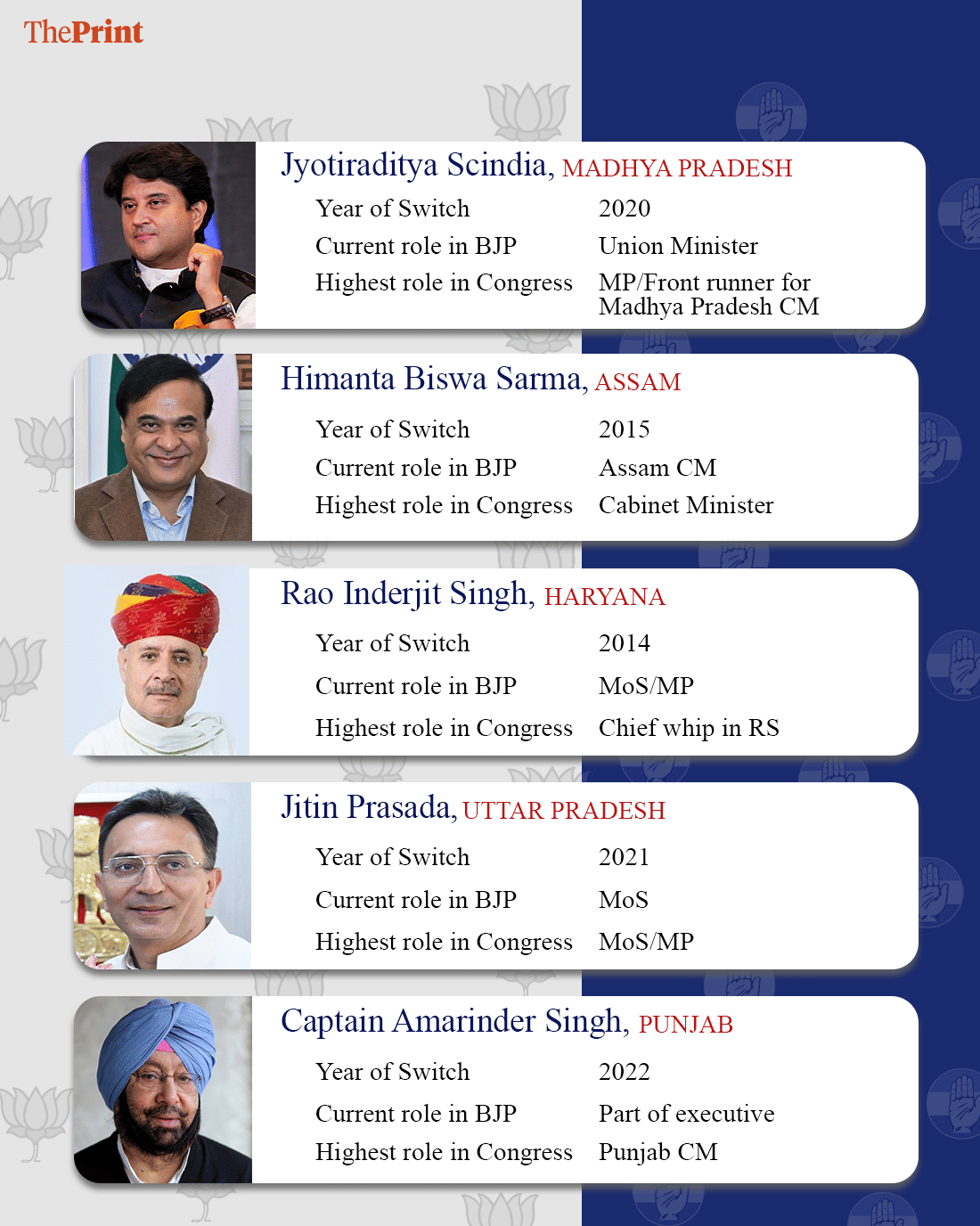
Unlike the group of successful defectors like Jyotiraditya Scindia, Kiren Rijiju and Himanta Biswa Sarma, there is a cohort which finds itself ending with either little reward or facing swift marginalisation.
For instance, former CMs—Vijay Bahuguna of Uttarakhand and Nallari Kiran Kumar Reddy of Andhra Pradesh—hold little political relevance today.
Bahuguna has been largely confined to the BJP’s national executive without any significant electoral or organisational role. His sister Rita Bahuguna, who was once the UP Congress chief and close to the Gandhi family, defected to the BJP in 2016.
She managed to get a ministerial berth in the Yogi Adityanath government for two years before winning the Lok Sabha election in 2019. She has gone into political oblivion ever since the BJP denied her the ticket in the 2024 Lok Sabha election.
Ashok Chavan, once among the Congress’s most prominent leaders in Maharashtra, joined the BJP in 2024 and was accommodated in the Rajya Sabha but has lost much of the clout he once commanded, analysts say.
As mentioned above, Amarinder Singh has largely disappeared from Punjab’s active political landscape. Even his wife Preneet Kaur, a former Union minister and Congress MP from Punjab, has been given no major organisational or electoral role. She had joined the BJP in 2024.
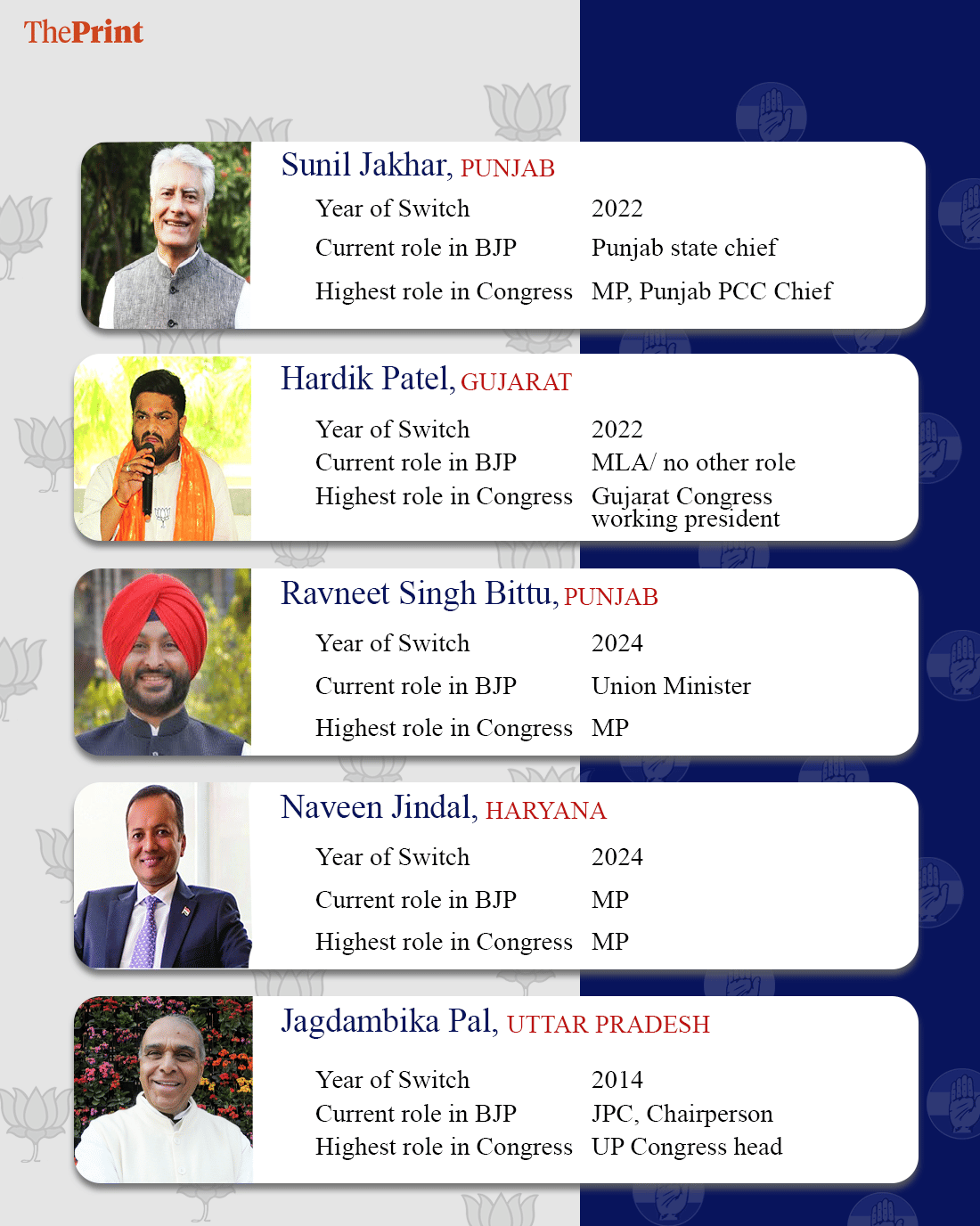
His one-time rival Sunil Jakhar fares no better. The former Punjab Congress chief was co-opted in the BJP in 2022, then elevated as president of the Punjab unit, and emerged as one of its key faces in the state in 2023. In May end, Jakhar was replaced by Kewal Singh Dhillon as the BJP state chief.
There was no change in fortune for former Union minister Suresh Pachouri, who was already sidelined within the Congress when he quit in 2024, since he has found no meaningful role in the BJP.
Ramnivas Rawat, a former Madhya Pradesh minister who switched sides in 2024, currently holds no significant party role. Kripashankar Singh, a former Maharashtra minister who joined the BJP in 2019, was given the largely symbolic position of state vice-president.
The pattern is sharpest among those who defected during legislative crises. In Madhya Pradesh, leaders such as Mahendra Singh Sisodia, Imarti Devi, Girraj Dandotiya, Raghuraj Singh Kansana and Kamlesh Jatav either lost elections or were left without significant ministerial or organisational roles despite their role in bringing down the Kamal Nath-led Congress government in 2020.
The same holds true for Karnataka’s B.C. Patil, Anand Singh, Narayan Gowda and Roshan Baig after helping topple the Congress-JD(S) government in 2019. In Goa, Chandrakant Kavlekar, Jennifer Monserrate and Clafasio Dias hold little influence within the BJP despite having been instrumental in weakening the Congress in 2019.
Among national-level figures, Tom Vadakkan—once among the Congress’s most visible spokespersons and close to 10 Janpath— is now confined to media duties. The leader from Kerala joined the BJP in 2019.
Anil Antony, son of former defence minister A.K.Antony, quit the Congress in 2023 while heading its digital communications cell in Kerala. He was appointed BJP national spokesperson and national secretary. Some within the Congress believe he had stronger long-term prospects in the party had he stayed on.
Gfx: Jeyasri | ThePrint
The winners
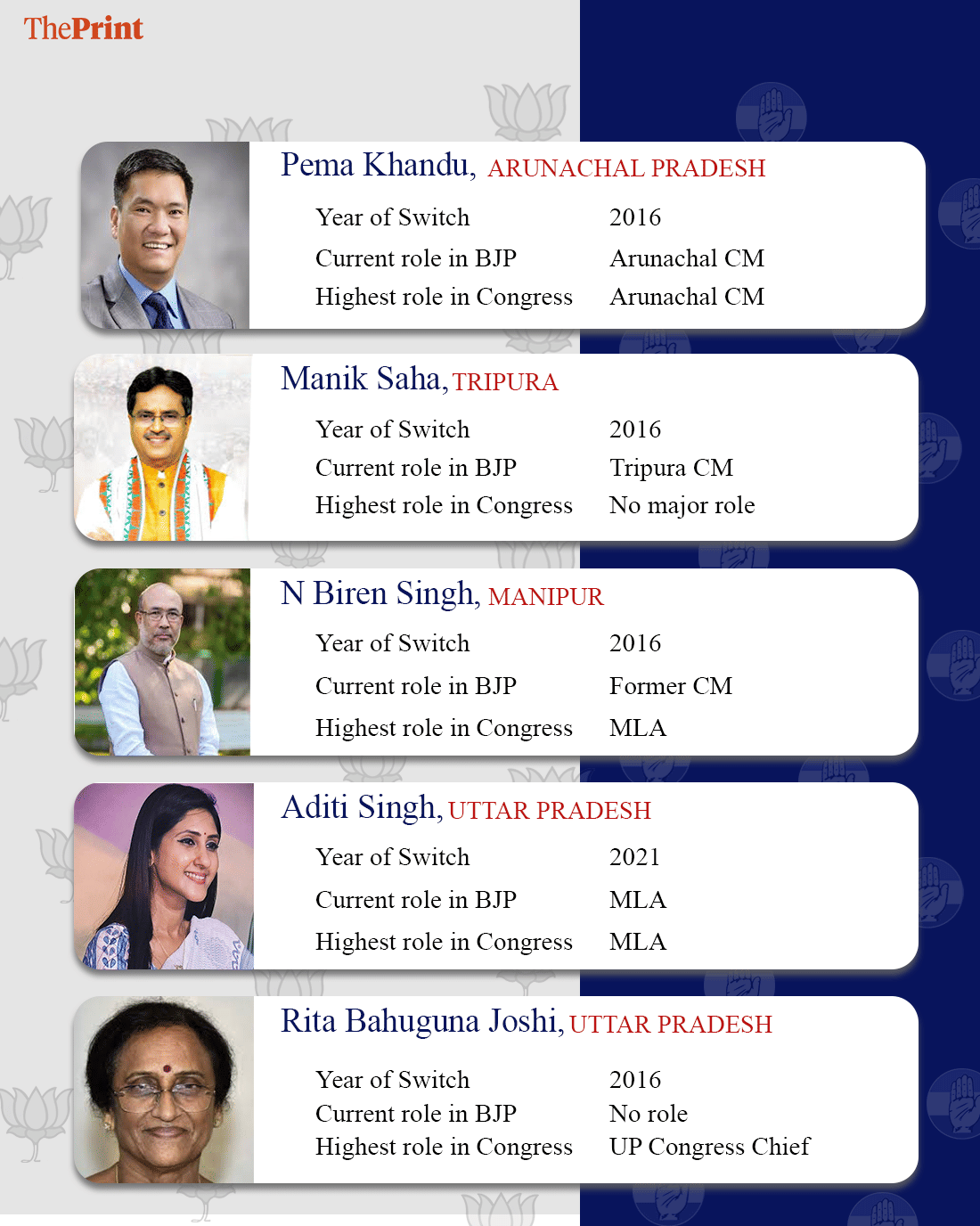
Out of the seven defectors who became Chief Ministers in the BJP-led governments, four are from the Congress—Himanta Biswa Sarma in Assam, Pema Khandu in Arunachal Pradesh, Manik Saha in Tripura and (ex-CM) Biren Singh in Manipur.
The other three include West Bengal’s Suvendu Adhikari (from the TMC), Bihar’s Samrat Choudhary (from the Rashtriya Janata Dal) and ex-Assam CM Sarbanand Sonowal (from the Asom Gana Parishad).
There are at least four defectors—Jyotiraditya Scindia from the Congress, Annapurna Devi from the Rashtriya Janata Dal, Kiren Rijiju from the Congress, and AGP’s Sonowal—in the Union Cabinet. Rijiju was a BJP MP before he joined the Congress in 2009 only to return three years later.
For each of these successful defectors who made it big, there are several others who find themselves on the political margins as they lose their utility.
Himanta Biswa Sarma, a senior Congress cabinet minister in Assam during the later years of Tarun Gogoi’s tenure in 2011-2015, is now one of BJP’s most influential chief ministers.
Pema Khandu was the Congress chief minister of Arunachal Pradesh for two months before he defected with 43 Congress MLAs and merged with the People’s Party of Arunachal (PPA) in September 2016 and formed the government. Three months later, he defected with 33 PPA MLAs to merge with the BJP, giving the party its first CM in the state.
N. Biren Singh and Manik Saha also rose to chief ministerial positions after crossing over in 2016; Biren Singh was the Manipur CM till February last year and Saha is the incumbent in Tripura.
Further, Jyotiraditya Scindia’s 2020 rebellion—in which 22 Congress MLAs defected, bringing down the Madhya Pradesh government—earned him a Union Cabinet berth. Scindia is now the Union Minister for Communications and Development of North Eastern Region.
But Scindia, considered among the Congress’s most influential young national leaders, never became a chief minister, and analysts say he doesn’t hold the same stature within the BJP’s ranks.
The rebellion’s immediate beneficiaries—Govind Singh Rajput (revenue and transport minister, 2020–2023), Tulsi Silawat (water resources minister, 2020 onwards) and Pradhuman Singh Tomar (energy minister, 2020 onwards)—were rewarded with state cabinet positions.
Others who joined the BJP in the 2020 rebellion and were later rewarded with ministerial or senior organisational roles include Prabhuram Choudhary (health minister, 2020–2023) and Aidal Singh Kansana (minister in the Shivraj Singh Chouhan government, 2020 onwards).
Other notable gainers are Jitin Prasada, who moved from the Congress’s Group of 23 dissent group to becoming a Union Minister of State in 2021. Jagdambika Pal, a former state minister who joined the BJP in 2014, became a multiple-term Lok Sabha MP and was appointed chairperson of the joint parliamentary committee on the Waqf Amendment Bill.
Radhakrishna Vikhe Patil, who was Leader of Opposition in the Maharashtra Assembly before quitting in 2019 following a dispute over seat-sharing involving his son Sujay, is now a senior cabinet minister in the state handling the water resources portfolio. His son Sujay was an MP from Ahmednagar.
Ex-Congress minister Ramesh Jarkiholi, who had a central role in the 2019 Karnataka defections that toppled the then Congress-JD(S) government, was rewarded with a state cabinet berth and remains an MLA and an influential BJP leader in the state.
Former Goa Chief Minister Digambar Kamat, who spent years in opposition and lost much of his standing within the Congress, was accommodated as a state minister after joining the BJP in 2022—a personal gain, though analysts believe he no longer commands the influence he once had.
Dilip Ray, a former Congress leader from Odisha, was given a Rajya Sabha seat by the BJP this year.
The in-betweens
Another group of defectors sits in a grey zone—neither dramatically empowered nor visibly diminished by the switch.
Rao Inderjit Singh of Haryana continued as an MP and Union Minister of State, broadly retaining the standing he held in the Congress, where he had served as chief whip in the Rajya Sabha. Industrialist-politician Naveen Jindal remains an MP with seemingly little say in the political sphere.
Gourav Vallabh moved from being a Congress spokesperson to a similar role in the BJP. Hardik Patel, once the Congress’s working president in Gujarat and one of its most visible young OBC faces, is now a BJP MLA but holds no major organisational or ministerial responsibility.
In Madhya Pradesh, Bisahulal Singh remained an MLA and state executive member; Manoj Choudhary continued mainly as an MLA without any significant rise in influence. Karnataka’s Munirathna, K. Gopalaiah and Byrathi Basavaraj retained their legislative relevance after the 2019 defections without emerging as major power centres within the BJP.
In Goa, Michael Lobo, Delilah Lobo, Rajesh Phaldesai and Aleixo Sequeira continued as MLAs without any meaningful rise in stature.
And in Gujarat, Alpesh Thakor and C.J. Chavda largely retained the same level of relevance they had held in the Congress. Konda Vishweshwar Reddy, Aditi Singh, Raj Kumar Chauhan and Neeraj Basoya remain politically active and electorally relevant but without any substantial rise in organisational influence or national prominence.
Also Read: I-PAC to boutique firms: The rise, reach & reinvention of India’s political consultancy market
The ones who came back
A small number of defectors such as Ashok Tanwar eventually found their way back to the Congress. In Haryana, former Congress chief and MP Tanwar rejoined after a brief stint. Similarly, Baijnath Singh Yadav—who had been close to Scindia during the 2020 rebellion—also returned to the parent party in Madhya Pradesh.
Likewise, former MLAs Amrish Singh Gautam and Bhisham Sharma rejoined ahead of the 2020 Delhi Assembly elections. In Punjab, Balwinder Singh Laddi returned to the Congress just days after joining the BJP—among the more emphatic statements available about the arithmetic of defection.
Why the defections?
In the above-mentioned period by ADR, the scale of defections from the Congress was often sufficient to topple governments: 43 MLAs shifted to the BJP in Arunachal Pradesh in 2016, 35 crossed over in Gujarat in 2017, and 22 in Madhya Pradesh triggered the collapse of the Congress government in 2020
Defections of legislators also reshaped political equations in Assam (15), Karnataka (13), Telangana (12), Uttarakhand (11) and Goa (8) and Manipur (8) during the 2014-2021 period, the ADR analysis found.
In several of these cases, the anti-defection law proved ineffective. MLAs resigned before disqualification proceedings could begin, decisions by Speakers were delayed, or merger provisions were used to bypass the law.
The Congress has become vulnerable to defections because it remains a large pan-India party with a weakened organisational structure, according to Singh.
“Unlike regional parties, which are usually more tightly controlled, the Congress has created wider spaces for drift and dissatisfaction as many leaders no longer see it as an effective vehicle for influence, patronage or political advancement,” the political analyst added.
Senior Congress leader and former Chhattisgarh deputy chief minister T.S. Singh Deo pointed to a more coercive dynamic. “There is too much pressure from the ED and CBI. Some may leave for short-term gains, but many switch because the pressure becomes unbearable,” he told ThePrint.
A former chief minister who spoke on condition of anonymity described the defections as the result of a party that has grown inaccessible to its own.
“It has become increasingly difficult to meet (Leader of Opposition in Lok Sabha) Rahul Gandhi. Even veterans struggle to get access, so one can imagine the situation for younger leaders. Many feel their voices go unheard. Some leave because of that frustration, while others get drawn by the power and opportunities the BJP offers. After all, they have all the money and resources,” the former CM said.
The “biggest factor” for the party’s rise and the “Congress’s decline” was “leadership”, BJP spokesperson Ajay Alok told ThePrint. “A strong leadership makes a party decisive and gives confidence to its workers. Over the last two decades, Congress’s leadership has been its weakest link, creating dissatisfaction, while Narendra Modi’s leadership has given the BJP momentum, stability and sustained public trust,” he explained.
This is an updated version of the report.
(Edited by Tony Rai)
Also Read: In CM Revanth’s governance style in Telangana, a reflection of ‘guru’ Chandrababu Naidu’s playbook
Mistake in the article. Hardik Patel was never an OBC leader. Alpesh Thakor is an OBC but not much of a leader.
People should never vote for such defectors, be them from any party.