



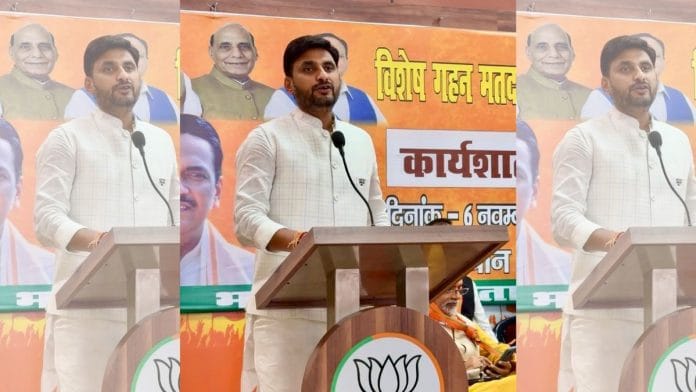
Lucknow: Social engineering and regional representation are the focus of the new organisational team announced by the Bharatiya Janata Party (BJP) in Uttar Pradesh ahead of the crucial 2027 assembly elections. One of the most notable appointments is that of Amit Shah’s close aide, Ankur Sharma, a resident of Bulandshahr district who has been appointed as state secretary.
Neeraj Singh, the 42-year-old younger son of Defence Minister Rajnath Singh, has been appointed a state vice-president. The defence minister’s elder son Pankaj Singh, a legislator from Noida, earlier held the same post.
Neeraj Singh has been associated with the party organisation for years and has remained active in Lucknow. He has not previously held an official organisational post, though he has often represented his father at interactions with party workers and residents in Lucknow.
Former Samajwadi Party (SP) leader Pooja Pal has also been appointed a vice-president. Pal joined the BJP after rebelling against the SP and cross-voting in favour of the BJP candidate during the Rajya Sabha elections in 2024. Having missed out on a ministerial berth during the recent Cabinet reshuffle, her appointment is being viewed as an effort by the party to accommodate her within the organisational structure.
Delhi-based TV journalist Yatendra Sharma has also been appointed as state secretary. He belongs to Hathras district of western Uttar Pradesh.
The newly announced team includes 19 vice-presidents, eight general secretaries and 19 state secretaries. The BJP has also named presidents for all six organisational regions in the state: West, Braj, Kanpur, Awadh, Kashi and Gorakhpur.
Caste & regional balance
Central minister Pankaj Chaudhary who was appointed as a state chief in December 2025 has got his new team within six months of his appointment. The new team seeks to balance caste equations as a part of the BJP’s strategy to broaden its social coalition ahead of the 2027 assembly polls. While retaining its traditional upper-caste support base the party has given significant representation to Other Backward Castes (OBCs), Dalits and women.
Among the 19 vice-presidents, the BJP has appointed four leaders from the Rajput community: Suresh Rana, Ramesh Singh, Neeraj Singh and Kameshwar Singh. Three Brahmin leaders—Archana Mishra, Braj Bahadur and Shankar Girihave—also been included, while Kritika Agrawal and Alok Gupta represent the Vaishya community.
The party has also sought to strengthen its outreach among non-Jatav Dalit communities by appointing Devesh Kori and Priyanka Rawat as vice-presidents. BJP strategists have long considered communities such as Pasis and Koris crucial to maintaining the party’s support among Dalits.
A significant part of vice-presidential positions has gone to OBC leaders representing different caste groups. These include Satyapal Saini, Durvijay Shakya and Suresh Maurya from the Kushwaha, Maurya, and Saini blocs respectively, Mohit Beniwal from the Jat community, Dharmendra Singh from the Kurmi community, Rajesh Yadav from the Yadav community and Pooja Pal from the Pal community. Krishna Bihari Rai has been included as a representative of the Bhumihar community.
The BJP has also attempted to maintain caste balance in the appointment of its eight general secretaries. The list includes Ram Pratap Singh Chauhan (Rajput), Geeta Shakya (Shakya), Abhijat Mishra (Brahmin), Upendra Rawat (Pasi), Sanjay Rai (Bhumihar), Shankar Lodhi (Lodhi), Dilip Patel (Kurmi) and Rajesh Chaudhary (Jat).
Similarly the party has inducted leaders from across caste segments as state secretaries. Representatives from Brahmin, Rajput, Bhumihar, Dalit and several OBC communities have been accommodated. The appointments include leaders from communities such as Rajbhar, Vishwakarma, Nishad, Bind, Nonia and Valmiki, reflecting the BJP’s continued focus on non-Yadav OBCs and non-Jatav Dalits.
The party has also reshuffled all six regional presidents. Nawab Singh Nagar, a Gujjar leader, has been appointed regional president for western Uttar Pradesh. The move is being viewed as a counter to the Samajwadi Party’s attempts to expand its influence among Gujjar voters.
In the Braj region, Puran Lal Lodhi has been appointed president, while Kishore Sahu will lead the Kanpur region. Awadh will be headed by Avadhesh Dwivedi, Kashi by Ashok Chaurasia and Gorakhpur by Vinoy Rai.
According to UP-based political analyst SK Dwivedi, “The latest organisational overhaul in Uttar Pradesh BJP is widely seen as the party’s response to the Samajwadi Party’s PDA (Backward, Dalit and Minority) strategy. By giving substantial representation to backward classes, Dalits, EBCs and women, the BJP is seeking to consolidate a broader social alliance before the 2027 electoral battle in Uttar Pradesh. The new team reflects the party’s effort to combine caste arithmetic, regional balance and organisational experience as it prepares for the next Assembly elections.”
A senior Uttar Pradesh BJP functionary told ThePrint that “the newly constituted state team bears the imprint of national president Nitin Nabin and Uttar Pradesh organisational in-charge Dharampal. Kameshwar Singh, who is considered close to Chief Minister Yogi Adityanath, has been appointed as a state vice-president. Several leaders perceived to be close to Sunil Bansal, including Triyambak Tripathi and Vijay Bahadur Pathak, did not find a place in the new organisational setup, though another close one Archana Mishra has got a place in the team.”
(Edited by Nardeep Singh Dahiya)