





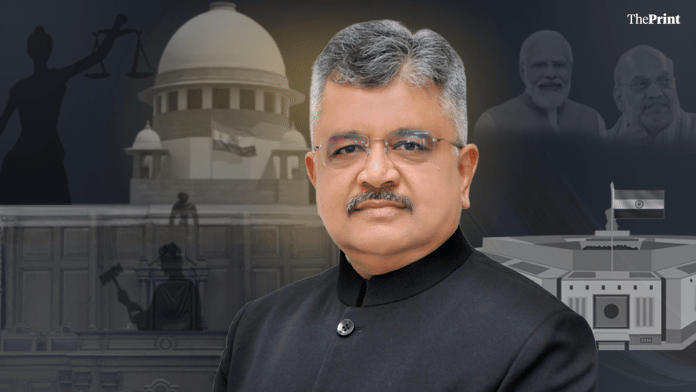


New Delhi: After Narendra Modi took oath as the Prime Minister of India in 2014, he brought with him his trusted officers from Gujarat. Solicitor General Tushar Mehta’s name has since stood out as a trusted law officer of the Bharatiya Janata Party-led (BJP) central government.
When the BJP-led National Democratic Alliance (NDA) came to power, Mehta was appointed as the Additional Solicitor General (ASG) in 2014. He quickly rose to take over as the country’s second-most senior legal officer, being appointed as the Solicitor General of India in October 2018. He was re-appointed for another three years in 2023, and has now been re-appointed to the post once again, for another term of three years.
This gives Mehta a total of 11 years as the Solicitor General, just two years short of the longest serving person at the post, C.K. Daphtary, who held the office for 13 years from 1950 to 1963.
But what makes Mehta so indispensable to the Modi government?
Senior lawyers credit Mehta’s loyalty to his brief, the years-long trust that Union Home Minister Amit Shah has had in the Solicitor General, Mehta’s ability to present the “correct political line” before the court, and his ability to be the “voice of the government” in the courtroom.
“He is the most effective solicitor general in the history of India… the number of major matters that he has delivered for the government is incredible. No one in the history of government law officers has delivered consistently over and over again,” a senior advocate who has worked closely with Mehta says, on the condition of anonymity.
Since 2014, Mehta has led the government’s charge in several matters—abrogation of Article 370 in the Supreme Court, electoral bonds case, challenge to provisions of the Prevention of Money Laundering Act in Vijay Madanlal Choudhary vs Union of India (2022), Ramjanmabhoomi title dispute, Supreme Court’s suo motu proceedings related to the treatment of Covid-19 patients and the dignified handling of bodies in hospitals, the case relating to deportation of Rohingya refugees to Myanmar, SC’s affirmation of 28% GST on online money gaming, constitutional validity of the Waqf (Amendment) Act, 2025, marriage equality case, Aadhaar case, EWS reservation case, and the most recent government ban on Telegram messaging app.
“He is the most important piece in the government strategy,” the senior advocate told ThePrint.
Also Read: ‘Not a forum for theatrics’—Solicitor General takes potshot at Kejriwal during Delhi HC hearing
‘Loyal to his brief’
Having studied at the Sir L.A. Shah Law College in Ahmedabad, Mehta’s arc began from the law offices of senior advocate Krishnakant Vakharia.
Gujarat High Court senior advocate Nirupam Nanavaty, who Mehta has worked with, remembers him as a “studious and hardworking” lawyer.
For Nanavaty, the most distinct trait of Mehta is that he is “loyal to his brief”.
“He will work on that brief and see that the matter is conducted in the best possible manner to the advantage of his client,” Nanavaty asserts.
He recalled that Vakharia was the chairman of the legal cell of the Gujarat Congress and was also involved with the Indian National Trade Union Congress (INTUC). However, the political alignments didn’t seem to come in the way of their professional relationship. In fact, in 2021, Mehta felicitated Vakharia, proclaiming his gratitude towards his “father figure”, and crediting the senior advocate for all his achievements.
After Mehta was appointed as the Additional Advocate General of Gujarat in 2008, he went on to serve as the primary legal counsel for the State of Gujarat in the Sohrabuddin Sheikh encounter case, in which Shah was an accused.
In fact, the Supreme Court heavily scrutinised the Gujarat government’s approach during Mehta’s tenure, remarking that the state had adopted an “adversarial attitude” in the case. Shah was discharged in the case in 2014 by a special CBI court in Mumbai.
Mehta is also reportedly the person who saw the abrogation of Jammu & Kashmir’s special status through its formulation with the government, and in the Supreme Court, where he successfully defended the move.
“Being the only lawyer involved in the process of nullification of Article 370 through constitutional and legal means before 5 August, 2019, and having led the arguments before the constitution bench while defending the constitutional process, it is a historical day for me too,” he was quoted as saying in 2023, after the Supreme Court upheld the abrogation of Article 370 of the Constitution.
‘Voice of the government’
Mehta’s appointment as Solicitor General came in October 2018, after the post remained vacant for a year after Ranjit Kumar put in his papers in October 2017.
A second senior advocate recalls that at the time, ASG Maninder Singh was a frontrunner for the Solicitor General’s post too. “What sealed the deal for him (Mehta) was that Amit Shah wanted him,” he told ThePrint.
Singh resigned from his position the same day as Mehta’s appointment as Solicitor General of India.
Inside the court, lawyers say Mehta’s voice conveys that the matter he is appearing in holds significance for the government.
“Tushar Mehta is able to be the voice of the government to the judges to the extent that he can… he reminds me of someone like K. Parasaran (former Attorney General of India) at the time of the Congress government. His voice used to be that voice. The judges knew that if he’s saying something, that’s what the government wants,” says a second senior advocate, on the condition of anonymity.
“His (Mehta’s) presence indicates the importance of the matter. He is seen as having the government’s ear and everyone knows there is proximity to the highest powers.”
Senior advocate Indira Jaising asserts that the Solicitor General is an officer of the Court, not of the government.
“The late Gulam Vahanvati, who was the Attorney General when I was ASG, told me very clearly I had the right to disagree with the Government’s advice if it was considered beyond the law. Law officers advise the government on legal issues, not the other way round. Beyond this, I know nothing about his (Mehta’s) relationship with the government,” she told ThePrint.
Shah and Mehta’s friendship isn’t a secret. Just last month, Shah was the chief guest at the New Delhi launch event of two books authored by Mehta.
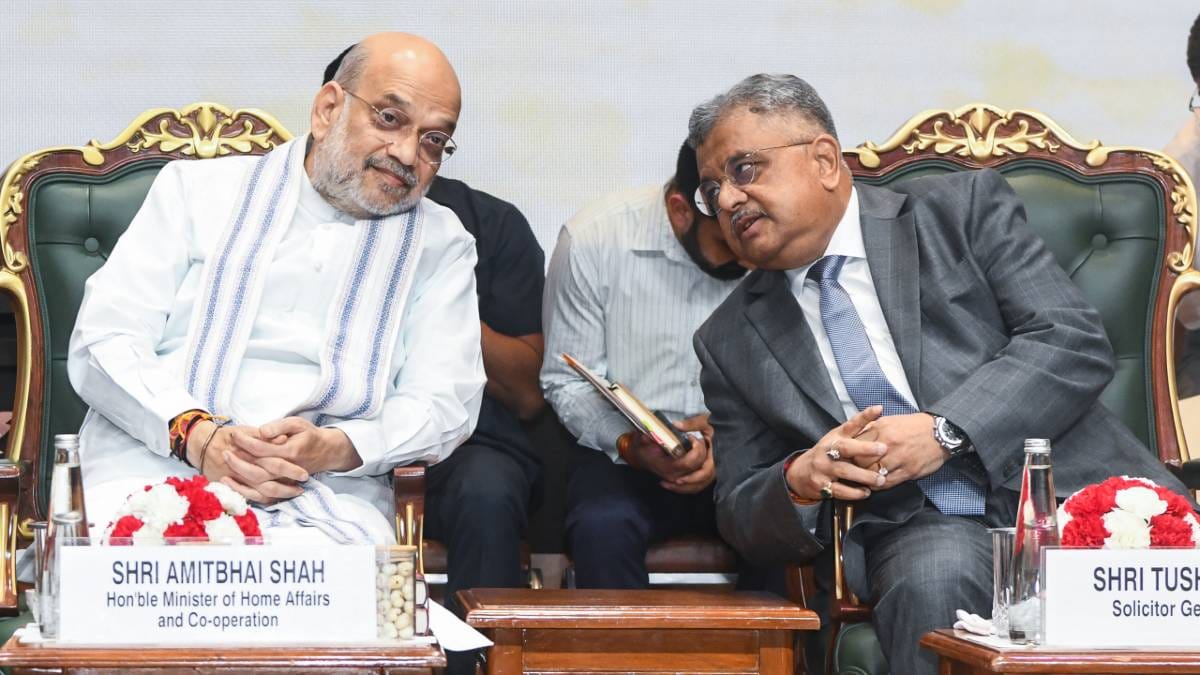
In his speech, he mentioned he had been warned that his speech “will not be seen as an old friend of Tushar Mehta”, but as a relationship between the court and the government.
The Solicitor General’s cases
According to the revised fee structure notified by the Centre in February 2026, the Solicitor General of India earns a retainer fee of Rs 96,000 per month, along with appearance and daily fees for handling government cases on a per case basis.
For instance, the Centre’s law officers in the Supreme Court receive Rs 96,000 per case per day for an appearance outside Delhi. They are paid Rs 38,000 per case per day for appearance in suits, writ petitions, appeals and references, and Rs 24,000 per case per day for special leave petitions and other applications.
A notification issued in September 2022 consolidated the power of allocation of most Supreme Court cases in the Solicitor General’s hands.
It says that in respect of cases before the Supreme Court, the list of cases on a daily basis will first be placed before the Attorney General for India who would select matters in which he thinks his appearance is necessary.
After that, this list of cases is to be placed before the Solicitor General, who would mark the cases to himself and to the ASGs to appear alone or with the Attorney General or the Solicitor General, and to counsels from other panels.
‘Correct political line’
As for the matters that Mehta takes up, the senior advocate quoted earlier says Mehta’s biggest strength may be the fact that he draws the “correct political line” in his matters, displaying a mix of politics and law together.
This political line often becomes visible in the arguments that Mehta presents before the court.
During a Supreme Court hearing on the plight of migrant workers during the Covid-19 outbreak, Mehta indirectly compared journalists covering the crisis to vultures, and accused high courts of “running parallel governments” by questioning the state governments over their inaction.
He also questioned the intent of parties who sought to intervene in the matter, calling them “prophets of doom” and alleging that they only spread “negativity, negativity and negativity”.
Welcoming the Ayodhya verdict in 2019, Mehta had called it “a rare combination of intellectual maturity”, and said, “This landmark verdict and the elaborate process undertaken by the highest court of the nation has reinforced and reaffirmed the faith and trust of the common man that his rights are in the safest possible hands of this great judicial institution.”
More recently, the court saw a heated exchange between Mehta and senior advocate Menaka Guruswamy, during the hearing of ED’s petition against former West Bengal CM Mamata Banerjee in connection with the raid on political consultancy firm I-PAC.
Guruswamy alleged that the proceedings were being used by a “major political party” on its social media handle. “My friend is using Your Lordships proceedings as a social media weapon in a political campaign. Your Lordships know this,” Guruswamy was quoted as saying by The Indian Express, when Mehta stood up to make his arguments on the ED’s behalf.
Cases of Singhal’s nephew, Shah’s son
Government law officers—Attorney General, Solicitor General and the ASG—can only take up private matters with the prior permission of the law ministry, in exceptional cases with compelling reasons.
While Mehta’s team says he has consistently refused to take up private matters after being appointed to the post of Solicitor General, his name does feature in a few private cases where the names of the parties stand out.
For instance, he represented Ravi Singhal, nephew of the late Ashok Singhal, who was a prominent leader and international president of the Vishva Hindu Parishad (VHP) in the divorce proceedings between Ravi and his wife Manali.
The proceedings had been going on since 1998 and were pending in the family court and the Delhi High Court before making their way to the Supreme Court, where Mehta came into the picture. At least two pleas were filed in the apex court, one in 2018 and another in 2019, and Mehta appeared in both of these on behalf of Ravi for some time.
According to court documents, Mehta represented Ravi up until December 2021, post which his name does not feature in the documents. In January last year, the couple filed a joint memo informing the court that they had decided to part ways and settle the matter between them.
When Mehta was the ASG, he also appeared for Amit Shah’s son Jay in 2017, in the criminal defamation case filed by the latter against news portal The Wire.
When the Congress questioned the propriety of government law officers appearing in a private case, it was reported that then law minister Ravi Shankar Prasad had granted approval to Mehta to appear in the case.
‘Knows how to get out of tough situations’
Outside the court, Mehta enjoys Urdu and Gujarati literature and poetry.
“Tushar bhai has a fantastic command over Urdu. He has a personal interest in Urdu shayari, Gujarati poems, English poems. If they say that a lawyer should be good in law and literature, he (Mehta) is good in both,” senior advocate Jal Unwalla told ThePrint.
“He also has an exceptional command over Indian history, global history and religious history of temples. You talk about Mohammad Ali Jinnah or Sardar Patel or Mahatma Gandhi, and he’ll talk about them like he knew them,” he adds.
According to Unwalla, Mehta’s secret is that he has a “diplomatic head over his shoulders and a good intellect”.
“He knows how to manage situations. And he actually knows how to get out of tough situations and come out clean,” Unwalla says.
This is an updated version of the report.
(Edited by Nida Fatima Siddiqui)
Also Read: Meet the lawyers who defend the govt: Cases & careers of 5 reappointed Additional Solicitors General