





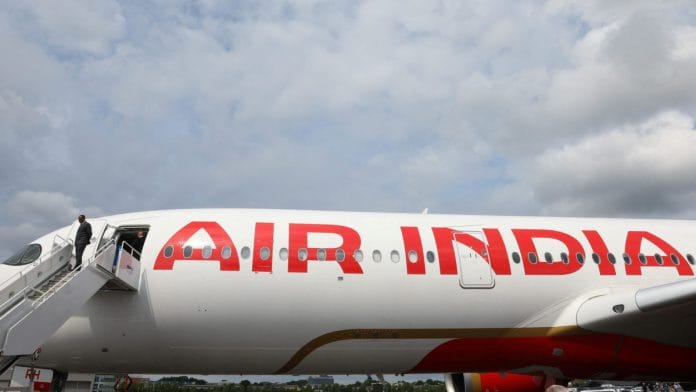


New Delhi: The Directorate General of Civil Aviation (DGCA) has ordered a probe after an Air India flight from Delhi to Amritsar entered Pakistani airspace while approaching Amritsar airport Wednesday. This comes days after three Pakistan-bound commercial aircraft similarly crossed into Indian airspace amid adverse weather conditions, despite the airspace restrictions.
In a statement issued Wednesday, the aviation regulator said Air India flight AI-479, operated by Airbus A321 aircraft (VT-PPV), had been instructed to hold its approach to Amritsar, while runway inspections were being carried out following a bird-strike-related incident.
It added that after the aircraft resumed approach, it briefly entered Pakistani airspace during radar vectoring, following directions issued by air traffic controllers during the approach. The movement was coordinated with Pakistani air traffic control authorities and the aircraft was then diverted back to Delhi, where it landed safely.
Interim action has been initiated against the air traffic controller at Amritsar as well as the operating crew for failing to report the occurrence, and not particularly for steering into restricted territory. The DGCA has not disclosed the nature of the action taken.
Air India confirmed the incident and said the aircraft had “marginally infringed” Pakistani airspace while carrying out a go-around at Amritsar.
“The crew operating flight AI479 from Delhi to Amritsar on 22 June had marginally infringed into Pakistan airspace while manoeuvring a go-around at Amritsar airport. The incident has been reported to the regulatory authorities and is being investigated internally. At Air India, the safety of passengers and crew remains our top priority,” an airline spokesperson said.
The DGCA is expected to examine the sequence of events that led to the airspace infringement, and whether established reporting and operational procedures were followed by both the flight crew and air traffic control officials.
A senior government official said that even though the two countries have closed their airspace to each other’s airlines, aviation authorities can get in touch when passenger safety is involved under serious circumstances.
“In such situations, the priority is to ensure the safety of passengers and crew. Civil aviation authorities coordinate when required although this is rare” the official said on condition of anonymity.
The Air India incident comes less than two weeks after at least three commercial aircraft operating flights connected to Lahore briefly entered Indian airspace, while navigating severe weather over Punjab in Pakistan.
Flight-tracking data showed that a Lahore-Dubai flight, a Lahore-Jeddah flight operated by Fly Jinnah and an Air Sial service from Dammam to Lahore crossed into Indian airspace on 12 June.
The incidents come at a time when India and Pakistan have barred each other’s airlines from using their airspace, following the deterioration in ties after the April 2025 Pahalgam terror attack, and the subsequent four-day conflict in May.
Captain C.S. Randhawa, former pilot and president of the Federation of Indian Pilots (FIP), said aircraft are not permitted to enter another country’s airspace without clearance except under exceptional circumstances.
“These rules are not meant to be broken. If an aircraft has to enter another country’s airspace, permission from the concerned air traffic control authority is required. In situations, such as an onboard fire or another serious emergency, permission may be granted. But under normal circumstances, aircraft cannot be steered into another country’s territory, this is not allowed and not okay,” Randhawa told ThePrint.
He said even civilian aircraft entering restricted airspace can raise security concerns. “Both countries have shut their airspace to each other. Even a civilian aircraft can be viewed as a potential threat. Authorities have to assess every such movement carefully. These are sensitive matters and procedures exist for a reason.”
(Edited by Mannat Chugh)
Also Read: Will sue Boeing if design or manufacturing defect is proved, says lawyer of Air India crash victims