





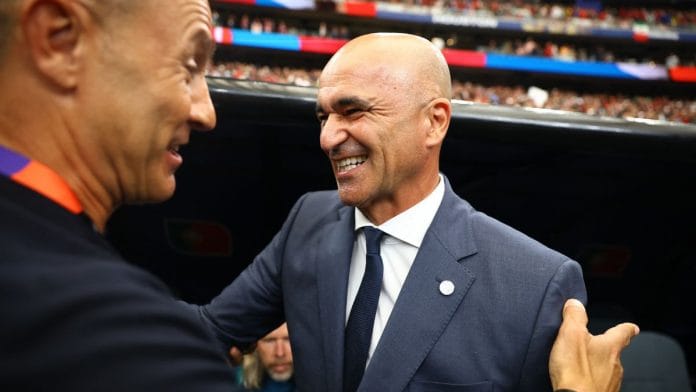


New Delhi: As Portugal routed Uzbekistan 5-0 in the FIFA World Cup, with Cristiano Ronaldo scoring a brace, a tactical tweak by head coach Roberto Martinez made the difference on the pitch. João Félix was deployed on the left wing, and Pedro Neto was shifted to the right with Bernardo Silva starting on the bench.
The change saw A Seleção start the game with far more incisive movement, with Bruno Fernandes roaming across the field and moving the ball quickly to Portugal’s wingers and fullbacks. This fluid movement stretched Uzbekistan’s defence and created spaces for Portugal to exploit.
With a classic 4-2-3-1 aggressive formation, the Spanish football manager injected pace, with the side backs pushing high while building up their gameplay. This allowed midfielder Bruno Fernandes to dictate the tempo of the match, exploiting the gaps in the attacking final third.
Félix changed Portugal’s attacking style. Unlike Neto, who prefers to skim the touchline and attack with pace, Félix frequently drifted into midfield. His movements pressured the defenders, forcing Uzbekistan to collapse under pressure. This opened spaces for Nuno Mendes, who constantly made overlapping runs.
Meanwhile, Neto’s role on the right flank was equally important. The winger stretched Uzbekistan’s defence with direct runs behind the full-back. His width prevented the opposition from congesting the midfield, giving Fernandes and Vitinha enough space to carry the ball forward.
A 4-2-3-1 magic
Martinez’s tactical tweak benefited Cristiano Ronaldo the most as he was acting as a poacher in the entire match. The Portuguese captain, who became Portugal’s leading scorer at the FIFA World Cup, kept his focus on the final third, occasionally dropping down. He went on to score a brace in the match.
“I’m back, I’m back,” shouted Ronaldo into a TV camera after the game, while announcing his arrival to the 2026 FIFA World Cup.
Meanwhile, Portugal’s counter-pressing was a decisive factor in the match. Whenever they lost possession, Fernandes, Vitinha and Félix flocked the opponent, preventing Uzbekistan from getting ahead with transitional attacks. The Asian side struggled to complete passes in midfield and were forced to clear the ball each time.
In the defence, Portugal maintained a high line with Rúben Dias and António Silva. Uzbekistan’s forwards rarely received the ball.
Also read: Ronaldo becomes the second-oldest player to score in FIFA World Cup. He turns back time at 41
Cristiano Ronaldo’s brilliance
After a lacklustre performance in the opening fixture, Ronaldo bounced back with two goals. The sixth-minute volley marked Ronaldo’s first goal in 10 games across all competitions, including the previous World Cup and the UEFA Euros.
The goal is also Ronaldo’s first in open play at the World Cup since his fourth-minute goal against Morocco in the second group game at the 2018 tournament in Russia—a little over eight years ago. Ronaldo’s second goal came from a sublime finish after Fernandes split the defence with a cutting through ball.
Ronaldo’s brace was complemented by strikes from Mendes and Rafael Leão, with an own goal adding to Uzbekistan’s misery.
The World Cup has so far seen the other big-name forwards – Lionel Messi, Kylian Mbappe and Erling Haaland – all getting off the mark in their first game. Messi has scored all five of Argentina’s goals in this tournament so far, breaking Miroslav Klose’s all-time record for goals scored at the FIFA World Cup. Mbappe’s brace against Iraq takes the 27-year-old French striker to 16 goals across three tournaments—matching Klose’s 12-year-old record.
Portugal’s real tests lie ahead. They are scheduled to face Colombia in their final fixture on 27 June.
(Edited by Saptak Datta)