





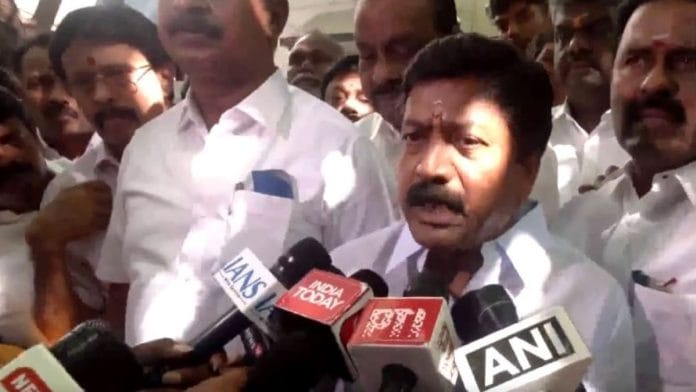


Chennai: A simmering rift within the All India Anna Dravida Munnetra Kazhagam (AIADMK) came to the fore Tuesday as a group of party MLAs announced it would back the TVK-led coalition government in Tamil Nadu.
Party MLAs led by C. V. Shanmugam formally announced support for Chief Minister Joseph Vijay’s Tamilaga Vettri Kazhagam (TVK) government, days after AIADMK recorded a poorer than expected performance in the 2026 Tamil Nadu Assembly elections.
Senior AIADMK leader C.V. Shanmugam, along with S.P. Velumani and others, said the faction has decided to back the TVK to ensure stability and allow the AIADMK to focus on organisational rebuilding after its electoral setbacks. The party won 47 assembly seats but found itself in a fragmented post-poll scenario.
“We founded this party against the DMK. For 53 years, our politics have been against the DMK. Given this history, a proposal suggesting that an AIADMK government be formed with the support of the DMK was put forward; however, the majority of our members rejected and opposed it,” Shanmugam told the media Tuesday.
He added that if the party were to form an alliance with the DMK, the AIADMK would cease to exist. They refused to accept such a scenario.
“We currently stand without any alliance, and our focus must now be on revitalising and strengthening our own party. We ultimately decided to extend our support to the TVK, which emerged victorious. We accept the people’s mandate. The mandate is for Vijay to become the Chief Minister. We congratulate Chief Minister Vijay and we extend our support to the TVK government headed by the Chief Minister,” he said.
Shanmugam said that S.P. Velumani and G. Hari have been elected as the Leader and Deputy Leader of the legislative party, respectively. Velumani told the media that the faction has no intention of splitting the AIADMK but are extending support to TVK as they are concerned about the AIADMK.
“There are allegations that we are dividing the party. It’s all false allegations. We have been in this party for a long time and we don’t intend to break it. All we want is to convene the general council meeting and discuss the reasons for the continued defeat in the election and have to take a healthy decision,” Velumani clarified.
The crisis began after the TVK began seeking post-poll allies to form the government.
The move reopened simmering internal rifts within the AIADMK, with a bloc of around 30-36 MLAs—led by senior figures such as Shanmugam and Velumani—were moved to a private resort.
They were seen as strongly pushing for extending support to the TVK government to ensure the party’s political survival and relevance after repeated electoral defeats.
Tensions burst into the open on Monday when the party’s 47 MLAs arrived in two separate factions at the Tamil Nadu Assembly for oath-taking.
A smaller group of about 11-17 MLAs arrived with party General Secretary Edappadi K. Palaniswami (EPS), while another faction of around 30-36 MLAs aligned with other leaders arrived separately.
The differences were visible when the newly elected members of the AIADMK came to the first session of the 17th Legislative Assembly of Tamil Nadu.
A group of AIADMK MLAs led by former minister Shanmugam submitted a letter to pro-tem Speaker M.V. Karuppaiah, urging him to declare another former minister, Velumani, as the AIADMK legislature party leader.
Another group of MLAs, which included former state minister N. Thalavai Sundaram, requested Karuppaiah to announce party General Secretary Palaniswami as the legislature party leader.
The development comes ahead of a crucial floor test for the Vijay government on 13 May.
The TVK emerged as the single largest party with 108 seats but needed support to cross the majority mark of 118 in the 234-member Assembly.
With backing from the Congress and smaller allies, including the CPI, CPI(M), IUML and VCK, already in place, the AIADMK rebel support is expected to bolster the government’s numbers significantly.
Party insiders described the fracture as symbolic and painful for EPS, but Velumani and Shanmugam appear to have the upper hand, with several MLAs reportedly ready to join the government or extend outside support.
The rebellion stems from repeated electoral defeats under EPS’s leadership and a desire among many MLAs to remain politically relevant by aligning with the rising TVK, which has disrupted the traditional DMK-AIADMK duopoly.
But a small group of senior leaders, including R.B. Udhayakumar, O.S. Manian, and others, continues to stand by Palaniswami.
Political analysts have indicated that the AIADMK’s position was seen to be weakening in the state assembly elections, and EPS’s leadership was being questioned.
Political analyst Sumanth Raman says that the majority of MLAs are on the other side.
“It is not that they are against EPS but they have lost confidence in him that he can make the party win. Logically, EPS should resign, but it depends on how he handles it,” he told ThePrint.
While EPS had successfully handled several internal rifts since J. Jayalalithaa’s death in 2016, the split with Sasikala, the rivalry with OPS, and the struggles over a dual leadership model, as well as the expulsion of veteran, K.A. Sengottaiyan, deepened divisions within the party.
“EPS is a strict leader, but he is not as capable. The AIADMK is weakening in the state, and it is evident,” political commentator S. Gurumurthy told ThePrint. A formal split could reshape the state’s political landscape and signal the possible end of the long-standing Dravidian bipolarity, with the TVK gaining from the AIADMK fracture.
(Edited by Sugita Katyal)
Also Read: Three new state governments, three old debts—what are TVK, BJP and UDF dealing with?