





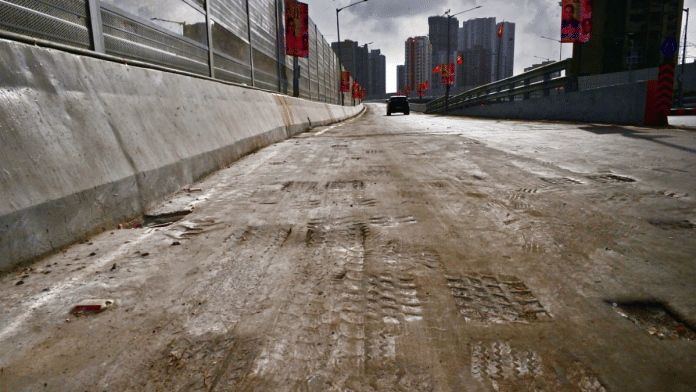


Mumbai: A flyover extension that was meant to ease Goregaon’s east-west commute has become the latest flashpoint in Mumbai’s infrastructure politics. Within hours of being opened, the Mrinaltai Gore flyover arm drew complaints of a patchy surface, loose grit and uneven road quality.
The 750-metre, four-lane extension, built at a cost of nearly Rs 248 crore, was opened on 6 June after nearly six years of delay. It connects the existing Mrinaltai Gore flyover network towards Ram Mandir Road and Relief Road in Goregaon West. The extension project received administrative approval in 2018, and the delay pushed its cost from Rs 209 crore to nearly Rs 248 crore.
The construction began in 2019, the flyover took more than seven years to open. It aims to improve east-west connectivity within the city, cutting travel time from 45 minutes to 10 minutes, for motorists moving between the Western Express Highway, Goregaon, Oshiwara and adjoining western suburbs.
It is also planned to connect the upcoming northern extension of the Coastal Road (Versova-Bhayander) project and the Goregaon-Mulund Link Road (GMLR), which will significantly reduce travel time in the city’s suburban east-west corridor.
The growing attention around the flyover extension has shifted from connectivity to construction quality. Videos and photographs shared by motorists showed rough-looking patches, visible joints and loose material on the carriageway.
Anish Gawande, national spokesperson of Sharad Pawar led Nationalist Congress Party (NCP-SP), criticised the condition of the newly opened flyover.
“Welcome to Mumbai’s newest flyover worth ₹248 crore. At 750 metres of road, that’s ₹33 lakh a metre. And it opened this week full of potholes,” he wrote in a post on X.
He also invoked veteran socialist leader Mrinal Gore’s legacy, saying, “The flyover is named after the iconic Mrinal Tai Gore, who spent her whole life fighting, so ordinary Mumbaikars got a life of dignity.”
Welcome to Mumbai’s newest flyover worth ₹248 crore. At 750 metres of road, that’s ₹33 lakh a metre.
And it opened this week full of potholes.
The flyover is named after the iconic Mrinal Tai Gore, who spent her whole life fighting so ordinary Mumbaikars got a life of… https://t.co/E30NEGcuUO
— Anish Gawande (@anishgawande) June 7, 2026
Also Read: 3 years & Rs 17,000 crore later, Mumbai’s ambitious concrete roads project is 80% complete
What BMC says
On Sunday, the Brihanmumbai Municipal Corporation (BMC) issued a clarification on the road surface appearance. That was followed by an inspection of the flyover by Mayor Ritu Tawde on Tuesday.
The BMC said its bridges department has taken note of observations and comments made by citizens, elected representatives, and various stakeholders on social media regarding the “apparent unevenness and patch-like appearance of portions” of the road surface on the Mrinaltai Gore Extension Flyover.
“In this regard, it is clarified that a 40-mm thick Mastic Asphalt wearing course has been provided on the bridge carriageway,” it said in a statement issued on Sunday.
It further added, “It is the nature of mastic asphalt that it looks patchy and rough immediately after laying, especially where it’s done manually.”
However as more and more vehicles ply on the road, the surface starts getting even and tidy, it said. “Mastic asphalt is a specialized bituminous surfacing material that is widely used on bridge decks because of its excellent waterproofing properties, long-term durability, resistance to rutting, and extended service life.”
According to Abhijit Bangar, Assistant Municipal Commissioner (Projects) at the BMC, the flyover has a 40-mm layer of mastic asphalt, a material that is highly sensitive to temperature. “In high heat, especially when temperatures cross 35-40 degrees Celsius, the surface becomes soft and can show tyre rutting after heavy vehicles pass over it.”
“You may feel it little bumpy,” he told the ThePrint. “However, as the temperature rises, and the vehicles pass over it, it becomes as smooth as before. That is the nature of mastic. That cannot be called a bad quality.”
The BMC‘s clarification statement also argued that the flyover’s geometry made the work “relatively” more complex.
“The bridge’s geometric configuration includes long horizontal curves and varying levels of superelevation at different locations, making it relatively complex. Consequently, the mastic asphalt wearing course was laid in stages and in separate sections. As a result, certain construction joints between adjoining sections are currently visible and may resemble patches at some locations.”
Bangar told ThePrint that the uneven appearance was partly because the 7.5-metre-wide road surface could not be fully laid by the 4-metre paver machine. Part of it had to be done manually. “The finishing by paver machine and manual work makes a difference. Moreover, when half of it is done by the paver and the other half manually, and then they are joined, like in this case, then we see unevenness,” he said.
The BMC‘s clarification statement has also said that mastic asphalt has self-healing properties and with regular traffic movements, the visible joints will blend and give a smoother experience.
“Mastic asphalt is a highly dense and voidless material. Under traffic loads and varying atmospheric temperatures, it exhibits self-healing and flow characteristics. Once regular and continuous vehicular traffic begins, these joints will gradually blend into the surrounding surface, resulting in a more uniform appearance and a smoother riding experience over time.”
On the loose grit seen on the surface in the first few days, Bangar said, “Freshly laid mastic can be slippery, so grit is spread to make it anti-skid”. He added, “Rutting is not a serious issue, the surface looks very even, but the surface quality is not bad.”
He also said mastic offers better riding quality than concrete and is commonly used on bridges for that reason. “With regard to riding quality, mastic is considered very good against concrete,” he said.
He added that mastic also has strong waterproofing properties, which helps protect the road layer below. “It has a very good waterproofing ability… Because of that, the road below is protected well.”
However, the explanation has not convinced either commuters or opposition leaders.
Following the growing criticism, Mayor Ritu Tawde, who inaugurated the extension, inspected the site on Tuesday and found the work satisfactory. “I inspected the site and I found the work to be satisfactory. It needs some finishing work and I have conveyed them the same,” she told reporters on Tuesday.
However, she directed officials to level minor undulations, align the road edges, complete finishing work, and develop greenery along both sides of the flyover through vertical gardens or other suitable methods.
‘Not as bad as it looks’
Pankaj Joshi, Principal Director of Urban Centre Mumbai, a non-profit organisation focused on urban planning, said the uneven surface on the newly opened flyover arm may not necessarily indicate a structural problem, but could be linked to the top surfacing layer.
According to him, the real failure of mastic asphalt would look different. “See, the failure of mastic is when it comes out in cakes,” he told ThePrint.
He added that the current condition could be linked to high temperatures or excess bitumen in the mix. Bitumen acts as a binding agent for the other dry ingredients that make up the mastic asphalt.
“I think there are two things which require attention. One is the temperature in which the work was done. It’s extreme heat right now in Mumbai. Normally, it is not a good time to do this kind of work. Second is, whether bitumen is put more. Sometimes, the contractors tend to be more careful and add more content of bitumen in the mastic, which makes it more vulnerable to heat,” Joshi said.
Although bitumen’s composition is semi-solid, in extreme temperatures, it melts into a fluid and as it cools down, bitumen hardens into a solid mass.
The bumps, he added, can still be corrected. “It can be flattened easily. Because it’s bitumen. It is like clay and it can be rolled back in place,” he said. “But normally with heavy vehicles moving on it, it will all level up. Mastic is done on all bridges everywhere. So, it’s not like something which is fundamentally problematic,” he added.
Explaining the surfacing used on flyovers, he said, “Mastic asphalt is a substantially richer bitumen compound, which is laid, and which is elastic in nature. So, it generally takes care of vibrations and cracks. But essentially because of the higher bitumen content, mastic asphalt becomes glossy and slippery.”
For this reason, he said small stone pieces are embedded on top to create friction. “So, the standard process is you need to embed pieces of stone, which is called metal, metal number one, metal number two, which is embedded on top, so that the texture, which is rough, can be made smooth, so that tyres don’t slip on it,” he said.
“In my understanding, that’s why they kept the pieces slightly up, so that as the vehicle movement happens, it will be embedded.”
“But the real test is post-monsoon in 15-20 days. If it comes out as cakey, then it’s a failure,” he said. “It’s not something which they can hide in any way. That’s not possible. But I think it’s not mature enough to say anything now. It is too early to say if it has failed,” he added.
Opposition criticism
Shiv Sena (UBT) leader Aaditya Thackeray took a dig at the state of the newly opened bridge. “Look at the quality of the political posters. And then look at the quality of the road surface they had delivered. They’re only looting our beloved city,” he posted on X.
Look at the quality of the political posters.
And then look at the quality of the road surface they had delivered.
They’re only looting our beloved city! https://t.co/26ULVRzH9A
— Aaditya Thackeray (@AUThackeray) June 6, 2026
Varsha Gaikwad, Mumbai Congress President and Member of Parliament from the Mumbai North Central Constituency, also criticised the “shoddy work” and the uneven surfacing of the flyover.
“Why is there patchwork already on a newly laid road? This whole stretch looks so badly done, it might develop craters with just one rainfall. Appalling quality of work. What excuse does @mybmc have this time?” she wrote.
In another tweet she wrote, “The official handle of @mybmc has posted an aerial shot of the Mrinal Tai Gore flyover extension rather than an on-ground close up shot. But even from this height, the shoddy work, the uneven surface is quite visible. Shame!”
The official handle of @mybmc has posted an aerial shot of the Mrinal Tai Gore flyover extension rather than an on-ground close up shot. But even from this height, the shoddy work, the uneven surface is quite visible. Shame! https://t.co/8Aa4pTX8Pw
— Prof. Varsha Eknath Gaikwad (@VarshaEGaikwad) June 6, 2026
NCP (SP) national spokesperson Anish Gawande criticised the BMC’s clarification letter that was released on Sunday calling it a “half-baked letter full of misinformation.”
“Which officer is responsible for lying to the people of Mumbai?” He posted on X. “@TawdeRitu ji, I will be writing to your office tomorrow. If you do not fix accountability for this, don’t expect Mumbaikars to stay silent.”
Who has written this half-baked letter full of misinformation? Which officer is responsible for lying to the people of Mumbai?@TawdeRitu ji, I will be writing to your office tomorrow. If you do not fix accountability for this, don’t expect Mumbaikars to stay silent. https://t.co/At6UZ7ddKH
— Anish Gawande (@anishgawande) June 7, 2026
On Monday, he wrote a letter to Mayor Ritu Tawde and BMC Commissioner Ashwini Bhide, asking the corporation to release the engineering quality test data and withdraw the unsigned clarification letter by the BMC and reissue a statement with the name of the responsible officer.
The criticism later moved beyond social media.
On Tuesday, Shiv Sena (UBT) corporators, led by former mayor and BMC Leader of Opposition Kishori Pednekar, staged a protest at the flyover and inspected the alleged shoddy work.
Pednekar criticised the ruling party for allegedly rushing to inaugurate the bridge. “The authorities are more interested in putting up the nameplate than ensuring that the work has been completed properly,” she told ThePrint.
Pednekar questioned the escalation in the project cost, asking why the work, which had already been delayed for several years, had gone up to nearly Rs 248 crore. “The administration is responsible for this and needs to explain the reason for these failures.” She added, “The quality of the work should have been checked before the bridge was inaugurated to motorists, in a rush to showcase achievements.”
(Edited by Ajeet Tiwari)
Also Read: BMC’s road concretisation project has turned Mumbai into a maze of rubble. Why it’s going south