







Mumbai: As Mumbai braces for the monsoon, typically accompanied by pothole-ridden roads and chaotic traffic, the Brihanmumbai Municipal Corporation (BMC) says it has completed 80.5 percent of its flagship road concretisation project. But, BMC data reveals progress has been uneven, with parts of south and central Mumbai trailing, and concretisation in large sections of the western suburbs either complete or near completion.
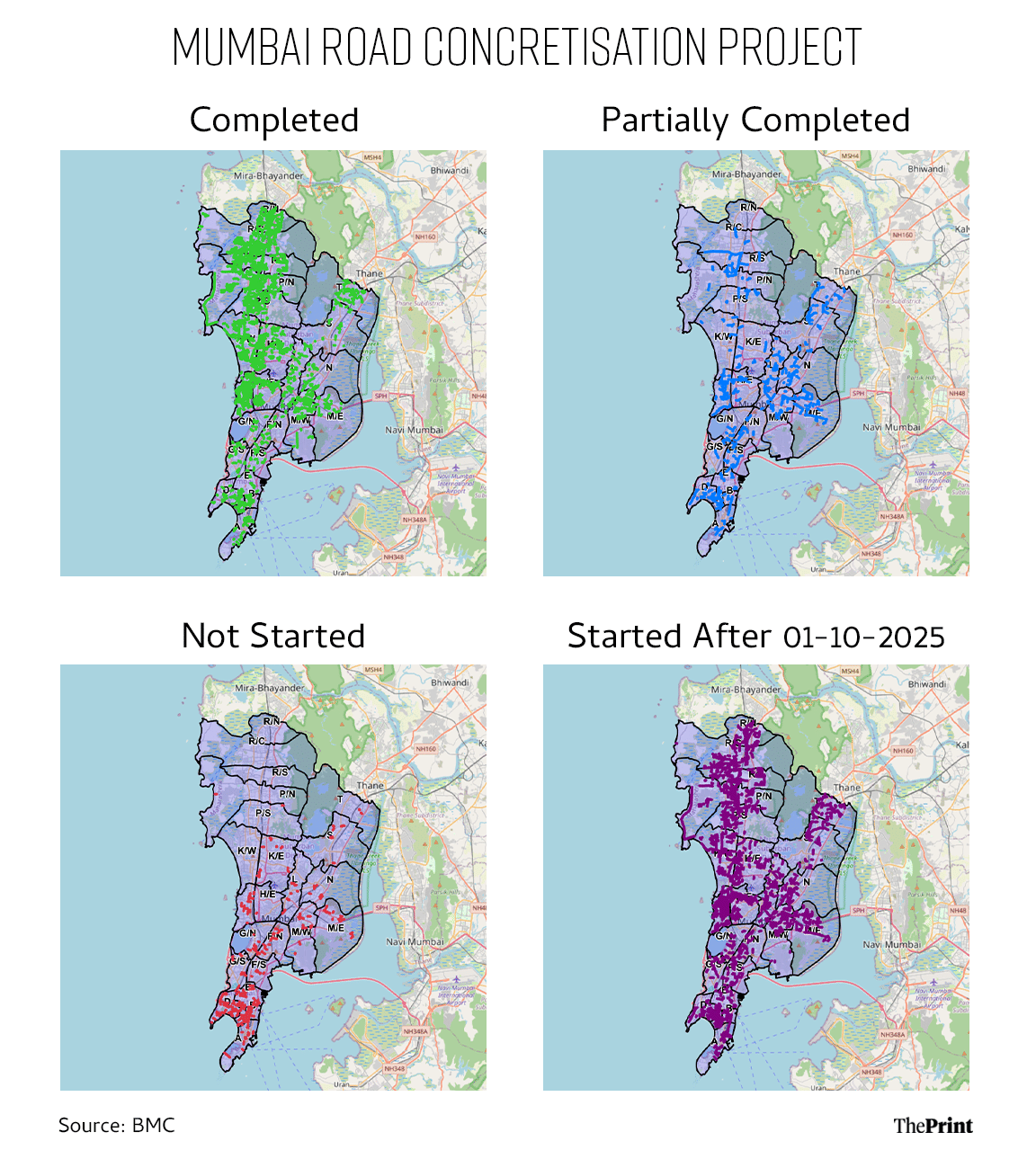
Of the 2,175 roads spanning 714.10 km under the citywide project, 1,575 have been concretised, 325 have been partially concretised, while work on 275 has not yet begun.
Overall, the project is 80.5 percent complete, with nine percent in progress and 10.5 percent yet to begin.
The project was implemented in two phases: Phase I began in 2023 and Phase II in 2024. The first phase covered over 300 km of roads, while the second covers about 400 km.
Officials attribute delays in overall completion to heavy and prolonged monsoons over the last two years and the challenge of dealing with a web of underground utility lines. The BMC has to completely stop work during the rains, officials said.
Under nearly every road lies a crowded maze of water lines, stormwater drains, sewer networks, electricity and telecom cables and gas pipelines, managed by multiple agencies.
“Navigating, shifting and protecting the underground infrastructure is a major factor in the delayed progress,” Abhijit Bangar, Additional Municipal Commissioner (projects) at the BMC, told ThePrint. On 6 April, BMC Municipal Commissioner Ashwini Bhide directed civic officials to complete all ongoing roadworks by 31 May, ahead of the monsoon.
She also set revised timelines for the broader project, saying Phase I was to be completed by December 2026, while Phase II has been scheduled for completion by May 2027.
The road concretisation plan dates back to 2022 when then chief minister Eknath Shinde, after assuming office, announced a vision to make Mumbai “pothole-free”. BMC issued tenders for Phase I in February 2023, though work on the ground began in October 2023.
The government initially earmarked Rs 12,000 crore for the project, including this year’s budgetary allocation of Rs 5,520 crore but the total cost has now crossed Rs 17,000 crore.
Also Read: The story of Mumbai’s Garib Nagar slum—railways land, Sunil Dutt & Slumdog cameo
Progress report
Data on the BMC dashboard indicated that progress has been slowest in Zone 1, covering much of the island city, from Colaba, Fort, Nariman Point and Churchgate to Dongri, Mohammed Ali Road, Bhuleshwar, Malabar Hill, Byculla, Mumbai Central and Nagpada.
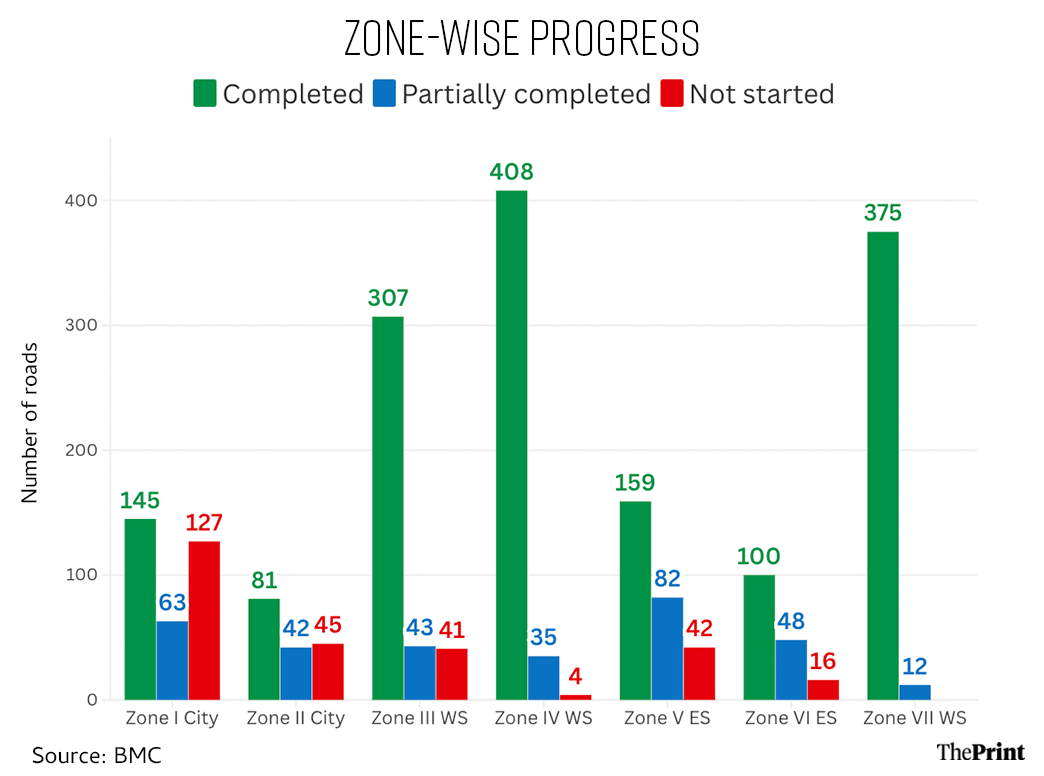
Of the 335 roads earmarked for concretisation in Zone 1, spanning 83.41 km, only 145 have been concretised. Work on another 63 remains partially complete, while work on 127 roads is yet to begin, accounting for over 45 percent of total pending project work.
Within Zone 1, Ward B—covering Sandhurst Road, Dongri and Mohammed Ali Road—has the highest number of roads with work yet to begin, at 39. Ward D—encompassing the upscale areas of Walkeshwar, Malabar Hill, Nepean Sea Road and Bhulabhai Desai Road/Peddar Road—follows closely with work on 34 roads yet to begin.
With just 16 roads concretised here, Ward E, spanning Byculla, Mazgaon, Agripada, Mumbai Central and Nagpada, is the laggard, while work on 29 of the total 54 roads is yet to begin.
On the flip side, the story is markedly better in Mumbai’s western suburbs.
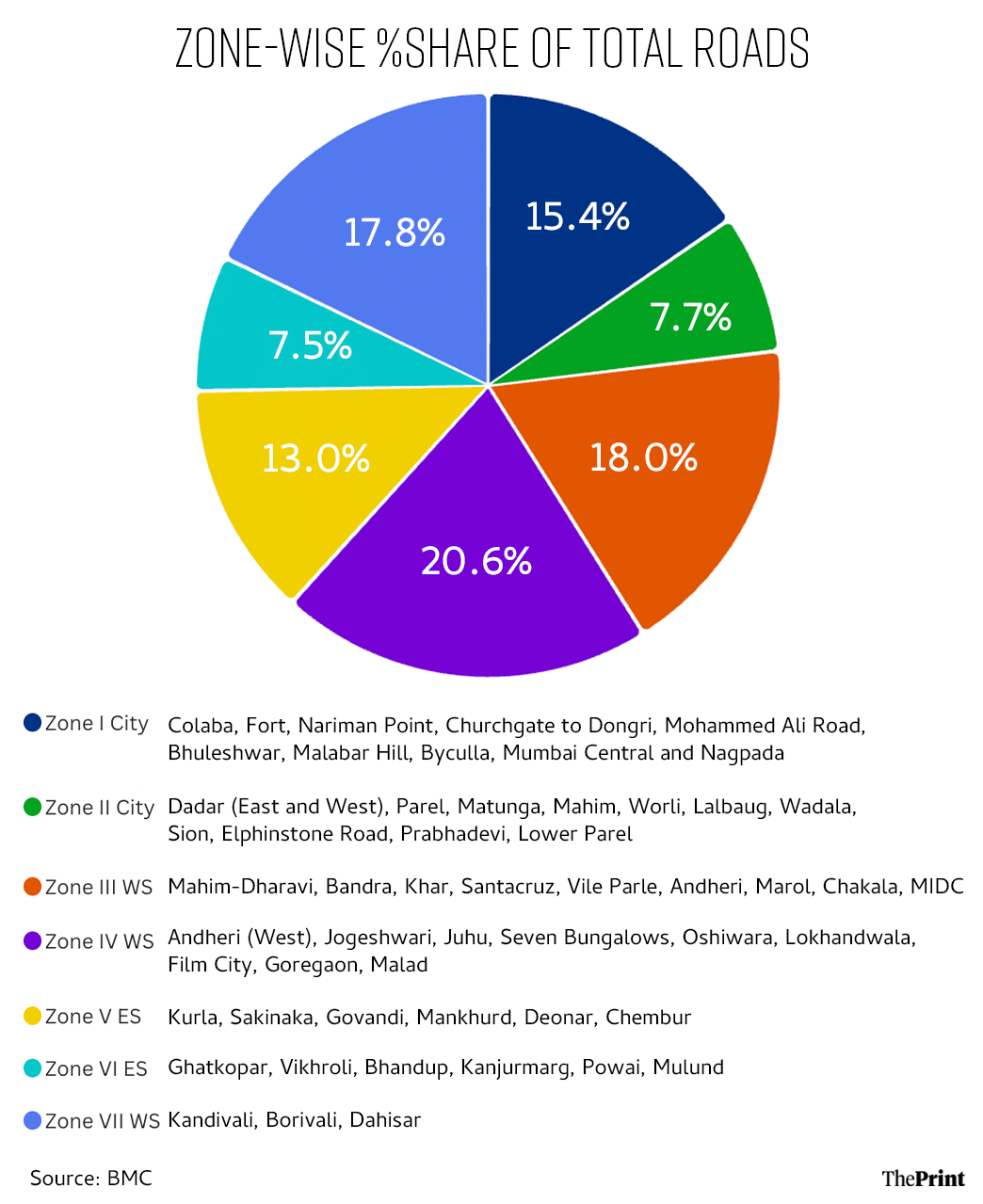
Zone 4—covering western suburbs including Andheri West, Juhu, Oshiwara, Goregaon and Malad—is Mumbai’s largest project cluster, with a total of 447 roads spanning 177.93 km. It is also among the best-performing zones, with 408 roads spanning 150.90 km concretised.
At the ward-level, the standout performer is the Borivali-Dahisar belt.
BMC dashboard figures show that Ward R/Central (Borivali) is leading in Mumbai with 179 of its total 182 roads concretised, spanning a total length of 50.77 km, while work on the remaining three is underway.
Ward R/North (Dahisar) is the only ward in the city to have completed project work, with all of its 89 roads spanning 29.64 km already concretised.
Bangar said the reason for the delayed work in South Mumbai was that while work on Phase I of the project started in 2023, a year before Phase II in all other areas, both phases in South Mumbai started simultaneously in October 2024.
“Other zones had a one-year headstart while work in Zone 1 and Zone 2 began late and, therefore, seems comparatively slower,” he said.
He added that the work order for Phase I was issued in February 2023 while work began in October 2023. For Phase II, the work order was issued in August 2024, and work began in October 2024. “So, there is a clear one-season gap between the two,” he said.
Mantayya Swami, Chief Engineer (roads) with the BMC, said restrictions on heavy vehicular movement in South Mumbai are much higher compared to the suburbs.
“There are traffic restrictions on heavy trucks carrying debris and other material and on JCBs and concrete rollers. That adds to the delay. These vehicles can move more easily in the suburbs. That is also why they are near completion,” he told ThePrint.
Utility maze
The road concretisation project entails replacing traditional asphalt roads with high-strength M40 grade concrete roads offering a longer pothole-free lifespan.
Bangar told ThePrint that concretisation gives roads a minimum pothole-free lifespan of 10 years, which can go up to 25-30 years if constructed well. He reiterated that the maze of utility lines is the reason for a shift from asphalt roads to concrete roads.
“Utility shifting is one of the reasons for moving from asphalt to concrete roads. Asphalt gets damaged when it interacts with water. Roads are excavated to fix certain damaged utility lines. The integrity of the road gets affected whenever excavation happens,” he said.
Adding, “The nature of concrete roads is such that water does not enter the concrete. The real problem arises when an asphalt road is dug up, and water reaches the inner layer of the trench; that is when the road starts deteriorating. There is no such problem with concrete roads.”
The biggest challenge, he emphasised, was shifting utility lines. According to him, the average road in Mumbai has more than 15 utilities underneath, with the number even going beyond 30 in some areas. “There could be 10 pipelines underground. Even if they are all water pipelines, they cannot all be shifted at the same time. We have to examine which line starts where and ends where, point A to point B, and that route can differ for each of the 10 pipelines. Accordingly, replacement planning has to be done,” said Bangar.
Swami echoed these concerns. “A massive amount of time and energy goes into utility shifting. Utility shifting is a main reason projects get delayed. Any excavated road takes time to be completed. When road work begins, agencies come in to repair their utility lines in order to avoid digging the road after completion. That takes up extra time,” he said.
(Edited by Sugita Katyal)
Also Read: Mumbai’s iconic BEST bus crippled by chronic ailments. Age, mounting bills & a shoestring budget