


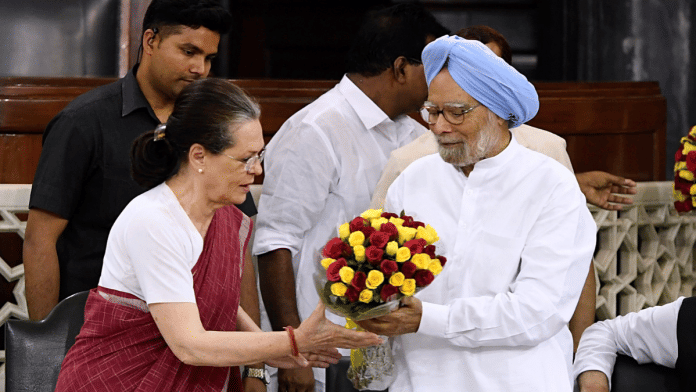
New Delhi: With the Congress-led government set to take office with the support of Communist parties in 2004, the then Congress president Sonia Gandhi believed Manmohan Singh was the right choice for prime minister because his economy credentials would reassure people of the Left-backed government’s commitment to reforms.
In her memoir, Sonia Gandhi also explains why she turned down the post herself and how she and Singh divided responsibilities, with him heading the government and her leading the party.
“There were several people qualified for the post, who would have been more than willing to accept it—but amongst all of them was one who had long been in my sights as a person above reproach, and possessed of a deep and consummate understanding of India’s economy. It was Dr Manmohan Singh,” she writes in ‘Belonging, A journey of Love’.
Gandhi directly links her choice to the political circumstances in which the government was coming to power.
“Over a period of time, the Congress had been painted as being left of centre, and our government would now be supported by the Communist parties as well. I thought Dr Manmohan Singh would assuage the doubts of many about our ability to manage and continue the policies that had been begun years ago,” she writes.
Singh had introduced economic reforms in India in the early 1990s under P. V. Narasimha Rao. He was also not aligned with any faction in the Congress. Gandhi says she discussed his name with senior colleagues, and none of them opposed it. Singh was approached privately and initially declined before agreeing to take up the post.
Gandhi also recounts the pressure she faced to become prime minister herself. She writes that she had already told her children, Rahul and Priyanka, that she would not take the job. She also writes about how her children were against her becoming PM as they had seen the assassination of their grandmother and father.
The memoir also addresses the question of who exercised authority in the government after Singh became prime minister. Sonia Gandhi described it as an “unspoken division of responsibility”.
“In reality, there was an unspoken division of responsibility between the prime minister and me, one that worked smoothly: The government under Dr Manmohan Singh, and the party under me,” she writes.
A core group met weekly with the prime minister to ensure coordination between the government and the party. Sonia Gandhi says both she and Singh knew their opponents would try to drive a wedge between them, and that they made it a point to discuss disagreements directly.
“Both Dr Singh and I knew perfectly well that our opponents would lose no opportunity to try to create trouble between the two of us, so we made it a point to speak frankly to each other and sort out any differences or work problems,” she says in the book.
“It was my duty to defer to him,” Sonia Gandhi writes.
(Edited by Viny Mishra)
Also read: Sonia Gandhi spent 30 yrs proving that she belongs. What proof is enough?