



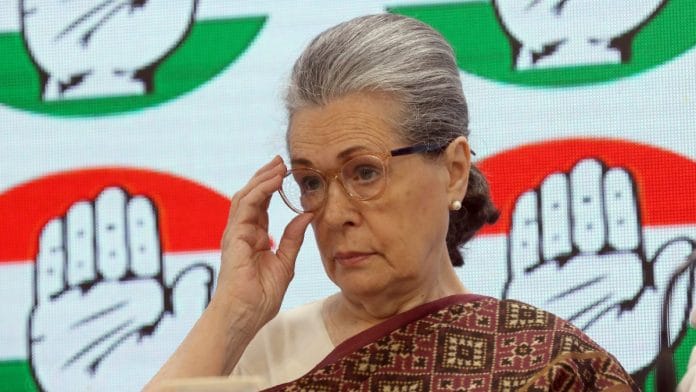
There is very little that Sonia Gandhi hasn’t been accused of in 30 years of her public life. The longest-serving president of the Congress party, Gandhi has simultaneously been labelled a foreign puppet and a puppeteer, a renunciate who didn’t earn her place in India’s political arena and a scheming, power-hungry dominatrix holding the reins of at least two proxy prime ministers — often, in the same news cycle. The woman of very few words is now all set to release Belonging: A Journey of Love, a 544-page memoir, tomorrow, and even at 79, Gandhi is still being made to walk the tightrope of public opinion.
On her newly minted Instagram account — essential for selling books these days — Gandhi sat for a chat with her daughter Priyanka and granddaughter Miraya to talk about Diwali at Delhi’s 1, Safdarjung Road. The eldest Gandhi speaks fondly about the festival, the decorations around the house, the Ganesha idol and the phuljhadis. But she has little patience for the noisier firecrackers. “People would go berserk,” she says with some astonishment, having momentarily forgotten that bursting crackers in India now doubles up as a certificate of belonging. Immediately, Priyanka steers the conversation back to safe nostalgia, by recalling how her father would take them shopping for crackers in Old Delhi.
Priyanka’s instincts are well trained: After all, the Right has never needed a reason to remind her mother of her foreign origins. For three decades, it has dipped into a familiar glossary — “bar dancer”, “videshi bahu”, “Italian chashma” — to stay in business. The memoir’s own history demonstrates how far the caution goes. For at least two months this year, the book’s former publishers Penguin Random House India were apparently contending with Gandhi over what she was allowed to say about Prime Minister Narendra Modi’s 12 years in office, the RSS, and references to communal riots and the state of India’s minorities.
The deal eventually fell through and the book is now being published by HarperCollins in India. Gandhi has said that it’s an attempt at censorship that doesn’t surprise her, though the publishers have downplayed it as editorial differences. Asked about it in a recent interview with The Hindu — where few of her answers ran past a sentence or two — Gandhi responded with a clipped: “I would rather not involve myself in these controversies.”
A life under public scrutiny
Political memoirs in India have to live up to modest expectations, written, as they usually are, at the end of public careers by men with legacies to buff. Everything else is often a matter of record. Gandhi’s life has been especially scrutinised, in the media, in Parliament, and also in other people’s biographies. Journalist and columnist Tavleen Singh’s catty Durbar, released in 2012, went a long way in shaping opinion around Gandhi. Singh was an insider and close to the Gandhis for a long time, until she wrote the infamous India Today profile that led to their fallout.
“Unwarned, Sonia Gandhi was suddenly pitch-forked into the position she would have least wanted — India’s First Lady,” the profile asserted. “It is, as the last two years have painfully revealed, a role she is not comfortable in. Compared to the relaxed style of her debonair husband, she appears awkward and wooden. Though impeccably attired and carefully groomed, her face, framed by luxuriant chestnut hair, is an immobile mask. Perhaps deliberately, her public personality has given her the image of a mere ceremonial appendage to the Prime Minister.”
The same piece went on to accuse her of “being the power behind the throne” and of plotting the downfall of her husband’s opponents.
The only thing left for Gandhi to do is to take some control of her story and present her point of view, even if it has taken her the better part of three decades. She has good reason to be so cautious: Gandhi seems to have decided early on that the less of herself she offered to the public eye, the less there would be to use against her.
Writing in The Atlantic in 2017, author Raghu Karnad described the T&C Gandhi accepted when she took over the Congress in 1998: “[To] succeed as Congress president required an even deeper act of ethnic passing. She now only wore saris, in subdued tones. She addressed rallies in Hindi, though with an imperfect accent. There would be no more unguarded interviews, memoirs, or photos from the beach. For Mrs. Gandhi to emerge, Sonia had to be sealed away.”
Private admiration aside, every step towards assimilation has only underscored for the Right wing, how foreign she actually is.
Also read: Narendra Modi isn’t Donald Trump. India’s electoral math makes it harder to humble BJP
‘A war with myself’
For years, we have asked Gandhi to prove that she belongs. But what proof would be enough for us? Do six decades of living here — longer than most of her critics have been alive — count? What about cremating a husband and a mother–in–law in this country? Or that she has raised two children who now sit in the Lok Sabha? Would the word of the Supreme Court do? In 2001, the top court dismissed a challenge to the validity of her citizenship, ruling that the Constitution makes no distinction between a citizen by birth and one by registration. Evidently not, considering how Subramanian Swamy has turned it into a personal quest.
It was fair to question Gandhi’s experience at running a party or a country when it first arose, but even inexperience has an expiry date: By 2004, she had led the party for six years into a victory at the general elections. However, a birth certificate can be trotted out every so often, good as new. That same year, BJP politician Sushma Swaraj announced that she would shave her head, wear white, sleep on the floor and survive on roasted chana, if a foreign-born woman became India’s prime minister. It was the full regalia of Hindu widowhood, bereavement for a country that would presumably die. And it was used to taunt a woman who had already been widowed so publicly 13 years earlier.
Of course, Gandhi declined the post, cementing it as one of the most public acts of self-denial in modern Indian politics. For her critics though, this was just another performance.
Belonging suggests that the reluctance was real. In an excerpt from the memoir published in The Hindu, Gandhi describes being “caught in a war with myself: part of me recoiled at the world of politics, of the ambition and greed, hypocrisy and treachery that goes inescapably with the game of power everywhere. But I couldn’t repudiate the inner compulsions that had been drilled into me from my childhood — diligence in assigned tasks, respect towards elders, obedience to parents, fidelity to family norms. They kept gnawing at me.”
What eventually moved her was the party’s alarm at the rise of communal forces and the part her husband’s family had played in building a secular nation. That, and a deeper reading of the Bhagavad Gita with “Shastriji”. When answering the call, Gandhi took the most Indian route possible — via family, duty, and scripture.
Those credentials haven’t worked so far for Gandhi. What could a memoir possibly say that we would finally be willing to hear?
Karanjeet Kaur is a journalist and a partner at TWO Design. She tweets @Kaju_Katri. Views are personal.
(Edited by Aamaan Alam Khan)