



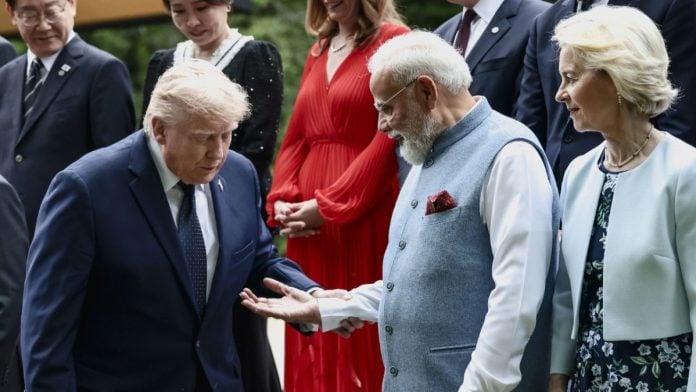
Liberals all over the world have cheered the stunning reverses suffered by the Republican Party in the US mid-term elections. And it’s not just liberals who are celebrating. It’s all sensible people everywhere who have been stunned and horrified by the chaos that the Donald Trump Presidency has caused around the world. Possibly the only place where these results have evoked disappointment is Islamabad, where many commercial arrangements with the Trump family may now be re-examined.
It’s easy to understand why a wave of relief has swept the world. Many of us grew up admiring America and its political system. For instance, when I studied US politics at university, I was taught that the American system of checks and balances was so strong that no rogue individual could change very much. Consensus or something like it was the ultimate aim of all decision-making.
The second Trump Presidency (much more than his first stint in the White House) has demonstrated that this is nonsense. A strong man with no commitment to the ideals that his nation was founded on can easily override all checks and balances, can turn the legislature into his poodle, can rely on the Supreme Court, terrorise the media, target minorities, enrich his fat cat pals and make a mockery of the principle of collective decision-making.
In India, unlike America, we have had no illusions about the strength of our system. We know that a strong leader can easily subvert the institutions of our democracy. Indira Gandhi did it. And Prime Minister Narendra Modi can do pretty much as he wants without worrying about consensus or democratic precedent.
At least some of the euphoria among educated Indians over Trump’s reverses comes from a hopeful drawing of parallels. If the most powerful man in the world can be humbled so dramatically, then what about our own leadership? Will it happen here too?
Donald Trump’s electoral troubles
The short answer is yes, it may happen, but don’t read too much into the parallels between America and India. There are important differences.
And yet, it is tempting to focus on the similarities. If you listened to the speeches of victorious Democratic candidates once the results were announced, it was hard not to be reminded of India. When Abdul el Sayed, the 42-year-old newly elected Senator from Michigan, said that his opponents had demonised Islam and hoped to defeat him by provoking anti-Muslim sentiment, it sounded familiar to us.
When James Talarico, the 37-year-old Senator-elect, spoke of replacing the politics of divisiveness with the politics of love, he sounded a lot like Rahul Gandhi. The 39-year-old Senator Jon Ossoff complained about corruption and the rise of oligarchs who got richer while the rest of us got poorer in a speech that would have seemed relevant at an Indian parliamentary election.
The complaints not only seemed familiar, but there was the same sense that we have in India: it’s time for a generational change; for the old men who have ruled us for so long to make way for the future.
For all this, some things are worth remembering. First of all, the Republicans did not lose because Trump followed socially divisive policies and preached hatred of minorities. If Americans disapproved of that sort of thing, they would never have elected him to begin with.
The polling evidence suggests that inflation was a powerful factor in these defeats. So was the unnecessary and interminable war with Iran, which America will never win. The price of gasoline has shot up in the US mostly as a result of that war. Other inflationary pressures came from the foolish tariffs Trump levied on most of the world.
Those are the factors that made the difference. And while the minorities and young people voted against Trump’s policies, his core constituency of lightly educated white people did not vote Democrat to the same extent.
Also read: US midterms have created conditions to tame Superman Trump
PM Modi’s electoral cushion
The parallels with Modi are limited. Inflation is not yet a dominant issue in India. There is some disquiet here over the rise of the oligarchs, but it has not reached the stage where it can influence elections. We are not involved in needless wars we cannot win. And the spectacular failure of Modi’s big foreign policy bet — that he and his buddy Trump would work together to counteract China’s influence — does not seem to have registered with voters who have not minded that Trump has stripped Modi of his huggy-buddy status and has no use for India in his China strategy.
And there are the personality differences. Trump is a slightly deranged figure lost in his own chaotic megalomania and baffling narcissism. Modi is shrewd, calculating and thinks of long-term strategy. He sometimes appears to have lost his touch as protests against his rule have grown, but even on his worst day he is smarter than Trump on his best day.
For instance, Trump took too long to realise how his party would be humbled at the midterms. In India, Modi began thinking months ago about next year’s UP elections: one reason why he is fighting so hard to keep Chief Election Commissioner (CEC) Gyanesh Kumar in place.
There are two other distinguishing factors. The first is that despite Trump’s threats and reign of terror, there are enough mainstream news outlets in the US that still report the truth. In India, nearly all of the mainstream media is so scared of the government that it only reports Modi’s successes. The Hindi TV channels venerate him so much that you wonder if each day in the studio begins with some holy invocation to the great man. It matters because a poorly informed electorate makes poor electoral choices.
And then there are the numbers. When Trump beat Kamala Harris, he had 49.8 per cent of the vote. Today, even when Trump is one of America’s most unpopular presidents, he can still count on a hardcore of around 34-35 per cent of voters. In American terms, to drop to 34 per cent from nearly 50 per cent is a huge decline and explains the midterm results.
But in a multi-party system like India, the figures required for victory are totally different. For all the talk of Modi’s popularity, the BJP rarely wins more than 37-38 per cent of the vote. It gets enough seats for a majority or a near majority because its votes are concentrated in a few areas (mostly Hindi belt states).
So even if the BJP drops to 35 per cent, which is considered a losing percentage in American Presidential elections, it will probably still form the government along with some allies.
So, our system is very different from America’s. The percentage numbers required to form governments are much lower. Let’s assume that the BJP’s 37 per cent vote share depends on the Prime Minister’s popularity, which (according to opinion polls) is higher than his party’s. Even if Modi is less popular today than he was at the last General Election (which seems like a reasonable assumption), he will have to be really unpopular for the BJP’s vote share to drop to, say, 30 per cent, at which level it may be unable to form a government.
So things are easier for the BJP (with or without Gyanesh Kumar) than they are for Trump. It’s that numerical factor alone that suggests that Modi could beat anti-incumbency.
Unless, of course, things get worse over the next two years. Which they might.
Vir Sanghvi is a print and television journalist and talk show host. He tweets @virsanghvi. Views are personal.
(Edited by Saptak Datta)