



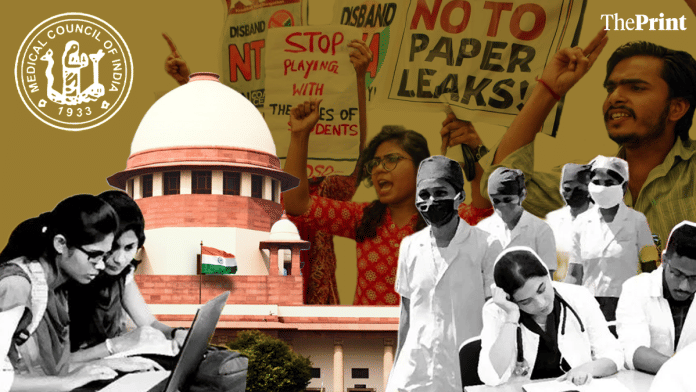
The Monsoon Session of the Parliament opened in chaos. Frequent disruptions, head-butting and repeated adjournments brought the house to a standstill. In the thick of things was NEET – the National Eligibility-cum-Entrance Test. The house had gathered after a series of the Supreme Court’s landmark judgements that had overnight torn apart the old order and completely overhauled India’s medical education landscape. It was 19 July 2016.
Nearly a decade later, the examination remains just as contentious. Every year, over two million aspirants stake years of preparation and often their families’ savings on a single examination. For the last few months, allegations of paper leaks, shattered student trust and accusations of government apathy have hijacked television debates and social media feeds alike.
Yet rewinding the clock a decade and a half back, the story looked quite different. India did not have a single, uniform medical entrance test; states set their own rules, their own syllabus, and their own priorities.
Then came a proposal that would ignite one of the fiercest battles over education in independent India – a single, nationwide entrance examination for medical colleges. To its proponents, it promised merit, transparency and purging the labyrinth of examinations. To its critics, it touched the jugular vein of Indian polity – federal character and state autonomy.
So, how did a proposal meant to reform medical admissions become one of India’s most polarising education reforms? What transpired in between that made a single, central exam feel inevitable?
A country of many exams
Long before NEET, there wasn’t even an entrance examination. There was just a murky mix of British legacy, fragmentation, and an unregularised system.
While the Portuguese brought Western medicine to Indian shores in the 1500s, Justice K. Kannan in Medicine and Law wrote that organised medical education took shape under the British. It was in 1664 that the British East India Company established a permanent medical facility to care for its troops. Formal training emerged in 1827 with the Calcutta Medical College, followed by campuses in Madras and Bombay, each affiliated with its provincial university. By 1896, the Indian Medical Services (IMS) took shape.
Though primarily a military service, its officers performed key civilian duties, battling epidemics and managing sanitation. Yet there was a striking contradiction. The services, originally enlisted from England, opened recruitment to Indians through competitive examinations. Yet, by 1905, barely 5% of the IMS were Indian.
Calling it “Indian” was the quintessential colonial jibe.
Addressing the Indian Medical Association, Dr TSS Rajan, as quoted in an Indian Express article dated 27 October 1941, said, “So it could not be Indian in its personnel. Nor was it a recruitment for civil medical service. The nomenclature is a misfit. Properly speaking, it ought to be termed ‘Military Medical Service for India.’
After Independence, medical education became part of a much larger nation-building project. Inaugurating the Silver Jubilee of the Indian Medical Association’s UP branch on 24 October 1959, Jawaharlal Nehru argued that “the scientific approach must govern all our constructive activity,” insisting that “every system had to pass the test of scientific approach.”
For Nehru, the ultimate goal was “free medical aid for all.” But achieving it meant breaking free from a lingering colonial hangover.
“Our standards in Government and elsewhere tend to imitate prosperous countries in Europe and America. This is a legacy of British rule.” Instead of a few grand hospitals, Nehru argued, “we should have small hospitals in villages with 10 or 20 beds,” to meet people’s primary healthcare needs.
Recalling the system he grew up with, Dinesh Singh, Former Vice Chancellor of Delhi University, told ThePrint, early admissions were entirely arbitrary and very few colleges existed.
“They really relied on school exam results. There was a fair amount of discretion,” said Singh. Up until the 1960s, admission hinged on school performance plus a one-year pre-university course. “I was in the sixth or seventh grade in Baroda when my brother finished 11 years of schooling and sat for the one-year pre-university course,” said Singh.
Only in the 1970s did states introduce entrance examinations, driven by demands for a more regularised and transparent system.
Dr Vikash R Keshri, Associate Professor at OP Jindal Global University, in a conversation with ThePrint, said that before the 1970s, private medical colleges were virtually non-existent.
“Over 90% of institutions were state-funded. While the Medical Council of India (MCI) prescribed standards and recognised degrees, admissions remained firmly in the hands of the States. Each conducted its own entrance examination, largely for students domiciled within the State,” said Keshri.
But the State-level system had its own cracks. Singh recalled that by the time he finished school in 1972, “I had already begun to hear whispers of results being fixed.” Allegations of manipulation and irregularities began surfacing.
By 1988-89, the first move towards nationalisation subtly challenged the state monopoly. According to Keshri, the introduction of the All-India Pre-Medical Test (AIPMT), conducted by the CBSE, opened up a 15 per cent national quota in state colleges. The move, however, did not replace state examinations; it merely opened the doors to inter-state mobility.
For the first time, merit allowed students to cross borders. Students from states with few medical colleges could finally dream big. Yet, this 15 per cent window was just a small escape. 90% of the system remained a state-centric, fragmented Wild West.
While AIPMT solved one problem, it exposed many others. Dozens of state entrance tests, board merit lists, and independent university exams ran simultaneously – the system lacked uniformity.
In the 1990s and 2000s, becoming a doctor meant a cross-country exam marathon.
“Every Sunday there was an exam,” said Keshri. “Sometimes there were two exams on the same day – one in Bangalore, another in Delhi. Students had to choose.”
AIIMS, Delhi University, Aligarh Muslim University and numerous private colleges all held separate examinations, said Dinesh Singh. “It was a bit of a free-for-all, and that was harming the interests of the students. It was a highly fragmented system.”
Yet, the picture was far from complete. The ultimate plot twist, however, came with mushrooming private medical colleges. Beginning in Karnataka and Maharashtra before spreading across the South, private institutions began taking over.
“Because they were handling their own entrance exams by themselves, they were doing lots of manipulations, I’ll be very honest,” said Keshri.
The recent explosive paper-leak scandals aren’t new. Rather, it is a ghost from the past – one that has haunted the Indian education system for decades. Long before the age of the internet and viral social media outrage, India’s medical tests were routinely compromised behind closed doors. The rot ran deep and wide for decades.
“Paper leaks were very common during AIPMT also. It happened almost every year,” said Keshri. Singh had witnessed it from within the system. Soon after taking charge as Vice-Chancellor in 2010, he ordered an inquiry into allegations that Delhi University’s medical entrance examination had been leaked. “We found incontrovertible evidence,” he recalled. The investigation eventually identified more than 150 students suspected of cheating. “I learned that this had been happening for the last 15-20 years; can you believe that?” he said.
The road to NEET
NEET’s journey began with a regulation issued by MCI on 21 December 2010.
Using its statutory powers, the MCI published sweeping amendments to Graduate Medical Education Regulations, 1997, which stated, “There shall be a single eligibility cum entrance examination, namely ‘National Eligibility-cum-Entrance Test for admission to MBBS course’ in each academic year.”
Then, on 27 February 2012, a second gazette notification followed, which officially activated these rules.
With that, all hell broke loose.
A tidal wave of writ petitions crashed into High Courts. Private colleges, state governments, and minority institutions filed petitions challenging the notifications’ validity, reasonability, and constitutional authority. At the heart of the dispute was the question of constitutionality.
Fiercest signs of opposition erupted from the South. Ironically, the resistance came from within the UPA itself. Leading the charge was Tamil Nadu Chief Minister M. Karunanidhi – even while his party, the DMK, was a key ally of the Congress-led coalition at the Centre.
In a conversation with ThePrint, P. Wilson, Rajya Sabha MP and former Additional Advocate General of Tamil Nadu, said that Karunanidhi refused to toe the New Delhi line and ordered immediate legal retaliation.
“For the first time in history, the Tamil Nadu government challenged the NEET regulation in the Madras High Court. A stay was imposed on MCI’s decision,” he recalled. “I still remember the date – 6 January 2011.”
On 5 January 2011, The Indian Express carried the headline, “TN Chief Minister Karunanidhi protests against common MBBS test.” Nearly two years later, as the battle intensified, The Times of India reported that the DMK – a key UPA ally – had urged the Centre to “totally abolish the system of entrance test.”
The High Court granted an interim stay on the MCI’s decision. Soon after, the Andhra Pradesh High Court also stayed the regulations.
Gains and gaps in Tamil Nadu
Tamil Nadu’s opposition was rooted in a reform of its own. In 2006, the State had scrapped entrance exams through the Tamil Nadu Admission in Professional Educational Institutions Act, which received presidential assent the following year.
“The law made Class XII board marks the sole basis for admissions, creating what the State believed was a more transparent and equitable system,” said Wilson.
The reform was born in the name of social justice. Tamil Nadu scrapped the Common Entrance Test, arguing that costly coaching handed better-off students an unfair edge over those from rural and disadvantaged backgrounds, though without compromising the quality of future doctors and engineers.
The gamble paid off, but only partly.
Years later, new problems emerged. The immediate casualty? Decline in conceptual learning. Schools shifted away from critical thinking to memorising textbooks. Though backward classes went on to capture nearly 75% of the open category medical seats, in addition to their 30% quota, the glass remained half-full. For the state’s most vulnerable – the Most Backward Classes (MBCs) and Scheduled Castes (SCs), the reforms made almost no impact.
A council in the dock
It was also around this time that MCI came under scrutiny.
Born in 1933 with a single, crucial mission, the MCI was created to safeguard the standards of Indian medicine and validate degrees at home and abroad. But as colleges multiplied, so did its power.
Under the 1956 amendments, the Council was transformed almost overnight into an all-powerful gatekeeper. The fate of medical institutions was in the grips of a handful of its inspectors. It could strip colleges of recognition, regulate infrastructure, and even decide whether institutions could add more seats. A single negative review could instantly shutter a college. With so much unchecked power, the whole system began to crack under its weight. The fault lines, as a result, ran through the entire medical education system.
By the dawn of the new century, MCI found itself in the dock as whispers of entrenched corruption exploded in national headlines.
At the eye of the storm was MCI President Dr Ketan Desai. In a 24 November 2001 article, The Times of India reported that the Delhi High Court ordered Desai’s immediate removal and directed the CBI to prosecute him for the alleged corrupt practices. The Bench made a scathing observation, “We are now certain that MCI is a den of corruption.”
Nearly a decade later, in April 2010, Desai was arrested, and two years later, in June 2012, the CBI officially filed chargesheets against the former President.
The die had been cast. With public trust shattered, demands for sweeping reform grew louder. Amid mounting hue and cry, Ghulam Nabi Azad, then Minister of Health and Family Welfare, introduced the Indian Medical Council (Amendment) Bill, 2011.
Azad informed the House that the Council was dissolved on 15 May 2010, replacing it with a six-member Board of Governors – to oversee its functions for a year.
Parliament debates common entrance test
But the debate, however, did not remain confined to cleaning up the MCI. The questions of the National Common Entrance Test (CET), soon, captured the parliamentary floor.
Praising the Board of Governors’ decision, Dr. Jyoti Mirdha emerged as one of the CET’s most vocal champions, arguing that there should be “…a Common Entrance Test so that we can standardise medical education.”
Acknowledging that it will be a Herculean task “…Because such an exercise required redesigning the curriculum across the entire country,” she added that CBSE had the capacity to conduct examinations for ten lakh students simultaneously.
Soon, Kalikesh Narayan Singh Deo took the floor and launched an offensive against the MCI, stating, “My allegation is that the MCI has failed and deliberately failed…” pointing to India’s abysmal doctor-patient ratio of 1:1722. Yet, Deo did not reject CET. He embraced it albeit with a caveat.
However, he argued that admissions alone would not solve the deeper problem and proposed recurring competency tests for practising doctors, saying, “What stops you from having a standardised test once in every five years?” “It happens in other countries,” he added.
Again, the fiercest pushback came from the South.
Striking first, K. Sugumar slammed the MCI’s “step-motherly attitude,” and said, leaving no room for ambiguity, “…our leader and the Chief Minister of Tamil Nadu Dr. Puratchi Thalaivi Amma has decided not to have any entrance examination for medical college admission….I would like to urge upon the Government to rescind the move.”
The sentiment echoed across party lines. Thol. Thirumavalavan of the Viduthalai Chiruthaigal Katchi warned that the proposed CET crossed a constitutional line.
“Education is… in the Concurrent List,” he reminded the House and cautioned that a central CET would actively strip states of their rights. “All the political parties in Tamil Nadu are united in their view that there must not be a Common Entrance Test at the national level, and if need be, it can be at the State level,” he added.
In his concluding statement, Thirumavalavan directly hit the Achilles heel of Indian Polity – the federal dimension, he said, “I strongly feel that it would be better to bring back Education to the State List.”
Meanwhile, leaders from West Bengal launched a second front, cautioning that a single national exam would crush rural aspirants. Prasanta Kumar Majumdar of the Revolutionary Socialist Party argued that a centralised CET would make it “difficult for the rural students to compete and get selected.”
Dr. Tarun Mandal branded the CET undemocratic. Shouting over relentless interruptions, Mandal rejected the bill and said, “I cannot support this amendment because it is anti-people, anti-students, anti-doctors and anti-poor.” In a written reply to Naresh Chandra Agarwarl on 13 December 2011, health minister Azad replied that the apex court, in the Simran Jain Case, had accepted the MCI’s proposal for a NEET for UG and PG medical courses. He added that the Centre had already constituted a committee to finalise the details.
The parliamentary debates were merely the first spark in a long line of imminent fires. One thing was clear: the CET was snowballing into a full-blown national crisis threatening the fragile centre-state fabric.
And snowball it did.
Supreme Court intervenes
Petitions after petitions were filed against NEET by private colleges, minority institutions, and disgruntled state governments, all fighting to protect their autonomy and quotas. At this juncture, the Apex Court had to step in.
The courtroom mirrored a battleground. And the battle was no longer limited to an entrance exam. It had become a contest over the Constitution itself.
When centralisation bulldozed its way in, many minority institutions saw their constitutional safeguards smashed. Holding the baton was Christian Medical College (CMC), Vellore. Represented by senior advocate Harish Salve, CMC cited the landmark T.M.A. Pai judgement, arguing the Centre’s mandates “stifled and stultified” minority rights guaranteed under Articles 25, 26, 29, and 30.
Selecting candidates bound for rural service was core to their Christian mission. Former CMC principal J. P. Muliyil says the institution had introduced its own MBBS entrance examination as early as 1947. The objective was never merely to admit the brightest students. “We are creating doctors for a purpose – not to make money, but to make sure they serve people who need their help,” he told ThePrint.
That was why CMC combined entrance examinations with interviews to identify students committed to serving rural India. “With NEET, our way of selection was banned. We lost our ability to select them based on their aptitude,” said Muliyil.
The Centre saw it very differently. Defending the regulations, the government argued that NEET was designed to bring uniform standards, merit and transparency while sparing students the burden of appearing for multiple entrance examinations.
The case ultimately boiled down to a constitutional tug-of-war. The MCI invoked Entry 66 of the Union List, which empowers the Centre to determine standards in higher education. Petitioners fought back using Entry 25 of the Concurrent List, arguing admissions belonged solely to states and educational institutions.
The stage was set. The fate of NEET now rested with the Supreme Court.
In a dramatic turn of events, a majority judgment delivered on 18 July 2013 in Christian Medical College Vellore & Ors. v. Union of India, Chief Justice Altamas Kabir delivered the final decision. In a single stroke, NEET was struck down as unconstitutional.
The court ruled, “The right to admit students… is an integral part of the right to administer an educational institution… Any attempt to nationalise or completely take over the admission process in such institutions would amount to an unreasonable restriction…”
With that, NEET lay dead. Or so it seemed.
Also read: Who said NEET hasn’t served its purpose? Just look at how the power elites fared
The resurrection of NEET
For nearly three years, it looked as though the idea of a ‘One Nation, One Medical Entrance Exam’ had been buried. Yet, in the summer of 2016, India was about to be swept into an intense 28-day storm that would overhaul an archaic system of medical education.
It was on 11 April 2016, in a rare move in the Medical Council of India vs. Christian Medical College Vellore & Ors., a five-judge Constitution Bench recalled its earlier 2013 verdict, rekindling the old battle from scratch. In a distinctive observation, it noted that the majority judgment in the verdict had not considered some binding precedents, and, more unusually, it remarked, “there was no discussion among the members of the Bench before pronouncement of the judgment.”
In a final statement, the Supreme Court resurrected NEET from the ashes: “We… allow these review petitions and recall the judgment dated 18th July, 2013 and direct that the matters be heard afresh.”
What followed was a wave of panic and mounting chaos. The verdict ended up creating more ambiguities than answers. The review order of 11 April 2016 had reopened the door. But a much bigger question loomed: Could NEET actually be implemented that very year?
The answer came just two weeks later. On 28 April 2016, in Sankalp Charitable Trust v. Union of India, the Supreme Court made a decision that stunned states, private colleges and thousands of students preparing under different admission systems. It said that NEET would become the single entrance examination for MBBS and BDS admissions throughout the country
In a blink, NEET was back. And it would commence that very year. There was going to be no catch-up period.
The court accepted the Centre’s war-plan.
“AIPMT to be held on 1st May, 2016 shall be phase I of NEET. Phase II of NEET for the left-out candidates shall be held on 24th July, 2016…Combined result of both the Tests shall be declared on 17th August, 2016,” the court stated.
Stakes were too high. And so was the temper of the country. It was, after all, a matter of about two million students.
Pandemonium followed.
Several states and private medical college associations argued that regional syllabus disparities, language barriers, and loss of institutional autonomy would devastate students. How could students who spent months preparing for state-specific exams suddenly crack an NCERT-based national paper? Scores of students complained that the rules had changed midway through the admission season.
The Apex Court wasn’t oblivious to these concerns. When the matter came up again in Association of Managements of Unaided Private Medical and Dental Colleges v. Union of India on 9 May 2016, the Bench recognised that many candidates had been caught in an extraordinary transition. But a rollback was not on the table.
Addressing the crippling anxiety of students, the court said, “….eligible candidates who could not appear in NEET-I and those who had appeared but have apprehension that they had not prepared well, be permitted to appear in NEET-II…”
Slamming all doors of ambiguity shut, the three-judge bench made a final observation. “…only NEET would enable students to get admission to MBBS or BDS studies.”
‘One Nation, One Exam’ had a rhetorical ring of virtue and the era of new centralised politics. Yet, the war was far from over.
Parliament reacts
Two days later, Parliament was ablaze.
In a rare break from bitter partisan bickering, MPs from across the political spectrum stood united in shock. Leading the discussion, Kakoli Ghosh Dastidar warned that “the future of lakhs of students… is going to get jeopardized.” She made it clear she was not opposed to NEET itself, “but this should be done in phases.” “When the kids are on the threshold of exams, and this decision comes at that time, what is their mental state during preparation?” asked Mohammad Salim. Tathagata Satpathy was more blunt: “We are playing with the lives of innocent children.”
The demand was not to scrap NEET, but to slow it down. And it was raised unanimously, across party lines. “Madam, my request is… defer it for one year,” urged Mallikarjun Kharge. Standing in solidarity was Union Minister M. Venkaiah Naidu, who said, “This is not a political issue, it is a very serious matter, lakhs of children are disturbed across the country…I agree with him.”
Two anxieties dominated the debate. First, timing. Students who had prepared under state board syllabi suddenly faced a different examination with only months to adapt. Second – and this hit the rawest nerve in Indian politics – language. State board students taught in vernacular tongues were suddenly expected to take a standardised central board exam.
Its most vocal advocate was Dastidar. She reminded the House that “The Constitution gives respect to all languages.” Prem Singh Chandumajra was equally agitated. Further, it was the exclusion of Punjabi from the list of regional languages that was a matter of concern.
Despite clear Supreme Court directions, displeasure continued to persist.
Tamil Nadu too refused to surrender. Successive governments tried to legislate their way out of NEET.
Before introducing a new anti-NEET Bill in 2021, Chief Minister M. K. Stalin appointed the A.K. Rajan Committee to examine NEET’s impact. The committee concluded, Wilson said, that NEET was “not an equitable method of admission,” disproportionately affecting government and Tamil-medium schools.
Wilson argued that the problem runs far deeper than a single examination.
“NEET is inequitable, antithetical to social justice and structurally disenfranchises disadvantaged groups from access to medical education,” he said, adding that it ends up fuelling a coaching industry worth thousands of crores. “NEET alone is not a yardstick for securing quality or merit. That is factually baseless.”
Calling the examination “anti-federal,” he argued that states should be free to evolve admission policies suited to their own social realities.
“After all, our time-tested methodology produced world-class doctors and made us the medical hub of the country. This ‘one size fits all’ approach must be given up totally,” said Wilson.
Irrespective of the incessant commotion, the following years would make it increasingly clear that NEET was here to stay. Against the growing tantrum of private and minority medical colleges of infringement of their right under Article 30, the court made one final point.
On 29 April 2020, in Christian Medical College Vellore & Ors. v. Union of India, the apex court summed up NEET’s purpose – “The idea behind NEET is to weed out evils from the system.” Those evils, the bench observed, included the maze of entrance tests, opaque admissions, capitation fees and the commercialisation of medical education.
Ten years after it was first conceived, seven years after it was overturned, and four years after it was resurrected, NEET, no doubt, had finally won its biggest battle.
Paper leaks and suicides reignite debate
Years later, the very ghosts NEET was meant to exorcise returned. Rampant paper leaks, government indifference and a devastating wave of student suicides had sparked nationwide outrage and massive protests. Every attempt to standardise and regulate the system remains hopelessly rigged, proving that until the underlying rot is gutted, changing the name of the exam changes absolutely nothing.
The debate, Dinesh Singh argues, has focused on whether NEET should exist, while ignoring a far more fundamental question: “Is it really testing the right qualities to produce good doctors?”
Multiple-choice questions alone cannot measure qualities every good doctor needs, creating a dangerous illusion of competence.
“What is the alternative? How do you holistically assess two million students?” asks Keshri. Yet, breaking free from the MCQ trap and introducing interview-based or subjective alternatives, he warns, risks “elite capture.”
The bottom line is: no alternative is foolproof. It is all about managing trade-offs.
“We must minimise the new problems and keep improving – that is the only way forward,” says Keshri.
(Edited by Maryam Hassan)