







Every society has a moment when the future stops being an abstract idea and becomes a deadline.
For Kerala, that moment is not symbolic. It is numerical. It is 2036.
This is not a prophecy. It is not pessimism. It is arithmetic.
By 2036, Kerala will cross a threshold that no amount of rhetoric, welfare sentiment or moral confidence can reverse. The working-age population will shrink decisively. The dependency ratio will tilt irreversibly. The fiscal burden of care will outpace the productive capacity required to sustain it. What remains negotiable today will become fixed.
This is what societies often misunderstand about demographic change. It does not announce itself with collapse. It announces itself with the loss of optionality.
The future does not arrive suddenly. It closes doors quietly. Kerala’s greatest illusion is not that it has problems. It knows it does. The illusion is that time is abundant.
It is not.
The idea that Kerala will ‘figure it out later’ is the most dangerous form of optimism—one that mistakes past adaptability for future permission. Kerala adapted before. Therefore, it believes it will adapt again. This belief is comforting. It is also mathematically unsound.
Adaptation is not a permanent trait. It is a response to conditions. And conditions change faster than cultures do. By 2036, three realities will converge.
First, demography will harden. Replacement rates will not magically recover. Fertility decisions are path-dependent and culturally sticky. Once a society normalizes late marriage, fewer children, and dispersed families, reversal becomes rare. Incentives can slow decline. They cannot undo it quickly.
Second, the labour market will contract. A shrinking workforce must support a growing care economy. This is not a moral problem; it is a capacity problem. Fewer contributors funding more dependents creates pressure that no redistribution model can indefinitely absorb.
Third, fiscal flexibility will disappear. Welfare states survive on growth, not virtue. When productivity plateaus and the tax base thins, generosity becomes arithmetic, not ideology. Choices that once felt compassionate begin to compete with solvency.
Also read: The heated rivalries in Malayalam cinema—Films, feuds, and firsts
These are not uniquely Kerala’s problems. They are universal. What makes Kerala’s situation distinctive is timing. Kerala is early enough to act—but late enough that delay is dangerous. This is the narrow corridor in which deliberate survival is still possible.
Societies that miss this corridor do not fall apart. They fade. They become places where systems continue to exist, but aspirations do not. Where institutions function, but vitality leaks out year after year. Where the young leave quietly and the old hold the ground out of habit.
This is extinction by erasure in its most advanced form.
No catastrophe. No villain. Just a gradual thinning of relevance.
2036 matters because it marks the point at which erasure becomes self-sustaining.
After that, even correct decisions struggle to compound. Too few workers. Too many dependents. Too little risk appetite. Too much nostalgia. Policy begins to manage decline rather than reverse it.
Before 2036, however, something crucial still exists: choice. Choice is the most underrated asset in statecraft. When a society has choice, it can sequence reform. It can gradually absorb discomfort. It can narrate change as self-respect rather than surrender. When choice disappears, reform becomes coercive, resented and brittle.
This blueprint is built entirely around preserving choice. That is why it works backwards from 2036, rather than forward from today.
Forward planning assumes continuity. Backward planning assumes constraint.
Backward planning asks different questions:
- What must already be in place by 2036 for Kerala to remain functional?
- What decisions must be made by 2030 for those systems to stabilize?
- What reforms must begin immediately for momentum to build?
- And most importantly, what comforting ideas must be abandoned now because they will not survive arithmetic?
This is not about pessimism. It is about maturity.
Mature societies do not wait for crises to validate action. They recognize inflection points before they harden into inevitabilities. They understand that dignity is preserved not by denial, but by timing.
The purpose of this blueprint is therefore not ambition. It is continuity.
It does not ask what Kerala should become. It asks what Kerala must do to remain viable—economically, demographically, institutionally. Only after viability is secured does ambition matter. This is where many policy conversations fail. They begin with vision statements and end with arithmetic. This blueprint reverses that order. Arithmetic comes first. Vision follows.
Because the future does not reward good intentions. It rewards systems that were designed early enough to matter. 2036 is not far away. It is close enough to demand seriousness.
Everything that follows in this blueprint is an answer to only one question: what must Kerala put in place now so that in 2036, it still has a future worth choosing?
From here on, sentiment yields to sequencing. What makes deadlines like 2036 uncomfortable is not their proximity, but their banality.
There will be no sirens in 2036. No announcement that a line has been crossed.
No singular event that marks the end of optionality. Life will look mostly the same.
Buses will still run. Elections will still be held. Festivals will still be celebrated. Government offices will still function. What will change is harder to see: fewer young people entering the workforce, more elderly requiring care, fewer risk-takers willing to build, and more administrators managing decline rather than designing growth.
This is how erasure disguises itself as continuity.
Kerala has lived comfortably inside this illusion before. Its success in health, literacy and social development created a belief that time itself could be managed the way outcomes once were.
Progress became assumed rather than constructed. The state learnt to measure achievement in indicators rather than capacity.
Indicators, however, do not sustain societies. Systems do.
By 2036, the systems Kerala relies on will demand more than moral confidence. They will require throughput: workers, productivity, innovation, fiscal elasticity. None of these appear suddenly. They compound slowly—or they decay.
What backward planning from 2036 forces us to confront is this: the future is already partially locked in.
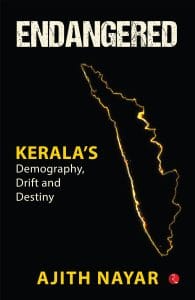
This excerpt from ‘Endangered’ by Ajith Nayar has been published with permission from Rupa Publication.