





The story of Malayalam cinema for the two decades beginning from the 1950s runs closely parallel to that of two major studios that had almost a stranglehold on it, Udaya and Merryland. It is also the story of a rivalry that made the studios compete with each other in making similar kinds of films and even in taking away the stars from the other studio to their fold. Commercial interests were certainly at the core of this game, but they had a key role to play in the evolution of cinema in Kerala into an industry.
Kunchacko, a businessman from Central Kerala with interests across various sectors, was the first off the block, setting up Udaya Studios in Alappuzha in 1946. He got Felix J. Beyse, a German cinematographer, rumoured to be a Nazi spy, to design the studio floors at a land earlier occupied by one of his coir factories. Among those who helped Kunchacko in this endeavour were communist leader T.V. Thomas and a few businessmen from different parts of Kerala, who invested money into the idea, according to Chelangatt Gopalakrishnan, who writes extensively about the studio era in his book Malayala Cinema Charithram Vichithram.
The German who made the studio also directed the studio’s first film Vellinakshatram (1949), said to be a patriotic film under the banner of K & K Productions, a joint venture of Kunchacko and film distributor K.V. Koshy. It was not the best of beginnings, but the studio struck gold with Nalla Thanka (1950), which also got them a marquee star in Miss Kumari. But the rival studio, which was just taking wings, would soon take away their star.
P. Subramaniam, an enterprising businessman, appears to have anticipated the growth of the film industry back in 1930, the year in which the first-ever Malayalam film was made. That year, he set up the New Theatre in Thiruvananthapuram, which is still one of the major theatres in the city. While running a transport business, he dabbled in local politics too, becoming Thiruvananthapuram’s mayor in 1944. Sensing the increasing possibilities in film production and to meet the demand for content in his own theatres, Subramaniam set up the Merryland Studio on a large parcel of land in the city’s outskirts in 1951. His close relationship with the erstwhile Travancore royal family appears to have helped in these endeavours. While Udaya Studios chose a logo of a cock standing on the globe and crowing, the Merryland logo had Lord Muruga standing with a peacock over the globe.
The studio’s first film Athmasakhi (1952) was not much of a success but it provided an opening for Sathyan, a police officer back then, into filmdom. Before that, Sathyan and Prem Nazir, two of the biggest actors of their generation, had debuted in an ill-fated film named Thyagaseema, which never got released. Two years later, Sathyan would attain stardom with Neelakuyil. Nazir worked his charm with the audience in Udaya Studios’ Visappinte Vili (1952), his second film and first major hit.
With not many acting models to look at, the actors in the early days of Malayalam cinema evolved their own style, which played to their strengths. Sathyan, a former cop, had more of those roles with a tough exterior, with the occasional romances, while Prem Nazir became the quintessential romantic hero of the era, or perhaps of all time in Malayalam cinema. Nazir’s initial shift to Merryland Studio with Ponkathir (1953) was a flop, but the humorous Avakashi (1954), in which he was paired with Miss Kumari, became a huge hit. It also made him a star in Tamil Nadu, and led to him becoming active in the Tamil industry for a while. Later, in the early 1960s, he decided to concentrate fully on Malayalam cinema, averaging even 25 films in some years. When it came to Nazir, there was always the mention of his Guinness records (for playing the lead in over 700 films and the record pairing with Sheela in over a hundred films), but there has always been a reluctance to list him among Malayalam’s great actors, in which he certainly deserves to be counted.
Meanwhile, the intense rivalry between Udaya and Merryland had them making films on the same formula around the same time. In November 1961, two mythological films with similar themes—Bhaktha Kuchela made by Merryland and Udaya’s Krishna Kuchela—released in successive weeks. While Udaya banked on stars like Nazir, Merryland got Telugu actors and had the first-mover advantage by releasing a week early. But the two studios cooperated too amid the rivalry, with instances like Merryland letting Udaya reuse a forest set that the studio had made for Kaadu (1973), one of the many forest-themed films that Merryland made. By the early 1960s, P. Subramaniam and Kunchacko, the studio owners, found it more convenient and economically wise to also direct the films that they produced. Subramaniam, in the end, directed 59 of the 69 films he produced including the superhit mythological film Kumarasambhavam (1969), while Kunchacko directed close to 40 films, which included a series of popular films based on the Vadakkan pattukal (heroic ballads from North Kerala).
By the time actor Madhu, formally trained from the National School of Drama, entered the industry with a small but memorable role in the war film Ninamaninja Kalpadukal (1963), Nazir and Sathyan had firmly established themselves as the titans of the industry. But in what looked like a challenging scenario, he found a place for himself becoming the hero in many popular literary adaptations ranging from Bhargavi Nilayam (1964) (in which he was the only actor on screen for a long time) to Chemmeen, Enippadikal (1973) and Ummachu (1971). Never a fan of the song-and-dance routines, he directed films to also break out of the hero image. In his directorial debut Priya (1970), he cast himself in a negative role. When the new wave dawned in Malayalam cinema in the 1970s, he was one of its faces as the lead actor in Olavum Theeravum (1970) and Swayamvaram. Madhu ended up making his mark across various departments, be it acting, direction, screenwriting, production or distribution, and even set up a film studio.
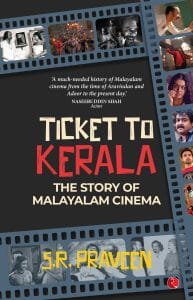 This excerpt from ‘Ticket to Kerala’ by SR Praveen has been published with permission from Rupa Publications.