



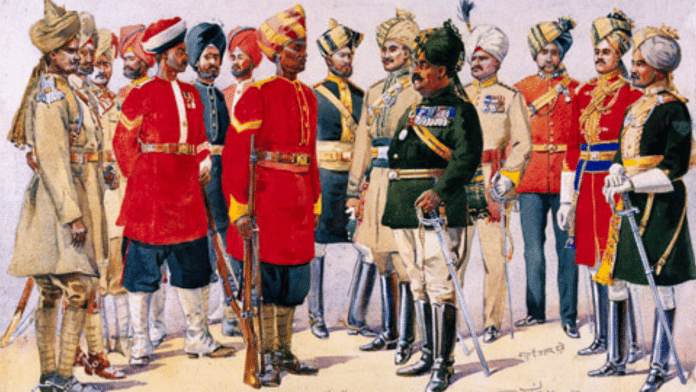
The British Empire’s global power rested on a single geopolitical concept: its dominance ‘East of Suez’. Britain knew that to be a ‘world power’, it had to dominate the region beyond the Suez Canal which included its most vital assets: the Persian Gulf, the naval base at Aden, the naval base at Singapore and most importantly, the ‘Jewel in the Crown’, India. The strategy, however, did not just include India; it was built on India.
Without India, the entire concept was hollow and unaffordable. India was the lynchpin that held the whole system together, serving as its military ‘barracks’, with the British Indian Army funded by Indians and the princely states policing the entire region from Suez to Hong Kong. This was no idle boast. Indian sepoys were the instrument of British expansion and control across the globe. They were shipped out to fight the Empire’s Opium Wars in China, to garrison the new colony of Hong Kong and to suppress rebellions in Malaya, Singapore and Burma. They fought in Afghanistan, Persia and as far away as Malta and Flanders. It was the administrative ‘hub’, as the British Raj directly administered territories like Aden, Burma and the Persian Gulf states.
Finally, it was the economic ‘engine’, with the Indian Rupee serving as the official currency for trade from Aden to the Gulf, demonstrating that this entire sphere was, in reality, a ‘Rupee Zone’ centred on the Indian economy. The final act of the British Empire in India, therefore, was not a simple withdrawal; it was a devastating, calculated masterstroke to dismantle this central hub. The goal was to shatter the anti-imperialist front and, crucially, prevent a unified India from inheriting the leadership of the post-colonial order they were leaving behind.
Where other colonial departures were marked by final, spiteful acts of physical destruction, the British method was far more permanent. They dismantled the very edifice of the empire in a manner it could not be rebuilt, wrecking the systemic unity drawn from India’s people and strength. This was not a single, frenzied moment but the grim culmination of a long-term strategy. Unlike other departing colonial powers who destroyed their assets, the British monetized the infrastructure they had built using Indian resources. In the final, meticulous calculation of their withdrawal, they ensured that a newly independent India would be forced to pay off the debts for the very railways, ports and barracks that had been used to control its people for a century.
Also read: The drama behind Tata Sons. How Cyrus Mistry was ousted as chair
The Blueprint of Partition: How the British Mastered the Art of Imperial Division
The ‘experiment in dismemberment’ was first tried in 1905. Lord Curzon’s Partition of Bengal was a vastly successful test, revealing the immense power of ‘divide and rule’. The British realized they didn’t need new weapons to subdue the population; they simply had to cultivate and weaponize existing communal forces against each other. Though the Bengal partition was annulled in 1911 due to intense protest, the lesson was not forgotten. Like meticulous shopkeepers, the British kept a careful account of this transaction, noting which forces could be leveraged to wreak havoc later. This lesson was carried forward and applied on a grand scale. Realizing they could not hold the entire Indian sphere indefinitely, they began the formal dismemberment in the 1930s, siphoning off vast territories that were once administered from India, like Burma and Aden, and setting a precedent for the final cuts to come.
 This excerpt from ‘India at War’ by Col DPK Pillay (Retd) has been published with permission from the author.