



We celebrate the great constitutional cases – the important questions of rights of citizens and how far the law can go, but most of our work deals with commercial matters. After all, most disagreements between people are about very predictable things – who owns what part of a building or a piece of land, or who was owed money or goods in a business deal, or what somebody’s shares in a company entitle them to.
Because a huge amount of money usually rides upon them, the biggest of these corporate battles often involve the best legal talent. Crack teams of lawyers from the big law firms work night and day and brief top counsel. As a result, the arguments are often very creative.
My first brush with such battles took place in the early 1990s, when the Shaw Wallace brothers, Manu and Kishore Chhabria, were fighting each other in courts across India. I used to lead the arguments even then, except in the Supreme Court, where I used to appear with Anil Divan.
As our economy opened up during liberalization, so did cases of commercial litigation. In terms of size of the businesses and stakes involved, those cases of the early 1990s look very small compared to the battles today. Of these, in recent years, nothing has attracted more eyeballs than the war between Tata and Cyrus Mistry.
The Tata group is probably the most pre-eminent of all Indian business houses, not only in size and breadth, but also in terms of their heritage and what they have meant to the country over the last 150 years. When Jamsetji Tata founded Tata Sons in 1868, he brought into existence the first Indian industrial business, laid down the foundation of technical education, created the steel and power industries and made it possible for the modern nation of India to start taking its infant steps.
Since then, the history of Tatas and the history of India have been inseparable. It was Tata Airlines which became Air India and Indian Airlines. The Tata group started with oil mills, spread into the key industries of steel and power and from there into every part of daily life in India, and today occupies a major, if not always dominant, place in industries across India, from tea and hotels to cars and telecom.
Tata Sons became the controlling parent of the Tata group of companies, the holding company, and remains the jewel in the Tata crown. Throughout the 150-year heritage of the company, only six people have been the chairmen of Tata Sons, which sits at the top of the whole empire of the Tata group.
From Jamsetji Tata, who was chairman for thirty-six years, the seat came to Sir Dorab Tata, who was chair for twenty-eight years, and who started the trusts which have given so much philanthropically. Nowroji Saklatwala was chairman for a relatively brief six years in the 1930s, and then J.R.D. Tata took over in 1938.
From 1938 to 1991 J.R.D. Tata was not only the chairman of the company, but also a pillar of Indian business and industry. It was under his guidance that civil aviation, for one, emerged in India. From 1991 to 2012 his nephew Ratan Tata guided the company into the bold new world of the global markets as the Indian giant embarked on some of the most daring adventures yet undertaken by an Indian business. It was under his stewardship that Tata bought global businesses like Corus Steel and Jaguar Land Rover. In one of my meetings with Ratan, I told him that many Indians, including myself, were proud of this reverse imperialism of the British!
But in 2012 even Ratan Tata had to retire, and there was no obvious heir to the seat of chairman. A search commenced for a young, dynamic new leader who could guide the company in a millennial world. That man, installed with great pomp and ceremony, was Cyrus Mistry.
Cyrus Mistry had been a director at various Tata companies since 2006 and was the heir of the Shapoorji Pallonji construction business. His appointment was celebrated as the beginning of a brave new era. It was only the second time in Tata history that someone without the ‘Tata’ name would be the chairman. To outsiders, it might seem like a vote in favour of professional, non-family, management.
The truth is more complex. The families had long been connected, both by marriage and by shareholding. Shapoorji Pallonji held a major stake in Tata Sons, approximately 18.4 per cent of the equity shares of the company. The great majority of the shares of Tata Sons are held by a handful of trusts – the biggest among which are the Sir Dorabji Tata Trust and the Sir Ratan Tata Trust.
The idea behind having a set of trusts holding ultimate control of the shares was to lend an intergenerational stability to the business and to ensure the guiding hand of the elder members of the Tata family. So when Cyrus Mistry came into the company, he was inevitably going to be guided by the trusts, and the face of those trusts was naturally Ratan Tata.
There were tensions, and they grew and rankled. Cyrus Mistry was concerned by some of the business problems he had inherited. For example, the Corus acquisition had turned troublesome, and the Nano car, which had been one of Ratan Tata’s pet projects, had not been as popular as expected in the market. Ratan Tata and some other board members had been disappointed with Cyrus’s decision-making and concerned that they were not always informed about issues which were to be discussed at board meetings, even though they represented the majority of shareholders.
At 2 p.m. on 24 October 2016 a board meeting was to take place at Tata Sons, chaired by Cyrus Mistry. Nothing especially unusual was slated to happen at the meeting, and the agenda did not contain any surprises – primarily investments in AirAsia.
Cyrus Mistry took the chair and was confronted by the directors representing the Tata Trusts and told that since the relationship between the board and himself had not been working, he was being asked to step down as chairman and managing director.
Cyrus Mistry immediately asked why this was not on the agenda. He was informed that it was not legally necessary and that the company had sought legal opinions to back that up. Then, as he did not of his own accord step down, a resolution was moved to remove him as chairman. Two directors abstained, and the rest voted for his exit. No one voted for his continuance.
It was all over in an hour. Cyrus Mistry had been removed from one of the most coveted managerial spots in the world. He would continue as a director, which he had been since the year 2006, but he was no longer the head of Tata Sons. He was to clear out his office and leave Bombay House. His own council of employees who were outsiders were sacked with immediate effect as well. In the meantime, Ratan Tata was appointed interim chairman, and the company began to look for a permanent replacement. By the end of the day, the dramatic events were all over the press. Even the share markets were stunned.
Cyrus Mistry went immediately to court. The court he chose to approach was the National Company Law Tribunal (NCLT) in a kind of case called an ‘oppression and mismanagement’ case. This is unusual because it is not an action you pursue in order to enforce, for example, an employment agreement or to seek damages. It is a case you file supposedly to protect your rights as a shareholder who meets a certain minimum criterion of shareholding. The NCLTs are specialized company law courts which handle cases of corporate insolvency and shareholder disputes. These cases do not go before the regular courts; by law they must go to the NCLT.
A company is a democracy in a sense – it will do the will of the majority of shareholders. But where a minority of shareholders is obviously squeezed out, or deprived of the value of their shareholding, against the law, and against the interest of the company, they can seek relief in a petition for oppression and mismanagement.
But Cyrus Mistry himself did not hold significant shares. Those shares were held by the Shapoorji Pallonji companies. They filed a petition against Tata Sons, and Cyrus Mistry was a respondent party supporting them. Shapoorji Pallonji were claiming that their voice on the board of Tata Sons was being drowned out.
At this point, Ratan Tata called me to take on this fight, and warned me that it would be a big one. I had not met him earlier and was pleased to find him a dignified, balanced, solid and sober person, not flashy or ostentatious in the least.
I knew that this case would be a long-drawn one. It had started with a rush of anger on both sides. In most cases like this where the litigants are proud, the anger remains inflamed for some time, then cooler heads win and a settlement is reached. But I didn’t expect this to happen here as the issues were more deep-rooted and both sides had enormous resources.
This being a very prestigious, major battle, I had a team of about twelve people with me, including four or five senior advocates whom I led. With me were Ravi Kadam from Bombay, Mohan Parasaran of Delhi (former Solicitor General of India), S.N. Mukherjee of Calcutta, Zal Andhyarujina and many others. The other side was led by C. Aryama Sundaram but they had a smaller team overall. Janak Dwarkadas was personally appearing for Cyrus Mistry.
At the first stage, the fight was about two things: interim measures and maintainability. From December 2016 to January 2017 every attempt was made by the petitioners to get some kind of interim order. It wasn’t even a very important thing they were seeking, but they wanted a victory, any victory. They had to save face somehow after the ouster.
They were coming from a position where their man had been sacked, and so they felt they had lost something and needed to have a win. So they pleaded that there were various things which required interim protection. An interim or interlocutory order is not a final decision on anything, but merely an arrangement directed by the court to prevent anything from going awry while the case is being heard.
Now I think interim protections are sometimes really ego trips, and have very little practical use. If a property is in danger of being destroyed, an interim protection might save it, and that is a valid case. But where a person has been removed from a management position, then in the course of hearing whether he should or should not have been, a court is very unlikely to reverse the removal. But because he was on a losing wicket, Cyrus Mistry wanted to score a symbolic victory by having some kind of an order in his favour.
Unfortunately, in high-profile cases, the press impressions and perceptions of the public are more important than the actual thing. So if you sneezed, it would be reported. There was a lot of misreporting and it was alleged by our side that the other side tended to place stories in the media which were not exactly what transpired in Court.
I am proud to say I prevented any interim orders from being passed. On each of those attempts an appeal was also put forth to the National Company Law Appellate Tribunal (NCLAT) in Delhi but there too requests by Mistry were turned down. Mistry’s side thus did not get the satisfaction of an interim order, even a symbolic one.
Maintainability – whether a case meets the basic requirements to be filed and heard – is a battle where the petitioners did succeed though later at the appellate stage of the NCLAT after having lost even maintainability at the primary level of the NCLT. Our objection was on the technical ground that in order to maintain a petition before the NCLT, a shareholder or group of shareholders must either be more than a hundred individuals or one-tenth of all individuals, or must hold at least 10 per cent of the issued share capital of the company.
A company is a democracy, after all, and while each shareholder has rights, a tiny group cannot be permitted to defeat the rights of the vast majority. That is why the law contains this qualificatory hurdle – if you have more than 10 per cent, you can come to the NCLT seeking protection. Even taken together, the Shapoorji Pallonji companies only held 2.17 per cent of the share capital of Tata Sons.
But wait, you may ask, didn’t I tell you earlier that they held 18.4 per cent of the equity of Tata Sons, and were the third biggest shareholders after the two Tata Trusts? That is true, but there are two kinds of share capital, equity and preference. Equity is what the Shapoorji Pallonji companies held 18.4 per cent of, and that entitled them to voting rights; equity is closest to the conception of ‘ownership’ of a company. Preference shares are more like a debt or borrowing – they do not usually carry voting rights, and therefore they can be issued to raise money more freely, because the promoters of companies do not necessarily lose control while raising money.
In Tata Sons, the total equity share capital amounted to Rs 40 crore and the total preference share capital stood at Rs 294 crore. Taken together, the 18.4 per cent of the equity shares that Cyrus Mistry’s companies held represented what was actually only 2.17 per cent of the total issued shares. Therefore, as they were less than 10 per cent of the issued share capital, they could not have maintained the petition they had filed.
However, one further route was open to them, which was to seek special dispensation to maintain the petition because of unusual circumstances, a waiver of the rule. This they succeeded in obtaining, not at first from the NCLT in Bombay, where they lost on maintainability as well as on injunction, but from the NCLAT in appeal. The main reason the NCLAT allowed them the wavier was that as the shareholding stood, only the Tata Trusts could ever meet the threshold 10 per cent condition, and to do so, even they would have to band together.
If the provision was to provide minority protection in such circumstances, a waiver would have to be granted. The high proportion of the relative value of the minority shareholding in the company, that is, about one lakh crore out of a value of six lakh crore, was also key in the NCLAT granting a waiver.
All of that, hundreds and hundreds of man-hours, before judges and in preparation, was only a skirmish. The main battle lay ahead.
The NCLT Bombay bench itself had a problem with setting a schedule for the hearings, because there were so many busy lawyers involved, and a lot of adjustments were made. It also involved persons like me and many others assisting me to displace ourselves from Delhi to go to Bombay. The matter was heard in three-day blocks, over months, in aggregate a few weeks’ worth of dates, but set apart to allow us all to function.
I had to go through a lot of painful scheduling, but it was also oddly relaxing to be away from Delhi, focusing on one case during those weeks. After a while you know the case inside out (so the preparation does not have to be as lengthy each time, although we had put in long hours of preparation initially) and you can relax. It is also always a pleasure working in Bombay because the bar there is a little more professional and a little less aggressive than it is in Delhi – perhaps something that can be said about the cities more generally as well.
Cyrus Mistry and his companies had pegged their case on the argument that the Tata Trusts did not permit him to function with a free hand and that Ratan Tata had never actually let him have real management. The Articles of Association – documents which lay down the rules of how the company is run – of the Trust made it impossible for anyone to function with true independence. Therefore, he was also seeking the striking down of those articles.
In his arguments he described the existing structure as one with ‘shadow directors’ and ‘super boards’. These ‘super boards’ were allegedly controlled by Ratan Tata and the Tata Trusts’ trustee Noshir Soonawala, with the independent directors on the boards not allowed to function independently.
To back up his arguments he took to a review of the decisions in which he felt he had been interfered with by the board, from having to invest in AirAsia in 2013 where he claimed frauds had taken place, being forced to set up Vistara Airlines with Singapore Airlines as a partner which he felt was financially unwise.
He claimed that Tata Teleservices was prejudicially affected by Ratan Tata’s relationship with C. Sivasankaran of Sterling, particularly in losses incurred while dealing with NTT DoCoMo, the Japanese telecom major. He claimed that his planned issue of shares of Tata Motors was stymied, sales of businesses were delayed and interfered with. And that price-sensitive information was constantly being sought from the board.
Cyrus Mistry also claimed to be aggrieved by what he had walked into. According to him, some of the divisions were performing very poorly and it had fallen to him to turn them around. He felt that bad business decisions were being clung to for emotional reasons such as the continuation of the Tata Nano, which had been a dream of Ratan Tata’s. He described these as ‘legacy hotspots’ or ‘white elephants’. His strategy was to get out of failing businesses and write off losses instead of throwing good money after bad.
Mistry cited the example of Tata’s acquisition of Corus Steel saying that it had left the company with underperforming European assets which had been bought at a high cost, and that it was loaded with debt and pension liabilities. He also wanted to write off assets and restructure the balance sheets of Indian Hotels Company – in some of these, the assets he wanted to write off were prestige projects such as the Pierre hotel in New York. He felt, however, that the older heads at the Trusts were more concerned with the image of these assets than in their viability financially.
He also pointed to the results of poor or compromised decision-making, an alleged fraud at AirAsia worth Rs 22 crore and an unconscionable decision by Tata Teleservices not to litigate against C. Sivasankaran and Sterling.
From our side, the argument was much more simple and rooted in law instead of highly disputed facts. Each of the issues he had raised had factual points and counterpoints. There was data to show the wisdom of every decision or the lack of it. All of these were also argued, but that is not what turned the case in our favour.
Cyrus Mistry was employed pursuant to a contract like any other employee of Tata Sons and was answerable to the board and ultimately to the shareholders represented on the board. The moment he lost their confidence, for better or worse, he had to go. The public was largely unaware that Mistry was actually on a five-year contract. He was not unceremoniously thrown out. He was firmly asked to leave. He did not leave and, therefore, he was voted out as chairman. He was still kept on as a director.
His shock at the historical state of various businesses or the decisions made could be understandable if he were truly an outsider, brought in and handed an unsteerable ship. But he had been on the board from 2006, and in individual companies even earlier. Each of the legacy hotspots, each of the white elephants he pointed to, was one that he had been in a position to caution about at the time they were entered into.
But he did not do so for more than a decade, and in fact in all of those decisions, he voted in favour of them. For him to now turn around and say he was saddled with them was unfair, highly opportunistic and highly selective. Documents showed that his complaints had arisen in the few months leading up to the crisis when his personal equations with Ratan Tata and Noshir Soonawaala had gone south.
His arguments against the articles themselves being unfair were far-fetched, I argued. Those articles had been there long before he was selected, and the shareholding of the companies had been in place since the 1960s. The structure with the Tata Trusts holding a controlling stake in the Tata Sons company had existed for almost a hundred years. In fact, those articles were amended and the amendments had been endorsed by him from time to time. Suddenly, when he fell afoul of them, the articles seemed problematic to him.
The argument of a super board being in place is just a fancy way of saying that an affirmative vote was required on certain major decisions. I argued that you could open the books of any company of any reasonable size and would find similar affirmative provisions – they would always exist to protect key shareholders. In fact, historically, those powers have never been exercised at Tata Sons, who believed that they have never been needed to be used.
But Cyrus Mistry, I argued, had failed in his duties to the board. He had failed to provide the Trusts and the members of the board with information on decisions in advance, and had failed to allow them to make informed decisions consistently. In doing so, he had acted as if he himself were the whole of the board, and this was why he had fallen out of favour with the shareholders.
It was also alleged that Cyrus Mistry had sent cartons of documents to the Income Tax Department after his dismissal as chairman, but while he was still a director. This had resulted in notices being issued to individuals as well as the company. According to our side, he was acting as a Trojan horse inside the company, completely against its interests.
Let us assume that the board’s decision was wrong and prejudiced. Let us assume that Cyrus Mistry was the greatest possible manager and it was a horrible mistake to sack him. The point is that you cannot, and equally a judge cannot, judge corporate decision-making by these standards.
The company is legally a person, and the board is its mind. That board is composed of directors who in turn
are nominated by the shareholders. Every employee is the servant of the company. One cannot have an unwilling master with an undesirable servant foisted upon him. One cannot compel a relationship which requires trust and confidence every day, that too by court injunction.
It is as simple as saying that your servant may be right, but you cannot work with him. You cannot be in the same house if you have lost confidence. Even Steve Jobs, who founded Apple, was removed from Apple by its board – that is how corporate democracy works.
That is what happened, we reminded the Court. He was voted out by six out of nine board members. One was himself, who did not vote, and two abstained. He did not get a single vote in his favour and none against the motion to remove him – the mind of the company had been made up.
Mistry had been unable to carry the board along with him. If six out of nine voted against you, and the other two merely abstained, there is only one conclusion – that you failed to carry them with you.
All the directors of Tata Sons are in fact of rare pedigree. They include a former defence secretary, a top financial wizard, a former ambassador to the United States and a current dean of the Harvard Business School. They are all well-known and respected. Some of them are designated as independent directors, as per the Companies Act, and are beholden to none of the shareholders.
Now to imagine that all were collectively conspiring against Mr Mistry and then acted against him out of bias is unlikely. When Cyrus Mistry complains about shadow directors and says that they are all biased in favour of, or voting on the directions of, Ratan Tata, he, according to us, ignores that this too is a feature of corporate democracy. That if an otherwise independent director can be persuaded to vote a certain way on the basis of the business advice or acumen of one person, that is a perfectly legitimate way to vote.
Tata Sons tried to behave decently with Cyrus Mistry. He was still kept on as director for more than four months. He was given an option to leave from the other Tata operating companies as well. He did neither. He could have said, ‘I do not agree with your actions, but I am exiting from this and the other companies.’ I do not blame him for this obstinacy, I blame his advisers.
The Tata operating companies are not minor subsidiaries of Tata Sons. Tata Motors, Tata Steel and Tata Consultancy Services are giants by any global standards. He tried to hold on to the chairs of those companies and did not leave till he was voted out, and so he brought bad blood upon himself.
He then started filing a number of defamation suits and defamation complaints, which caused the fight to get even more personal. Those matters are sub judice and so it would not be advisable to discuss their merits, but the effect was to antagonize the Tata side even further. Subsequently, the Tatas won both the defamation cases at the Bombay High Court, where I went and argued for them and one of them has been dismissed in the Supreme Court also. The other is pending in the Supreme Court without relief against the Tatas.
Many, many more arguments were raised, as you can imagine, given the interest involved and the importance of the matter. The NCLT heard both sides exhaustively, and then passed a judgement that was 368 pages long. Unsurprisingly, they dismissed the petition filed by Cyrus Mistry’s companies in toto. In fact the order was absolutely in favour of Tata Sons.
The key to the NCLT order was that this was in effect a dispute between an employee and an employer, and not between a minority and a majority shareholder. The NCLT came down heavily in favour of corporate democracy – that the will of the majority of shareholders cannot be held to ransom by a minority on such issues which are bona fide business decisions.
On each of the allegations that were raised by Cyrus Mistry, the Court summarily concluded that it found no merit in the claims made. In fact, the Court went one step further and reprimanded him for providing information to the Income Tax Department as being an action contrary to the interest of the company.
According to the NCLT, the most important thing was that the parties that had petitioned the NCLT, being the Shapoorji Pallonji companies, were not impacted as Tata shareholders. Their stake was never sought to be diminished or taken away. No issue of shares was carried out behind their backs. They were not deprived of notices to meetings. No notice to acquire their shares was given to them. Their share values were not driven into the ground. The company was not stripped of assets and sold to turn a quick buck. These are the traditional crimes of oppression and mismanagement, and they never happened. It is not oppression and mismanagement to fire an employee from a position.
Ultimately, this need not have become an issue of pride and could have been settled simply. By pushing the dispute, Cyrus Mistry lowered the price of Tata Sons shares. He controls 18.4 per cent of those shares. The shares controlled by him are worth many billions. The harm he has caused to himself is incalculable. He is the scion of the Shapoorji Pallonji empire, the largest shareholders in Tata Sons. By settling the dispute he would have always been in an advantageous position. Had he played his cards well and with more humility, he would have been the number one man in both the groups of companies.
However, now the matter has travelled to the NCLAT, to be finally decided in appeal. Once more, a valiant effort was made to get an interim stay of the effect of the NCLT’s order. But we succeeded in preventing that symbolic victory as well. The final order took over a year after conclusion of arguments in coming.
I can now admit that we were caught in a sticky position. While the NCLT judgement was thumpingly in our favour, it was poorly written and therefore gave us some anxiety at the appellate court. One of the worst positions for a counsel to be in is to be defending a judgement in your favour, but which has weaknesses – the rug might be swept out from under your feet at any time.
The judgement was over-effusive despite being legally sound. It was nothing but poetic and literary licence on the part of the judge, but in the wrong court of appeal, it might appear excessive. That was the only concern we had.
The NCLAT made a lot of comments in court about the language and the form of the NCLT judgement, and it came to within an inch of a possible stay this time. But thankfully the appellate tribunal appreciated that the language did not undermine the legal sense of the judgement and did not stay it. The whole thing was reargued before the appellate court, and was reversed by NCLAT days before this books went to press. More on this at the end of this chapter.
One hopes that the parties can find an end to this issue. But it illuminates one thing for me. One would think perhaps that these fights are very antiseptic and technical, balance sheet–driven affairs. Nothing could be further from the truth. Indian business is still very much centred around family and friends – and when family and friends fight each other, the undercurrents often run much deeper than what is apparently on the table.
Look at our histories. Stories of brothers fighting brothers and friends turning against each other have an ancient Indian heritage, running back to the Pandavas and Kauravas in the Mahabharata, or in Mughal times, the struggle between Aurangzeb and Dara Shukoh for the throne of India. What was true then is true now. Empires are won and lost on pride and personal insult.
PS: As this book was being readied for press, the NCLAT pronounced its judgement (on 18 December 2019). It reversed the order of the NCLT completely, and reinstated Cyrus Mistry to his former position. As the judgement had been pronounced during Supreme Court vacations, at my request, the appellate tribunal suspended the direction to reinstate Mistry as chairman of Tata Sons to allow Tata Sons to approach the Supreme Court in appeal. In the first week of January 2020, despite Mistry’s lawyers’ vociferous arguments, the Supreme Court gave a full stay on the NCLAT order, observing that they prima facie found the NCLAT judgement highly questionable since it gave the relief of the reinstatement to Mistry which had been expressly given up by him.
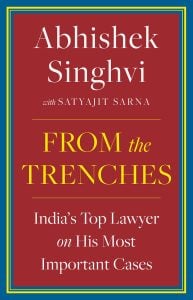 This excerpt from ‘From the Trenches’ by Abhishek Singhvi and Satyajit Sarna has been published with permission from the Juggernaut.