




It is nowhere more imperative that religion be freely debated than in a multicultural society such as India’s. With innumerable religions and philosophies blended, there is little hope that what is sacred to one will not be superstition or even anathema to another. In a culture as overwhelmingly non-Abrahamic as India’s, ‘blasphemy’ can play a beneficial role. Ironically, by challenging prevailing orthodoxy openly, we strengthen social harmony in the long term, instead of undermining it. This is because an open society strong enough to permit irreverence is one that has perfected the art of settling differences without violence or coercion.
India’s dominant religion, Hinduism, is typically described as endogenously plural and inclusive. Unlike the Abrahamic faiths (Islam, Christianity, and Judaism), which are based on a stricter, dualistic definition of dogma (one god, one holy book, and one set of truth claims), Hindu traditions encompass an immense variety of beliefs, from monotheism to monism to atheism, and all manner of scriptures, each of which determines the religion for any individual member. Hindu philosophy has been traditionally pluralistic by nature: old platforms such as discussion forums (such as those conducted in front of kings or during sessions of scholars) had open doors for heterodox scholars.
Within those forums, nastikas (heterodox scholars), such as the Cārvākas, could trade blows with astikas (orthodox scholars) on whether there is a god or the Vedas govern, without being killed or condemned forever as heretics. In fact, certain Indian philosophies rejected the Vedas per se but continued to enrich the subcontinent’s intellectual landscape. This is far removed from mediaeval Europe’s handling of heretics or the Islamic world’s manner of treating apostates. Simply put, Hindu civilization, glorious as it has been, has treated blasphemers as controversial opponents, not criminals.
This pluralistic spirit implies that Hinduism is exceptionally well equipped to weather—and even thrive through—the arrows of modernity and free thinking. A faith that has already accepted the depth and multiplicity of thought stands to gain nothing from a caricature or a challenging piece of writing. Instead, such a faith can make critique an occasion for reflection or rethinking. For instance, when reformers of the 19th and 20th centuries attacked certain Hindu practices (child marriage, sati, untouchability, etc.), orthodox factions shouted ‘blasphemy’ and ‘insult to our religion’.
But such denunciation did actually fortify Hindu society by purging it of some unjust practices. Raja Rammohan Roy’s denunciation of ‘Sati’ was violently resisted by priests as blasphemy, but without his courageous ‘blasphemy’ against that so-called venerable practice, an obnoxious ritual might have endured for a longer time. Likewise, B.R. Ambedkar’s and Vinayak Damodar Savarkar’s scathing denunciation of the caste system, and even of Hindu scriptures such as Manusmriti (which Ambedkar theatrically burnt in 1927) was not acceptable and was deeply insulting to many Hindus at the time.
Savarkar said, ‘Whatever we find in Manusmriti to be harmful or ridiculous today should not be followed.’ But now, most Hindus have acknowledged that Ambedkar’s and Savarkar’s criticism of caste hypocrisy was a moral imperative that instituted reform. Their ‘blasphemy’ brought to light profound defects which had to be rectified; trying to suppress Ambedkar and Savarkar (as some tried) only underlined their contention that bigotry lay behind religious rationalizations.
These examples support a central hypothesis: Blasphemy can be a force for intellectual and social advancement. Some of the most profound positive changes in India that have been brought about by people who were prepared to challenge religious tradition from the inside. Swami Dayananda Saraswati rejected idolatry and many other practices commonly believed at the time to reflect the authentic Vedic spirit—an act for which more traditionalist Hindus ridiculed him. But his iconoclasm (both literal and metaphorical) bred the reformist Arya Samaj movement, which revived Hindu thinking for many and emphasized education and social betterment.
Also read: Freud said many great men in history were gay. I read it as a gay man in 1960s Bombay
In the south, Periyar E.V. Ramasamy took it even further: conducting public ‘idol-breaking’ ceremonies and mocking mythological orthodoxy to challenge caste and gender oppression. Periyar was a rank blasphemer to orthodox eyes. That Hindu society accepted a person like Periyar, who himself was riddled with inconsistencies and problems, is proof that it can handle blasphemy, and that we need more of it. These internal rebellions did not eradicate Hinduism as a general culture; it was, on the other hand, refashioned. In fact, the very capacity of Hindu society to transform across millennia, from Vedic sacrificial religion to Puranic devotionalism to Bhakti egalitarianism to contemporary Hindu reformism, owes much to internal criticism and assimilation of new thinking.
And yet, stricter Abrahamic religions have responded throughout history to blasphemy with excommunication, inquisition, or fatwas, rather than argument. When the mediaeval European Catholic Church responded to blasphemous thinking (e.g., doubting the divinity of Christ or the authority of the Pope), the typical fix was to prosecute the blasphemer for heresy and burn the offender at the stake. That oppression left the Church nominally unchallenged for centuries, but only at the cost of keeping it static; when modernity eventually asserted itself (in the form of science, enlightenment thinking, and secular revolutions), the originally inflexible edifice collapsed under the weight of pent-up, unposed questions. Protestant Christianity emerged by shattering the monopoly of a single ‘truth’ and opening up individual conscience—basically a controlled detonation of blasphemy against the Catholic Church dogma.
Islam in certain nations today still has stringent blasphemy and apostasy laws—but these have not made the cultures more devout or more peaceful in any way whatsoever; it has only immobilized discussion and produced intellectual stagnation in religious discourse. Ironically, some of the most violent and unstable societies in today’s world are those with the strongest blasphemy laws, supposedly for the protection of religion. In contrast, those with strong free speech tend to have more stable religious pluralism. Why? Because rigid systems that can’t accommodate opposition will inevitably break down—and usually violently—while flexible systems flex and stretch. When ultimately free speech knocks on the door of an authoritarian theocracy (via social media, international debate, or internal reformers), the resulting arrests can rattle the system to its foundations.
Therefore, it can be claimed that Abrahamic faiths, by virtue of their more absolutist structures, are actually more likely to ‘collapse under the weight of free speech’, that is, suppose all their beliefs are publicly challenged.
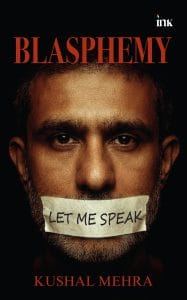 This excerpt from ‘Blasphemy’ by Kushal Mehra has been published with permission from BlueOne Ink.
The article is a thoughtful attempt to highlight the negative aspects relating to the strict theological positions of the catholic church enforced in medieval times and by Islam and Judaism in current times.
The writer seems to be ignorant of or has chosen not to talk of the major changes in Christianity that the 2nd Vatican Council has introduced in 1962 relating to the practice of Christianity, and which guides how the Catholic church actively reaches out to the poor and marginalised members of all societies through charity and love and informs them of the Salvation message of Jesus Christ in current day.
The Church from 1962 onwards is a reformed Catholic Church that has cut the bad practices of the medieval times. Hence the catholic church is best placed to continue to grow and flourish as is evident by the millions of Hindus and Muslims who are turning to Christianity across the world.
The church- going public are actively engaged to speak up and provide feedback which means it supports freedom of speech.
It is worth noting that right from its origin, Christianity has stressed that every person is important and has a unique soul planted by God and has the freedom to choose to do right or wrong. The person is accountable for their actions before God and if they repent and accept Christ as their saviour they are promised forgiveness and eternal life subject to the grace of God. Every person’s life matters.
On the other hand, Hinduism has constructed the caste system over thousands of years which supports the continuation of society, but has de-humanised those at the bottom of the pyramid. It has permitted evil practices of untouchability and Sati which were both stopped by the British government who found such practices were against humanity. Ambedkar denounced tgese practices.
The concept of Karma is another terrible religious practice that holds India back, where a person is promised a better spiritual life if they just continue to accept their current plate of injustice and inequality served to them by birth and fixed under the caste system.
People are getting more aware about the embedded evils of Hinduism and its idol worship – where lifeless idols are doused lavishly with hundreds of gallons of milk and Ghee by the rich while millions of other Indians go hungry and are crushed by poverty, which is clearly a crime against humanity; where people have to risk their lives travelling in overcrowded trains everday and drink filthy water and have little sanitation… these are pointers that Hinduism does not value life and the soul, but vakues only shallow cultural practices that have come down over the ages.
And unlike Christianity and the 2nd Vatican council led by the Pope, Hinduism is not trying to improve how it practices its faith.
The only way Hinduism continues to survive is through single minded Hindu bigotry led by politicians and radical hindu groups. This has had a serious impact on the image of India and regrettably India is losing its place among the Nations resulting in economic turmoil and lack of trust by its neighbours and other nations.
Islam and Judaism are in the same boat- they are highly fundamental in their religious thinking led by Rabbis and Mullahs, and unlike Christianity which always separated church and state, both Judaism and Islam are driven by political expressions of their faith. Judaism has always talked of having its own state for Jews only, which it achieved in Israel and there is ample evidence of other communities like Muslims and Christians in Israel being persecuted.
The notion of the Islamic state is an end goal for those practising early Islam and inevitably comes at the expense of or subjugation of other communities. it can be said that Islam values individual life and its pursuits, but it does not manage freedom of speech well.
One of the only podcasters who actually knows what he is doing. I am glad that I have been watching his content for a long time.
He is one of the few in this country who discusses policies and supports freedom of speech for both left and right wing commentators. Unlike some people/comedians who only want sycophants in their sides to have it.