




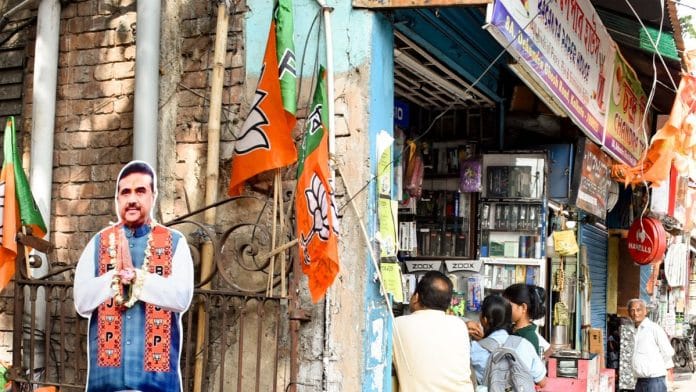

Seeing the results in West Bengal and Assam, social media has raised questions about democracy, especially the SIR controversy.
I asked my own question online: Can we now say that India has entered the era of Hindutva?
And, unsurprisingly, the responses were mixed. Some answered with pride, saying that Hindutva is now the dominant force in Indian politics. Others sounded more defensive—as if they supported the Bharatiya Janata Party politically, but did not want to associate themselves too directly with the idea of Hindutva, or at least with what they believed that term represented
But what caught my attention amid all the debates around SIR, Hindutva, incumbency, nationalism, and development was something else entirely, the discussion around the “Muslim vote bank.”
Mahua Moitra, in a now-deleted X post, pointed out how Muslim-majority areas did not ensure victory for certain All India Trinamool Congress candidates. And to be fair, I understand where that sentiment comes from. It reflects a feeling of political betrayal.
But it also made me pause. Why betrayal? Why does a party that presents itself as secular begin to feel a sense of entitlement over Muslim votes? And why do they not have the same sentiment toward Hindu voters who chose not to vote for TMC?
In an earlier column, I wrote about the voting patterns in my family—there were none. There is no single Muslim political mind, no unified instruction, and honestly, it would be impossible for that to exist in a country like India.
For a long time, I assumed the idea of Muslims voting as one bloc was pushed by sections of the Right, shaped by ignorance or hostility. But it looks like the perception on the other side is not entirely different.
There remains an underlying assumption that Muslims should vote for parties calling themselves secular—not because individual Muslims may genuinely believe in those values, but because those votes are somehow expected to belong there, even when other candidates contest the same space.
It also says something deeper about how secularism itself is understood in India. There is this common idea that secularism mainly exists to protect minorities. But reality is not that simple.
Secularism is equally important for the majority because it protects individual freedoms, prevents society from turning every identity into a political weapon, and creates space for people to live differently from one another without fear.
So why should defending secularism only be the burden of minorities? In the end, democracy moves in the direction that the majority wants.
Also read: Bengalis are tired of being ashamed of Kolkata. BJP is the last train to civilisation
Politics of fear
The other thing that came to my mind is how much of my childhood—as a Pasmanda Muslim—was shaped by fear around politics. Growing up, I constantly heard that we had to vote for certain parties, otherwise something terrible would happen. We had no real choice. If we wanted safety and if we wanted to avoid becoming targets because of our identity, then we had to support these parties.
And what did this politics slowly do to the community? It filled people with fear and pessimism to such an extent that many Muslims began looking at institutions, politics, and even society itself with deep distrust. Our political imagination became limited to survival.
Every election used to become a battle against some larger monster. Any form of change or reform is immediately framed as an attack on the community. Dissenting voices within were not allowed to exist. There was no concept of accountability. We were told not to ask too much from the leaders we voted for because, after all, they were supposedly giving us “protection.”
But now what?
The very political force we were told to fear is now in power in many parts of the country. So where does the community go from here? Do we finally begin asking different questions—how to strengthen the community within the constitutional framework, how to improve education and opportunities, how to build confidence rather than permanent anxiety? How to choose to vote for more than fear?
It increasingly feels like leaders such as Asaduddin Owaisi are comfortable with the politics of fear continuing. His recent statements seemed to suggest that Muslims should rally behind their own community’s leaders rather than look elsewhere politically.
And of course, for elite Muslim leaders, such politics can become very convenient. If identity alone becomes the main qualification, then accountability slowly disappears from the conversation. Look at Hyderabad, despite decades of AIMIM leadership, large sections of Muslims there reportedly continue to live below the poverty line.
Also read: By refusing to resign, Mamata Banerjee isn’t resisting authoritarianism—she is becoming it
A vision for the future
Perhaps this is the moment when the community needs to pause and rethink its political imagination altogether. Fear alone cannot remain the foundation forever.
Muslims, like every other community, need politics that go beyond symbolic protection and emotional rhetoric. Questions around education, economic upliftment, institutions, representation within the constitutional framework, internal reform, and accountability cannot always remain secondary.
Maybe the biggest shift is to stop seeing ourselves only as a community under permanent siege, and start seeing ourselves as citizens with agency, responsibility, and the ability to shape our own future beyond fear. In the end, Muslims need a vision for the future.
We also have to accept a political reality. Whoever is in power, the community has to learn how to work with institutions, understand constitutional rights, and stand for them instead of living only through fear and political dependency.
At the same time, the Bharatiya Janata Party also needs to understand that a country like India cannot function by politically excluding entire communities. Statements like those made by BJP’s Suvendu Adhikari—that he will work only for Hindus because only Hindus voted for him—may sound politically useful in the moment, but such rhetoric ultimately weakens the idea of a shared nation.
Elections can be won like this. But nations are not built this way.
Amana Begam Ansari is a columnist, writer, and TV news panellist. She runs a weekly YouTube show called ‘India This Week by Amana and Khalid’. She tweets @Amana_Ansari. Views are personal.
(Edited by Theres Sudeep)
Sunnis in bengal voted on communal lines, Hindus have to be awarded for carrying weight of secularism, If bengali sunnis were secular they wont be celebrating victory of jamat islami fascists in bangladesh, TMC was caught red handed by Hindus giving fake voter cards to Bangladeshis to uproot Bengali culture. Peace in Bengal now depends on secular education of muslims
Mahua Moitra is an entitled brat. She wins her Lok Sabha seat only because of Mamata Banerjee and TMC’s hooligans on the ground. In the next Lok Sabha elections, BJP will surely ensure that the local level goondas and thugs of the TMC are neutralised in Krishnanagar. With muscle power out of the equation, she will be totally dependent on Mamata Banerjee’s charisma. Let’s see how that turns out.
But one thing even Mahua Moitra will admit I believe – no one in Krishnanagar votes for her, they vote for Didi.
Dear Amana Begam. I agree with most of your views. But voting alone does not guarantee socio economic emancipation for members of any religion or caste. Voting has nothing to do with socio economic development of communities. Any community should have a philosophy of change, willingness to accept modern outlook, promote education, enhance gender equity, respect the intercultural sensitivities and copy the competencies for progress.