




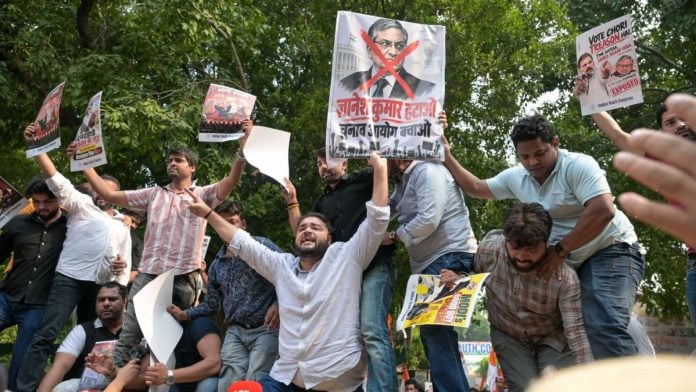

By now, the cables would have been sent, and ad hoc video conferences on the protests in Delhi would have become the norm for the diplomatic corps in India. The interest is understandable if we see the implications of the SIR crisis for India’s foreign relations.
Foremost is the risk of an impact on electoral assistance requests to India from other countries. Hearing about India’s electoral roll of 950 million pops the eyes of newly arrived diplomats in Delhi. In January 2026, the Election Commission of India (ECI) launched the new ECINet software at an international conference (IICDEM-2026) in Delhi attended by electoral bodies from 42 nations and representatives of 27 embassies. At least one Pacific nation has since been in negotiations to adopt ECINet.
Now, questions have been raised about the centralisation of electoral-roll data and the large number of voters flagged by the software for “logical discrepancies”. Unless these issues are swiftly resolved, would another nation risk using ECINet for its own electoral roll? Secondly, allegations about ECINet come at a time when India has been promoting its Digital Public Infrastructure and its capabilities as a global IT power. This promotion effort may face raised eyebrows if the questions around guardrails in ECINet are not addressed soon.
Thirdly, in recent years, India’s foreign policy community has watched governments in Sri Lanka, Bangladesh and Nepal fall in quick succession following large-scale protests and has looked for patterns in them. There is a fear that these events in the neighbourhood were trial runs by foreign actors to ultimately coerce the Indian state and threaten India’s territorial integrity. But even as the dots are yet to be connected, this fear has now become a chimera which may affect India’s relations with its closest partners if it is not properly managed.
Also Read: The next stage of India’s foreign policy is strategic leverage
Baseless speculation could have consequences
On 6 October, Organiser, a magazine that is now found on coffee tables in central ministries carried an allegation that funding for the Cockroach Janata Party (CJP) “is described as originating in the USA, passing through ISIS, then ISI, Riyadh, criminal elements in Mumbai and Delhi, and finally into the protests”!
The source of this theory of deeply questionable logic: a solitary social media video post by a user whose face was masked. When an influential magazine gives space to such theories without evidence, this risks affecting India’s relations with declared strategic partners.
On 10 October 2026, the ruling party’s president accused the country’s Opposition of working “on behalf of foreign forces”. The consequent question is: which countries constitute these foreign forces?
If there were a basis for the allegation, then India would be within its rights to contemplate all measures — whether expelling diplomats of the “foreign force/s”, restricting that nation’s businesses in India or taking other defensive actions as needed. But if the allegation is merely political rhetoric, is it responsible framing at a time when India is trying to balance its relations with all the major powers of the world?
Also Read: British Raj called freedom fighters anarchists & foreign agents. Sounds familiar?
Are we compromising our diplomatic capital?
Several theories on Indian social media about the threat of “regime change”, attributed to the SIR protests, point fingers at the West far more often than at India’s strategic rivals.
There is no question that India still has painful memories of colonial rule and Cold War-era interventions. But in recent decades, we have remade our relationship with the West. India has struck or is in the process of implementing major trade deals with the US, UK, Australia and the EU. India is counting on the votes of some of these very nations as it campaigns for the UN Security Council elections to be held next year. And while on some issues, such as climate, India disagrees with the approach of the West, on others — such as upholding a rules-based order and freedom of navigation — India has found common ground with the West.
Doesn’t finger-pointing without offering evidence then undermine India’s interests, at a time when India’s rise needs all the friends we can summon? In case there is tangible evidence of foreign interference, good statecraft requires that related concerns be firmly raised in quiet off-camera bilateral conversations, and not be made an object of public speculation, at least as long as the channels of communication between India and any foreign nation in question are still working.
Fourth, we need to talk about the fear-mongering in Indian media. When a section of the Indian media rejects foreign media reporting about protests, yet carries unproven theories about protests in France, or fuels baseless suspicion about nations like Germany that are selling India sensitive technologies, is it good journalism? Can we expect that such commentary has no impact on bilateral ties?
Above all, such allegations about “foreign” forces, made in the context of SIR and the nation’s electoral roll, risk internationalising India’s democratic discontents and raising questions about how the “mother of democracy” manages non-violent dissent within the country.
In sum, political rhetoric and theorising about a “foreign hand” should not be allowed to risk our carefully built diplomatic capital. India should preserve its strategic autonomy at all times, but cannot afford paranoia.
Raja Karthikeya is an international affairs researcher. Views are personal.
(Edited by Asavari Singh)