



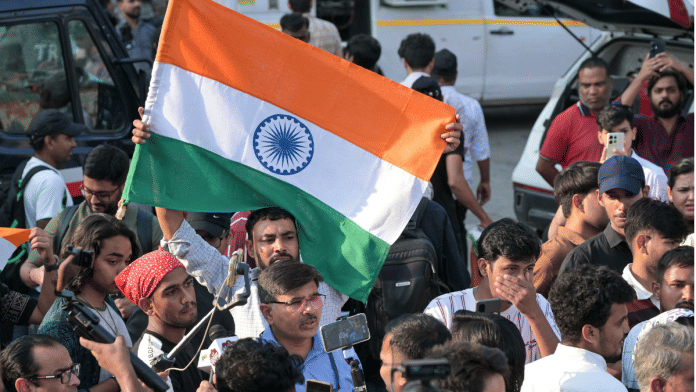
“Demonic forces” from the West want to destabilise India and “install their own proxies”, RSS chief Mohan Bhagwat claimed this week. Such is the language the BJP has chosen to delegitimise recent protests. Defence Minister Rajnath Singh says the country’s youth are being turned into “instruments of anarchy”. Party spokesperson Sudhanshu Trivedi accuses the opposition of “conspiring with foreign powers to bring about ‘regime change’”. BJP president Nitin Nabin calls Rahul Gandhi “a pawn of the foreign toolkit gang”.
Never mind that these very foreign powers are being enveloped in hugs by Narendra Modi at global meets. The BJP-RSS uses this framing to justify the lathis, tear gas and mass detentions with which the government has responded to nonviolent protests by the CJP, the INDIA bloc and students.
On 11 October, the Supreme Court, in a special Sunday sitting, ordered that no one at a peaceful, unarmed assembly be detained “except in accordance with the procedure established by law”, and that Delhi’s metro, trains and internet be restored. And when asked about foreign funding of the CJP’s earlier protests, the Ministry of External Affairs had “no information to share”.
As is blindingly obvious to most by now, this is the real toolkit: tar every popular struggle as “anti-national” and hope it sticks. The BJP has no idea how it sounds, in its uncanny echoing of everything the British Empire once said about the freedom fighters of the Indian National Congress.
Also Read: ‘Ghuspaithiye’ is Amit Shah’s smokescreen for Vote Chori
India’s ‘anarchists’ and ‘saboteurs’
“[A]t each stage Mr. Gandhi failed in his promises, and became discredited—I am not talking about the man, but about his objectives and methods, which became discredited by thinking people. Now he has embarked on things which are dangerous, and in his anarchical mood, the Government of India are entitled to call upon the support of every well-thinking and loyal Indian…”
This isn’t a BJP spokesperson talking about Rahul Gandhi. It is Secretary of State for India Edwin Montagu (of Montagu-Chelmsford Reforms fame) speaking in the House of Commons in February 1922 about Mahatma Gandhi’s campaign of non-cooperation and civil disobedience.
The Modi government has adopted the Raj’s vocabulary word for word, and the word that recurs most, then and now, is “anarchy”. The notorious Rowlatt Act of 1919, which let the government jail Indians for up to two years without trial, was titled the Anarchical and Revolutionary Crimes Act. The official British majority in the Imperial Legislative Council bulldozed it through against the unanimous opposition of every Indian member. Jinnah, Malaviya and Mazhar-ul-Haq resigned in protest at a rigged institution. Gandhi’s first all-India satyagraha followed. Sound familiar?
The charge sheet barely changed over three decades. A November 1920 Government of India resolution claimed that non-cooperation would leave India open to “foreign aggression and internal chaos”. In his February 1922 speech, Montagu added that “Bolshevist propaganda has contributed something to the unrest”. In 1931, the Marquess of Zetland, a former Governor of Bengal, warned the House of Lords that civil disobedience “threatened to throw the whole country into a state of anarchy”.
During Quit India, Secretary of State Leopold Amery cast Gandhi as the “arch-saboteur” and derided “the anarchy to which Mr. Gandhi seems to look forward with such complacency”. A month later he accused Congress of “a policy of sabotage” concentrated on “the vital strategic area now exposed to Japanese attack” in east India.
Anarchy and the foreign hand, decade after decade. Yet pressed for proof, the Raj rarely had any. In October 1942, at the height of Quit India, the India Office’s own minister, the Duke of Devonshire, admitted in the Lords there was “no direct evidence — none whatever” of “enemy political influences” in India. Eighty-four years later, the Ministry of External Affairs has “no information to share”.
The labels had consequences. In 1919 Punjab’s officials convinced themselves the protests were a rebellion, a conspiracy the Raj’s own Hunter Committee later found no evidence for. That conviction framed Brigadier General Reginald Dyer’s decision to fire on a peaceful Baisakhi gathering at Jallianwala Bagh to produce what he called a “moral effect” across Punjab.
Mahatma, then MLK
Nor were Indian satyagrahis alone. Martin Luther King Jr was convicted of leading an illegal boycott, branded an outside agitator, investigated as a communist tool and accused of reading from a foreign script, all for demanding equal rights.
Two days after his “I have a dream” speech of 28 August 1963, the FBI’s domestic intelligence chief, William Sullivan, wrote that the Bureau must mark King “as the most dangerous Negro of the future in this Nation from the standpoint of communism, the Negro and national security”.
In 1976, a US Senate committee found the FBI had set out to “neutralize” King, and that its own files could not substantiate the claim that his closest adviser was under Communist Party influence. The accusation is always loud; the evidence never arrives.
Also Read: Modi’s India is back where Nehru started—non-alignment, as strategic necessity
One electoral autocracy after another
Whether it is farmers, students or citizens who fear their names have vanished from the rolls, the response is the same: lathis, barricades, prohibitory orders, mass detentions, and the vocabulary of anarchy and the foreign hand.
Of course, the British Empire was the past, of course we live in the present, all resemblances are purely coincidental. The Raj was an electoral autocracy — at least after the Government of India Acts, in which elections happened, but didn’t produce serious change. Independent India today is an (checks notes) electoral autocracy. You vote, but the umpires are compromised, and since last year 13 crore names have simply disappeared from the rolls.
The Raj, too, was certain that its critics were anarchists in foreign pay. When asked for evidence, it had none to show. Nor did the FBI. In 2021, neither did the government that called farmers Khalistanis and then repealed its laws. Satyameva Jayate.
Amitabh Dubey is a Congress member. He tweets @dubeyamitabh. Views are personal.
(Edited by Asavari Singh)
Congress should look into the mirror. A congress-led rule means samajwadi party, rjd, communists and every other political filth there is. Even if I forget RaGa exists, the above forces leading India is a nightmare. Congress may well have 20% vote share, but are these all Indians? We vote for bjp and modi because we reject the others, not because we approve of bjp or modi
It does.
According to the bhakts, it was all good when people protested against the UPA with the India Against Corruption movement. That did bring a regime change: BJP came to power. It’s all well and good if they come to power. It’s not anarchy but a citizen’s duty.
Now the shoe is on the other foot. Suddenly, it’s anarchy, foreign funding, a nuisance to businesses. Businesses were happy when Indira imposed the emergency too. Hence, Modi bhakts are really Indira bhakts. Modi is Indira and Indira is Modi. QED
As for our own laws and articles in the constitution, we simply replaced with masters with brown masters. We are not citizens but subjects. Hence, we still have sedition laws, our free speech is hardly free and the state has a lot more power than it should. No matter which party is in power, we the citizens are always stuffed.
So now the 3 musketeers of CJP and Neha Bora and RaGa freedom fighters? What’s wrong with you folks? Its because of such narrative that voters shy away, at least makes me feel nauseous.
Nonsense…colonial imperial regime vs democratically elected government, go be an indentured servant of the English so you could protest and be proud of it!
Josef Stalin once said that it doesn’t matter who votes, Its those who count votes that matter.
Can you please source less from this comedian?
Rhere was no democratic process during the British rule.
That’s why people protested in the streets.
Today, the fault lies with the opposition that has no afenda, other than propping up an entitled dynast, who has zero vision for the country.
First, kick out Gandhi family, to prove you really care about the country’s progress.
Indian democracy doesn’t exist to train Rahul Gandhi forever.