




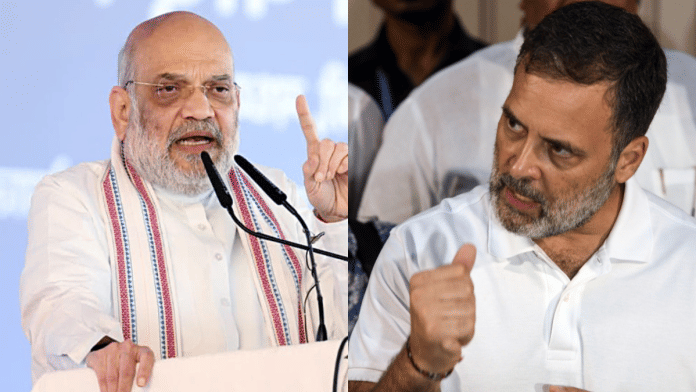

Trying to divert attention from a dodgy Special Intensive Revision and the oppressive policing of protesters, Union Home Minister Amit Shah has once again rolled out the charge that Opposition parties who demand accurate electoral rolls are supporting “ghuspaithiye”, or “infiltrators”. This outlandish claim would not ordinarily merit a response, were it not for the many people who live in a parallel reality created by Modi-fied media and social media.
The question naturally follows: how is it that an “all-powerful” Home Minister, assisted by the most intrusive and brutal weeding-out exercise in history, has been unable to tell us one simple thing — how many illegal immigrants has the SIR found?
It’s not as if the Modi government lacks the authority to do so. The Supreme Court’s 27 May 2026 SIR judgment clearly instructed the Election Commission of India (ECI) to refer every suspected non-citizen to the “competent authority” (paras 178, 186(g)). It required that authority to decide such cases “within a reasonable timeframe” and, in any event, before the next election in the state concerned, and allowed the ECI four weeks to make the Bihar referrals. This was to ensure, as the court put it, that voters’ electoral rights are not left “in a state of prolonged uncertainty”.
The net result? Nothing. Almost five months later, the ECI has released no data on referrals, and the Home Ministry hasn’t said who the competent authority is. We know this because RTI activist Venkatesh Nayak filed two RTI requests on 10 August 2026 with the ECI and the Home Ministry, respectively, asking (1) how many cases had been referred to the competent authority and (2) who that authority was. The ECI replied that it held none of the information. The Home Ministry passed the request to the Law Ministry, which passed it to the ECI, which sent the question about the competent authority back to the Home Ministry. Nobody knows nothin’.
More recently, the Home Ministry’s grandly named High-Level Committee on Demographic Changes asked the ECI for data on Bihar voters purged in the SIR as “non-citizens”. The Bihar rolls had been finalised on 30 September 2025, more than a year ago, but all the committee got from the ECI was silence.
One explanation emerged after a Reporters’ Collective investigation published on 16 October found that ERONET, the software officials used at SIR hearings in West Bengal, has no option to mark a voter as a non-citizen. Yes, you read that right.
It would appear that the “ghuspaithiye” have no better ally than Shah himself. Either that, or Shah has no real interest in identifying non-citizens, only in harvesting votes through anti-Muslim sentiment by invoking the word “ghuspaithiye”.
Anyone hear that dog whistle? (Trick question.)
SIR exposes Shah’s hollow rhetoric
Contrast this two-facedness with the record. The UPA deported 82,255 illegal immigrants to Bangladesh between 2005 and 2013, without stoking communal passions. The Modi government deported a mere fraction of that number — 3,568 — between 2014 and 2024, according to Home Ministry data reported in May 2026. (These figures broadly confirm earlier Congress claims.) Those shouting “detect, delete, deport” have delivered little more than political theatre and the mass disenfranchisement of Indian citizens.
The SIR itself shows how hollow Shah’s “ghuspaithiye” rhetoric is. In Bihar, the SIR removed about 68.5 lakh names, most of them because the voters were dead, absent, had shifted or were registered in more than one place. A team of journalists who scanned the Bihar rolls with optical character recognition software found only about 9,500 names marked under a fifth category, “ineligible”, and more than 85 per cent of them were in four districts bordering Nepal.
The journalists tracked down about 100 of these voters. At least 70 were not foreign nationals; the foreigners they did find were about 30 Nepali women who had moved to Bihar after marrying local men. So, at most, a fraction of the 0.013 per cent of voters declared “ineligible” were foreigners, many of whom have the right to live and work in India and are not “ghuspaithiye”.
Even in West Bengal, where the BJP campaigned non-stop on illegal immigration, nine in ten of the appeals decided by the tribunals had resulted in voters being restored to the roll, according to the West Bengal Chief Electoral Officer’s own RTI reply to Congress MP Isha Khan Choudhury (data as of 7 August). No tribunal decision reported so far has found a foreigner.
Of the 23 Murshidabad labourers detained in Bilaspur, Chhattisgarh, on 4 September as suspected Bangladeshis, 19 were released two weeks later after officials checked their voter-list entries and residence records. The remaining four, whose names were struck off during the SIR, are still being held while their appeals are pending.
‘Infiltrators’ is a cover for Vote Chori
So it’s glaringly obvious — the infiltrator rhetoric is being used to cover up Vote Chori on a massive scale. The BJP hopes that waving the “ghuspaithiye” red flag will distract a section of voters from the disenfranchisement and gaming of the electoral rolls.
Yet the evidence of centralised vote-rigging continues to mount: two Election Commissioners objected 14 times in ten months, one of them calling a change to Form 6 “unauthorised and illegal”; the Commissioners questioned the centralisation of the electoral-roll database on ECINet; and in Uttar Pradesh, the ECI’s software generated 85,854 deletion forms in election officers’ names with no reason recorded.
And however Shah tries to distract, a united Opposition will keep opposing Vote Chori and asking: How many infiltrators did the SIR find?
Amitabh Dubey is a Congress member. He tweets @dubeyamitabh. Views are personal.
(Edited by Prashant Dixit)