




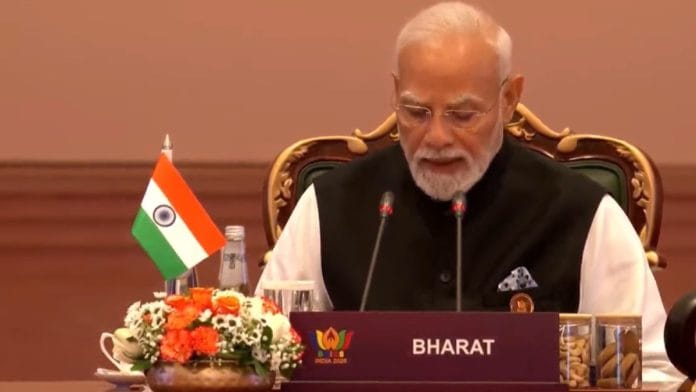

Prime Minister Narendra Modi’s entire political career has been based on trying to show that he is in stark opposition to the Congress party, its ideology and policies.
To the point that he has claimed during overseas trips that India, before his ascension as PM, had been no better than a “beggar” (in Germany), deserved to be called “Scam India” (Canada), and that people were once “ashamed of being born in India” (China). Yes, the same person who accuses Rahul Gandhi of “insulting” and “defaming” India for stating a few home truths abroad.
So, imagine everyone’s surprise at the Non-Aligned Movement (NAM) vibes that came out of the BRICS summit declaration that was produced under India’s chairmanship. Criticism of US trade policies? Check. Strong support for Palestine? Check. Calls for reforming global governance institutions like the UN Security Council and the International Monetary Fund? Check. References to Global South solidarity? Check. Silence on Russian military actions? Check. Laudatory references to the April 1955 Bandung Conference that catalysed the creation of NAM? Check.
Consider the strong words on Palestine. The text declared its “firm opposition to the forced displacement, temporary or permanent” of any Palestinians “from the Occupied Palestinian Territory,” supported the creation of a Palestinian state inside “the internationally recognised 1967 borders, which included the Gaza Strip and the West Bank, with East Jerusalem as its capital”. These are not words Israeli Prime Minister Benjamin Netanyahu or his close ally Modi would have wanted India to author (but the Congress party 100 per cent would).
Modi mugged by reality
It’s not so long ago that Modi had signalled a bizarre tilt toward Israel with a Prime Ministerial visit on the eve of an attack on Iran that everyone and their uncle knew was coming. Add to this instructions to Indian heads of mission not to sign Iranian condolence books for Iran’s assassinated Supreme Leader Ali Khamenei, and the silent acceptance of the IRIS Dena sinking by the US Navy in the Indian Ocean, days after leaving India. It was almost as if Modi had been convinced by his bestie that the Iranian regime would collapse after a short and intense US-Israeli campaign.
The fact is that Modi is a Right-winger who has been mugged by reality. He personalised foreign policy and prioritised image-building (remember ‘Howdy Modi’ and ‘Ab ki baar Trump sarkar’), which left him high and dry when the US changed direction – favouring a khaki-clad Pakistani Field Marshal once again. The much-vaunted Quad seemed to be of little consequence when China intruded in Galwan, killed 20 of our soldiers and squatted on buffer zones that lay entirely in Indian territory.
Now it is true that we live in a volatile and rapidly changing world. Few foresaw Donald Trump’s wilful overturning of the global order – although some of us did issue warnings at the time. But when narcissism and PR are the basis of foreign-policy making, you will end up declaring that “this is not an era of war” just when the era of war begins.
And so, structural factors are forcing Modi back into – let’s call it – Non-Alignment 3.0. It hasn’t been easy.
Also read: Manusmriti is the silent counter to constitutional equality. That’s why BJP-RSS is rattled
Back to the start
A preparatory BRICS meeting in New Delhi on 23-24 April failed to produce a draft declaration, in part because of an unexpected attempt by India to “tone down” language on Israel and Palestine. But the pressure from other countries proved overwhelming, in part because of India’s own United Nations Security Council ambitions — a campaign it would formally launch in July, running against Organisation of Islamic Cooperation-backed Tajikistan —gave it every reason to avoid alienating the Global South over Palestine.
Germany lost its own bid earlier this year because of its pro-Israel stance, as the German Foreign Minister himself admitted. That’s how reality mugs you.
India under Jawaharlal Nehru adopted non-alignment not just as a firm moral principle (that BJP-types love to sneer at), but also because of an accurate calculation of our position and vulnerabilities. Non-alignment maximised our room for manoeuvre and protected our interests in alliance with other decolonised nations. It was a pragmatic strategy aimed at securing India the benefits of superpower competition without paying the costs of being a pliable client state.
Non-alignment didn’t prevent Indira Gandhi from leaning toward the Soviet Union to neutralise the US-China threat in 1971, before engaging with Ronald Reagan both at the Cancun Summit (October 1981) and during her subsequent White House visit (July 1982) – both at the height of the Cold War.
This is the space Modi was in danger of losing in his rush to align with the West before, let’s be honest, Trump saved India from Modi’s tilt by upturning India-US relations.
Which is why we find ourselves back at the start, espousing non-alignment while pretending that the stated goal of “strategic autonomy” – a term that gained currency under Manmohan Singh – is completely different. This gives us the time and space to rebuild India without entangling alliances, what the International Relations literature calls ‘internal balancing’. Because, like it or not, we are in an era of war.
Amitabh Dubey is a Congress member. He tweets @dubeyamitabh. Views are personal.
(Edited by Ratan Priya)