




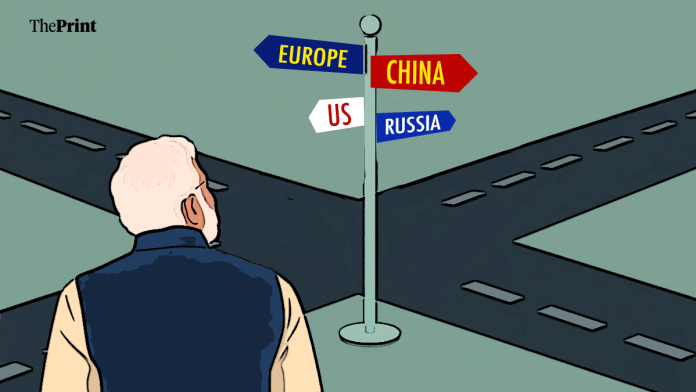

India has long cherished strategic autonomy as a defining principle of its foreign policy. This has enabled the country to preserve its independence of judgement, maintain relationships across competing power centres and pursue its national interests without becoming subordinate to any geopolitical bloc. In a world divided by the Cold War, this was a statement of sovereignty. In today’s more complex international environment, it remains an important source of diplomatic flexibility and national confidence.
But the world has changed, and so has India’s global standing. India is no longer simply a country seeking to protect its freedom of action; it is an increasingly consequential power with the economic weight, diplomatic reach and strategic ambitions to influence international outcomes. The task before India, therefore, is to convert its strategic autonomy to strategic power.
Strategic autonomy must become strategic leverage
The defining question of Indian foreign policy today is whether New Delhi can translate its strategic autonomy into greater influence over the emerging international order. The United States expects its partners to side with its strategic priorities. China seeks to expand its influence and reshape the regional balance. Europe is reassessing its economic and security dependencies, while conflicts and geopolitical rivalries are transforming the rules of international engagement.
In an increasingly polarised world, countries face growing pressure to align their policies with the strategic priorities of major powers, often at the expense of their own national interests.
India must resist the false choice between unquestioning alignment and diplomatic isolation. Strategic autonomy does not mean sitting on the fence, maintaining artificial equidistance between competing powers or refusing to take difficult positions. It means having the confidence to decide when interests converge, when they diverge and when taking an independent view is necessary. A country that cannot disagree with a partner without fearing retaliation is not fully exercising its strategic autonomy; it is operating within someone else’s strategic framework.
For India, this principle has deep historical roots, but its contemporary significance is different. Non-alignment emerged in a world divided by the Cold War. Today’s international system is more interconnected, economically complex and technologically contested. India now has greater economic weight, wider diplomatic reach and more consequential partnerships. The challenge is no longer simply to preserve independence in a divided world; it is to use that independence to advance Indian interests and strengthen India’s negotiating position.
Also read: No country is ever fully sovereign. Cold War era taught India its real meaning
Interdependence is the new battleground
Today, the greatest threat to strategic autonomy comes from dependence. Trade restrictions, tariffs, sanctions, technology controls, energy supplies and access to critical minerals have all been weaponised and turned into instruments against strategic independence. The assumption that economic interdependence will automatically encourage cooperation has proved inadequate. In an increasingly contested world, what a country imports, where its technology comes from and who controls its supply chains can determine the extent of freedom it can exercise in its foreign policy.
India’s relationships with the United States and China illustrate the complexity. Washington is an important partner in defence, advanced technology, trade and the Indo-Pacific. Yet cooperation does not eliminate differences over individual policies and priorities. A mature partnership must be able to accommodate disagreements without allowing them to overwhelm areas of shared interest. Equally, New Delhi’s relationship with Beijing requires a clear-eyed approach to the unresolved boundary question, security concerns and economic asymmetries. Dialogue remains necessary, but engagement cannot come at the cost of diluting national interest.
India’s multi-alignment offers a practical response. Cooperation with the United States, Japan and Australia through the Quad can coexist with participation in BRICS. Deeper engagement with Europe can complement partnerships across the Gulf, Africa and among other emerging economies. These relationships need not be mutually exclusive simply because the countries involved disagree with one another. But diplomatic breadth, by itself, is not a strategy. If India has many partners yet remains vulnerable to pressure in essential sectors, the appearance of autonomy may actually conceal its absence.
Make in India, secure India, empower India
Strategic autonomy cannot be sustained through diplomatic skill alone. It must rest on national capability. No country can negotiate confidently if it lacks economic resilience, technological depth, industrial capacity and credible defence preparedness. The more India develops domestically, diversifies its external sources of supply and secures access to essential resources, the less vulnerable it becomes to coercion. Self-reliance, properly understood, is not economic isolation; it is the ability to participate in the world without becoming hostage to any single external supplier or market.
This is where India’s economic transformation becomes central to its foreign policy. Manufacturing, research and development, advanced digital capabilities, energy security and resilient supply chains are not merely domestic policy priorities. They are instruments of international influence. Building indigenous capabilities in critical technologies, strengthening industrial ecosystems and developing reliable partnerships for critical minerals can widen India’s room for manoeuvre. So can expanding trade, attracting investment and connecting Indian enterprises more deeply with global markets. An India that produces, innovates and competes creates more choices than one that relies principally on diplomatic assurances.
The same logic applies to energy and defence. Diversified energy partnerships reduce exposure to external disruptions; stronger domestic capabilities improve resilience; and credible defence capacity makes diplomacy more persuasive. India must therefore judge international partnerships by tangible outcomes: access to advanced technology, investment, export markets, defence capabilities and reliable supplies. Do they strengthen India’s ability to act independently when interests diverge? Do they create alternatives when pressure mounts? Strategic autonomy becomes meaningful only when India can absorb the costs of saying no.
Also read: The world’s in a flux. India must reform, consolidate & build a strong economy
From independence of action to influencing outcomes
India’s ambitions should extend beyond preserving freedom of action. The next stage is strategic leverage: converting diplomatic relationships, economic weight and national capabilities into the power to shape international outcomes. This means moving from being a country that others seek to persuade to one whose participation helps determine outcomes. It also means influencing the rules of trade, technology, climate action and global governance, while making a stronger case for reforming institutions that no longer adequately reflect contemporary realities.
Such influence will not be secured by rhetoric alone. India’s aspiration for a greater role in institutions, such as the United Nations Security Council, requires sustained diplomatic engagement, credible contributions to international problem-solving and partnerships that extend beyond convenient political groupings. It also requires demonstrating that India’s independent positions are not simply expressions of national preference, but can contribute to addressing shared challenges. Leadership becomes durable when other countries see value in India’s participation, even when they do not agree with the position India may be taking.
The ultimate measure of strategic autonomy is not how frequently India is able to take an independent position without aligning itself with a major power’s position, no matter what the pressure. Instead, it will be answered by questions like these: Can India bridge divides without diluting its convictions? Can it shape rules rather than merely respond to them? These are the tests that will matter.
India has already established itself as an independent and consequential voice in world affairs. The task now is to build on that standing — to ensure that diplomatic autonomy is reinforced by economic strength, technological capability and strategic resilience. The progression from non-alignment to strategic autonomy, multi-alignment and ultimately strategic leverage is not a repudiation of India’s foreign policy tradition. It will be a natural evolution of that tradition, reflecting India’s growing global role.
Shishir Priyadarshi is president, Chintan Research Foundation. He tweets @priyadarshi_crf. Views are personal.
(Edited by Prashant Dixit)