








For decades, the economic trajectory of West Bengal has been discussed through the prism of industrial decline. Once among India’s foremost manufacturing and trading centres — with its engineering industries, jute mills, port economy, and commercial networks — the state gradually ceded ground to western and southern states such as Gujarat, Maharashtra, and Tamil Nadu.
The long shadow of industrial decline in Bengal
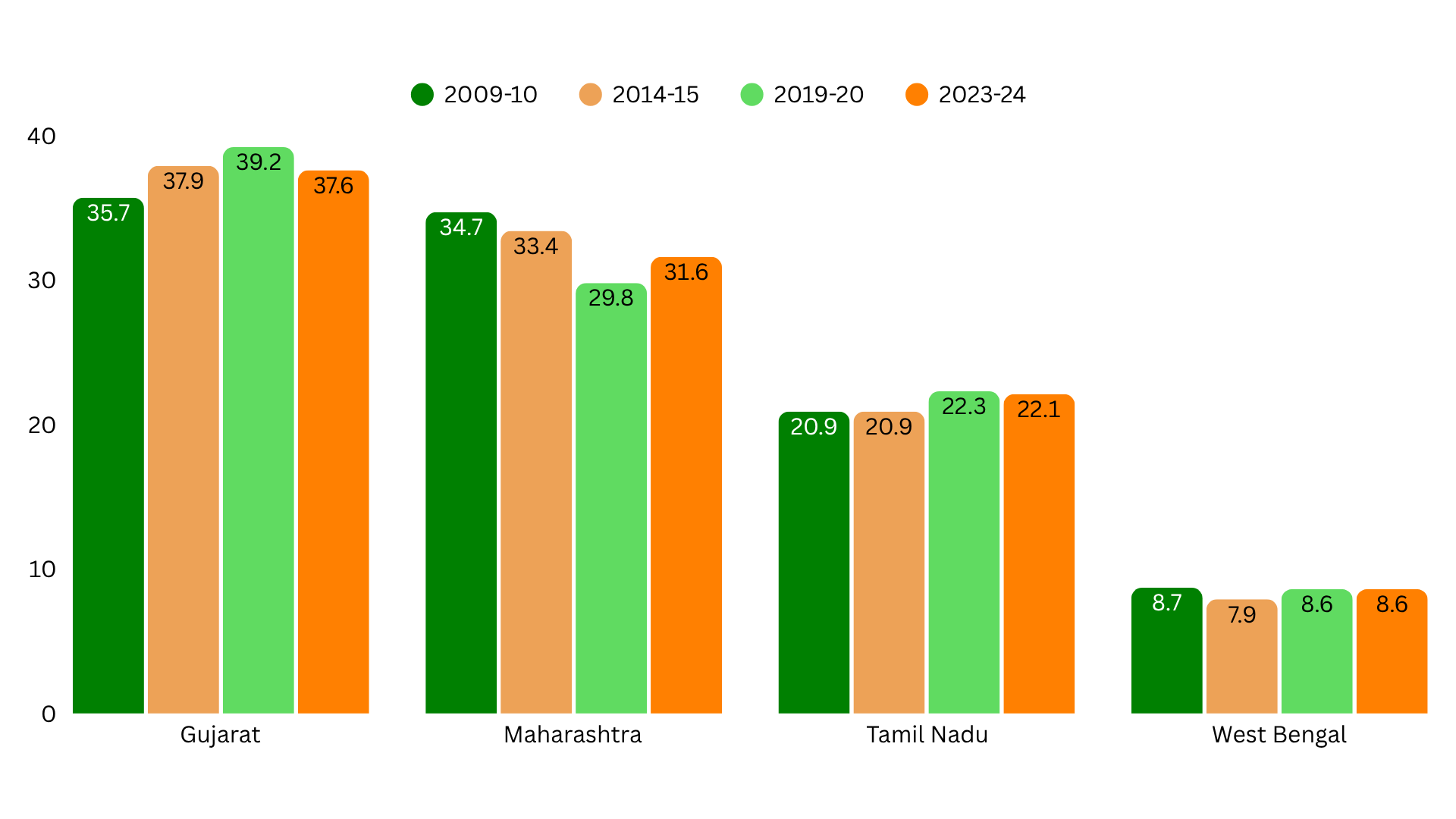
Over the past decade and a half, West Bengal’s share in India’s organised manufacturing has remained modest and, in relative terms, has lagged behind the rapid expansion witnessed in leading industrial states such as Gujarat, Maharashtra, and Tamil Nadu. The western and southern states strengthened their position as India’s principal industrial hub through export-oriented manufacturing, port-led development, and stronger infrastructure ecosystems.The evidence becomes even more striking when one examines the trend in Gross Value Added (GVA) relative to fixed capital in organised manufacturing. Figure 2 reveals that West Bengal’s GVA-to-fixed-capital ratio has remained significantly below that of leading industrial states and has generally weakened over time. This suggests lower capital productivity and slower value creation relative to competing manufacturing centres, highlighting the need for a renewed industrial strategy.
Figure 1. Share in total industrial output (% share)
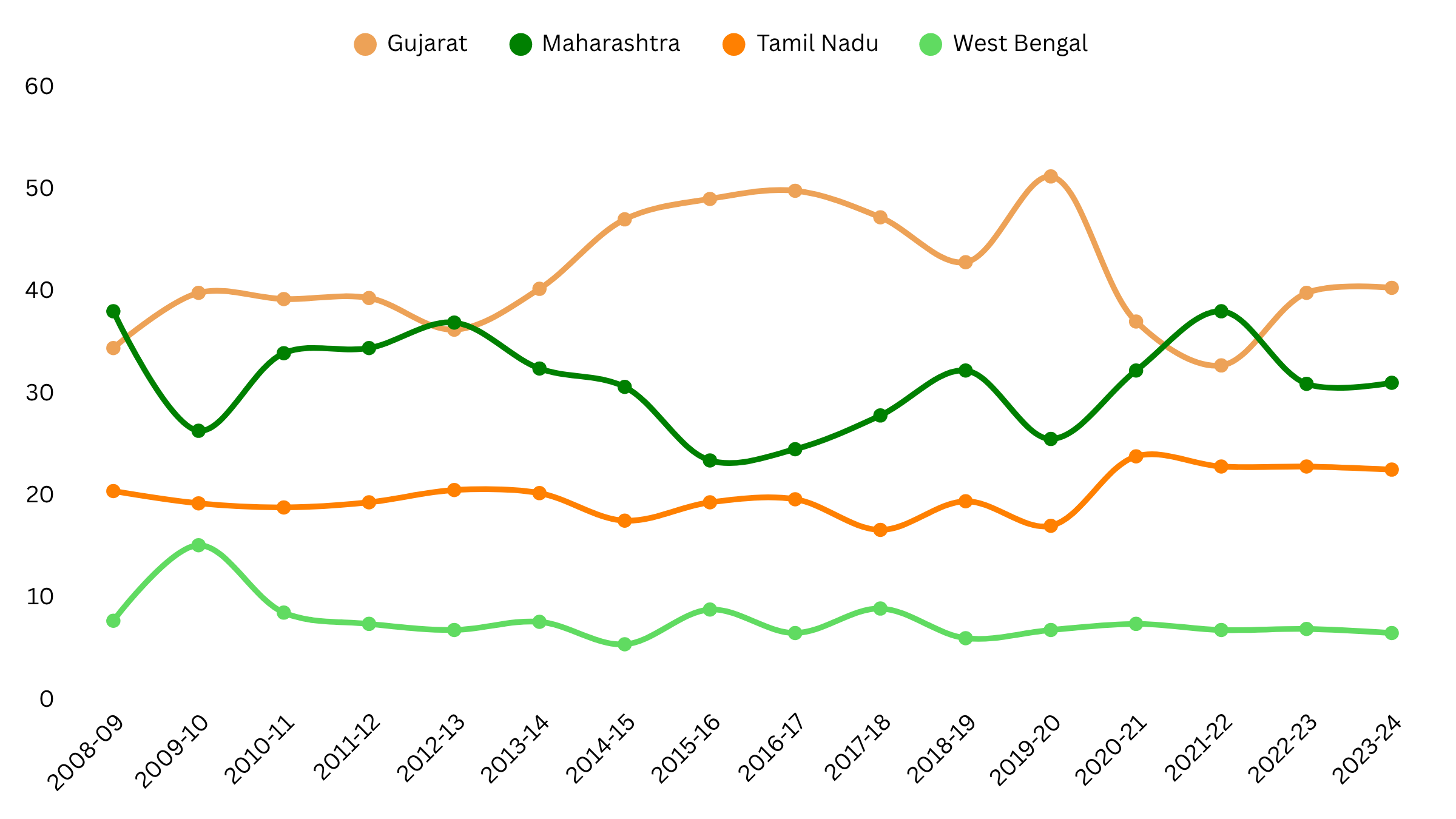
The evidence becomes even more striking when one examines the trend in Gross Value Added (GVA) relative to fixed capital in organised manufacturing. Figure 2 reveals that West Bengal’s GVA-to-fixed-capital ratio has remained significantly below that of leading industrial states and has generally weakened over time. This suggests lower capital productivity and slower value creation relative to competing manufacturing centres, highlighting the need for a renewed industrial strategy.
Figure 2. Gross value added relative to fixed capital in organised manufacturing (%)
The scale of this relative decline becomes clearer when viewed through broader economic indicators. Today, West Bengal remains one of India’s largest states in terms of population and aggregate economic size, yet its manufacturing contribution remains significantly below that of leading industrial states. States such as Gujarat and Tamil Nadu have built strong manufacturing-led growth models over the past three decades, reflected in their expanding industrial output and faster growth in aggregate net state domestic product (NSDP). Measured at constant 2011-12 prices, the economies of Maharashtra, Gujarat, and Tamil Nadu have expanded considerably faster than West Bengal’s over the past decade and a half – highlighting the cumulative effects of sustained industrialisation, infrastructure investment, and export-oriented growth strategies.
Figure 3 illustrates these divergent trajectories. While West Bengal remains one of India’s largest state economies, its per capita NSDP has grown more slowly than that of several leading industrial states over the past decade and a half. The widening gap reflects differences in industrial dynamism, productivity growth, and structural transformation. Maharashtra’s diversified industrial and services economy, Gujarat’s port-driven manufacturing ecosystem, and Tamil Nadu’s integrated MSME (micro, small, and medium enterprises)-industrial networks have generated stronger income growth, underscoring the developmental dividends of sustained industrialisation.
Figure 3. Comparative trends in per capita NSDP across major states (Rs. ‘000, at constant 2011-12 prices)

What makes the present moment different
Yet the comparison is not entirely discouraging for Bengal. Unlike many slower-growing states, West Bengal retains several structural advantages: strategic geography, port access, dense settlement patterns, a large labour force, an established urban network, and proximity to international markets. These advantages are becoming increasingly relevant as India’s economic geography itself undergoes transformation.
What makes the present moment different is not nostalgia for Bengal’s industrial past, but the emergence of a new connectivity-driven growth architecture stretching across eastern India, Bangladesh, and the Bay of Bengal region.
Over the last decade, Bangladesh has emerged as one of South Asia’s fastest-growing economies, with manufacturing exports — particularly garments and textiles — expanding rapidly. Bangladesh’s ready-made garment exports alone crossed US$45 billion in recent years, making it one of the world’s largest textile exporters. As regional production networks deepen across South Asia, India’s eastern states stand to benefit from growing cross-border trade, intermediate manufacturing, and logistics integration. According to the Ministry of Commerce, Government of India, Bangladesh has emerged as India’s largest trading partner in South Asia, with bilateral trade exceeding US$14 billion annually.
For West Bengal, the geographical proximity to Bangladesh is potentially transformational.
Nearly all major land-based trade routes between India and Bangladesh pass through eastern India, with Bengal serving as a principal gateway. Integrated Check Posts such as Petrapole-Benapole already handle a substantial share of bilateral trade between the two countries. Petrapole remains among South Asia’s busiest land ports, and improvements in border infrastructure, customs systems, and cargo handling are steadily expanding commercial activity.
Beyond facilitating trade, the corridor has the potential to support integrated regional value chains in textiles, food processing, light engineering and logistics services, creating new opportunities for industrial expansion in eastern India. This matters because industrialisation today increasingly follows connectivity.
As supply chains become regionally integrated, border states often gain disproportionate advantages in warehousing, transport services, agro-processing, and light manufacturing. West Bengal is therefore not merely another state economy; it is emerging as India’s principal economic interface between the domestic market and the rapidly integrating economies of Bangladesh and the wider Bay of Bengal region. The significance also extends beyond Bangladesh. The growing strategic importance of the Bay of Bengal region and India’s Act East policy are gradually strengthening connectivity with Southeast Asia. The Bay of Bengal is increasingly being viewed as a critical economic corridor linking South Asia with ASEAN (Association of Southeast Asian Nations) markets through a network of ports, shipping routes, and multimodal transport systems. Projects linking India’s northeast with Bangladeshi ports, multimodal transport systems, and coastal shipping arrangements are beginning to reshape trade flows across the eastern subcontinent.
In this context, Kolkata and Haldia could regain strategic economic importance. Historically, the port economy was central to Bengal’s industrial rise. Today, renewed investments in port modernisation, inland waterways, and logistics infrastructure may once again strengthen the state’s role in regional commerce.
The inland waterway route connecting the Ganga River system with Bangladesh protocol routes offers another underappreciated opportunity. Water-based cargo transport remains significantly cheaper for bulk commodities compared to road transport. As India pushes multimodal logistics under initiatives such as PM Gati Shakti, eastern river systems could become economically more relevant than they have been for decades.
Building long-term economic ecosystems
The experience of Gujarat is particularly instructive here. Gujarat’s industrial acceleration was closely linked to port-led industrialisation, logistics integration, and export-oriented manufacturing clusters. Tamil Nadu, meanwhile, demonstrated how diversified manufacturing ecosystems – combining large industries with MSMEs, skilling systems, and urban infrastructure – can create sustained industrial momentum over long periods.
While Gujarat leveraged ports to become a manufacturing and export powerhouse and Tamil Nadu built diversified industrial ecosystems around automobiles, electronics, and MSMEs, West Bengal’s comparative advantage may lie in combining logistics, cross-border trade, and labour-intensive manufacturing within a rapidly integrating eastern regional economy.
West Bengal need not replicate these models exactly, but the broader lesson remains important: industrial revival depends less on isolated mega-projects and more on the creation of long-term economic ecosystems where infrastructure, governance, logistics, and enterprise networks function together.
Encouragingly, recent policy signals suggest that the current state government increasingly recognises the centrality of industrial growth for long-term employment generation. Greater emphasis is now being placed on logistics parks, warehousing, MSMEs, tourism infrastructure, data centres, and manufacturing-oriented investments.
Coordination with the Union government will be equally critical. Large-scale industrial competitiveness today depends heavily on railway freight systems, highway integration, port connectivity, energy reliability, and trade facilitation. Central investments in eastern freight infrastructure and multimodal connectivity can significantly improve Bengal’s attractiveness for manufacturing and logistics industries.
There are already visible signs of economic transition in eastern India. Expanding highway networks, freight connectivity initiatives, port-led development strategies, and the increasing policy focus on waterways collectively point toward a gradual eastward broadening of India’s growth geography.
For Bengal, this opens possibilities across multiple sectors: food processing, textiles, leather, fisheries, electronics assembly, logistics services, renewable energy components, digital infrastructure, and agro-based manufacturing.
The state’s large MSME base can become particularly important in this transformation. Unlike capital-intensive mega industries that generate limited employment, MSME-led industrial ecosystems create wider labour absorption and stronger local economic multipliers.
At the same time, optimism must remain balanced with realism
Challenges and opportunities
West Bengal still faces an investor perception challenge rooted in historical memories of industrial disputes, land conflicts, and administrative uncertainty. Rebuilding confidence therefore requires institutional consistency rather than episodic investment summits.
Administrative predictability, transparent land policies, quicker approvals and stable industrial relations will be essential. Equally important is the need to ensure that industrialisation remains socially balanced through investments in skilling, urban services, and environmental safeguards.
The larger point, however, is that India’s next phase of growth may not mirror the geography of the previous one.
If western and southern India benefited most from the first major wave of post-reform industrialisation, eastern India — led by states such as West Bengal — may become increasingly important in the next phase shaped by connectivity, regional trade, and logistics integration.
The state’s industrial renewal, therefore, need not be viewed merely as an attempt to recover a lost past. It may instead represent the emergence of a new eastern growth frontier — one where Bengal’s geography, connectivity, and regional linkages once again become central economic assets.
Saurabh Bandyopadhyay is a Senior Fellow at the National Council of Applied Economic Research (NCAER). He tweets @sauban_10.
Views are personal.
This article was originally published on the Ideas for India website.