






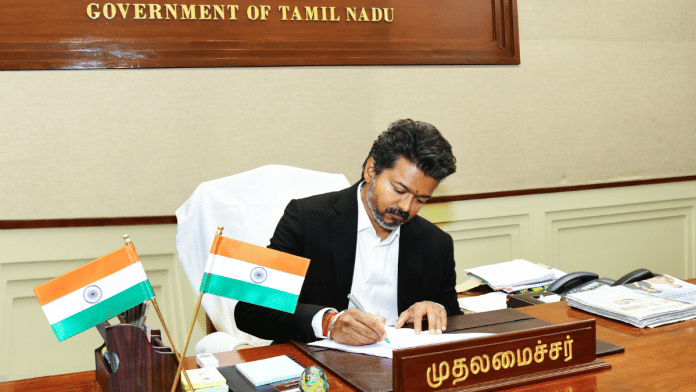

In 2018, at the audio launch of his film, Sarkar, Vijay was asked if he would become a real-life CM. “If I become the Chief Minister, I won’t just act like one. I will do my job with sincerity,” he reportedly said.
In the movie, Vijay plays the role of a ruthless NRI businessman who returns from the US to find that someone else has already cast his vote. His fight against that electoral fraud leads him into a war against the political class.
Incidentally, Gyanesh Kumar was still in the Union Ministry of Home Affairs in 2018. Otherwise, who knows—Vijay would probably have been fighting against the deletion of his name in the special intensive revision (SIR) exercise in that movie.
“If you want to change the government, don’t look for a leader. Become the leader,” reel-life Vijay of Sarkar says. The ruling and the opposition parties come together to defeat him. No prize guessing who won. Vijay wins the election but decides to make an honest IAS officer the CM.
In real life, Chandrasekaran Joseph Vijay decided to do the job himself. As he took oath as Tamil Nadu Chief Minister on Sunday, he may well have in mind what he had vowed to do at the audio launch of Sarkar seven-and-a-half years ago—to do the job with sincerity.
It’s probably too early to ask if he can. Or is it really early?
Vijay’s wobbly coalition
Look at how he has cobbled together a majority in the Assembly—with parties that still swear allegiance to what he calls his political enemy, the Dravida Munnetra Kazhagam (DMK). Vijay’s party, the Tamilaga Vettri Kazhagam or Tamil Nadu Victory Party, has 107 members after he resigned from his second seat, Trichy East.
For now, Vijay can count on the support of five Congress MLAs. If you saw Rahul Gandhi at the venue of Vijay’s swearing-in ceremony in Chennai on Sunday, you might get the impression that the two were long-lost pals.
Back in 2009, Vijay and his father visited Rahul Gandhi in New Delhi at the latter’s behest. Gandhi reportedly wanted Vijay to join the Youth Congress, but the actor had other plans.
Seventeen years later, as Gandhi sat beside Vijay in Chennai on Sunday, the Congress leader was beaming with pride. Should this make Vijay assured of the support of 112 MLAs? Let’s see.
These five Congress MLAs owe their poll wins to MK Stalin’s DMK, not Gandhi. Vijay can surely count on them as long as the DMK sits in the opposition, biding its time.
Then there are the four MLAs from the two Left parties, who have extended support from outside. They have clarified that they will continue to work with the DMK to safeguard the state’s interests.
The remaining four MLAs came from two parties, two each from the Indian Union Muslim League (IUML) and the Viduthalai Chiruthaigal Katchi (VCK). Both parties have also extended support to Vijay, but they remain in the DMK-led alliance. Except for the Congress, which has snapped ties with the DMK, all others are extending outside support to the government.
Essentially, the survival of Vijay’s government, as it looks today, depends on the pleasure of Stalin—his ‘political enemy’. And why is the DMK propping him up through its allies? Because it had to pre-empt the imposition of the President’s Rule and deny the single-MLA party, the Bharatiya Janata Party (BJP), any opportunity to rule Tamil Nadu by proxy.
Why not seal the deal with the All India Anna Dravida Munnetra Kazhagam (AIADMK) then? Well, the ruling and the opposition parties had come together in the Sarkar film, too, to deal with Vijay’s character, but he had the better of them in the end. In real life, DMK and AIADMK, who have been rivals for five decades, coming together to deny power to Vijay wouldn’t help their cause. Their cadres and the people in general would look at it as a cynical alliance.
Anyway, why give a new lease of life to EK Palaniswami, whose grip on the AIADMK is set to weaken fast after the latest electoral defeat? It’s only a matter of time before the AIADMK starts imploding. Stalin can always hope to demolish the AIADMK brick by brick. And with EPS coming a cropper and the AIADMK left in the doldrums without J. Jayalalithaa’s star power, Stalin can even hope to re-acquire what was once a breakaway faction of the DMK.
The AIADMK, it is said, was willing to support Vijay, but he was cold to its overtures. Stalin seems to have all the aces in hand.
How the DMK may play its cards
Stalin doesn’t seem to be in any hurry. Not letting Vijay form the government would have boomeranged. He would return with a big majority if there were fresh elections. As the DMK chief said in an interview after the results, he wouldn’t disturb Vijay for six months. By letting his alliance partners help Vijay form a majority, he looks like a statesman who has respected the public mandate. He would rather have Vijay fail.
The TVK has made very tall promises—cash and doles to almost everyone, big claims about women’s safety, honest administration as his ideology, etc. It’s easier said than done, especially for a newbie in politics and governance. But the people would expect the Vijay of Sarkar to deliver the same in real life.
In the first three to four days after the results, Vijay looked like a deer caught in the headlights. After his first meeting with the Governor—who asked him to come back with the letters of support to prove a majority—he should have realised that his ‘ideological enemy’, the BJP, was out there to test his mettle. The star that he is, he didn’t even try to meet the potential allies. He got other TVK leaders to reach out to them through WhatsApp messages. How could a Superhero seek anyone’s help or support?
In the meantime, Vijay called on the Governor twice, obviously hoping that the latter would relent. Even on Saturday, after he had secured the requisite numbers, Vijay set off for Raj Bhavan for a fourth meeting—only to be told that the appointment was yet to be confirmed. The meeting finally happened, but it must have come as a reality check for the superstar in Tamil Nadu.
At least one-fourth of his MLAs come from other parties who capitalized on his popularity to get TVK tickets and win. Can he bank on their support if the going gets tough? For instance, his close aide, Aadhav Arjuna, was in the DMK and the VCK before he joined the TVK. He was sworn in as a minister on Sunday. He is the son-in-law of lottery king Santiago Martin, who was the DMK’s biggest donor. Arjuna’s mother-in-law, Leema Rose Martin, is an AIADMK MLA. Many others who were sworn in have their roots in other parties. Vijay doesn’t even recognise most of his MLAs. Fan clubs were handy in the election, but they can’t supplant a well-knit political organisation.
Stalin must be watching Vijay’s every move very closely. He doesn’t have to hurry. He would just let the film star fumble and falter in governance in the next six months – perhaps a little less, perhaps a little more. If voters were fatigued with nearly six decades of rule by the two Dravidian majors, Stalin would want them to realise that the actor-turned-politician is no alternative.
Once Stalin is convinced of this message reaching those who were yearning for a change, he would ask his allies supporting the Vijay government to pull the rug from under its feet. Stalin would also wait to see what happens in the AIADMK camp in the meantime. When to go for a fresh election would be the DMK’s call.
What Stalin may need to account for is the possibility of the superhero springing a surprise on the traditional politicians, as he did in Sarkar.
Also read: Opposition doesn’t know how to beat BJP. What it can learn from Hungarian Magyar’s playbook
Vijay’s options—Kejriwal act, for one
Once Vijay proves the majority in the Assembly on 13 May, he will have gained at least six months to prove himself. Can he get more MLAs from the DMK or the AIADMK to consolidate his majority?
The DMK has 59 and the AIADMK has 47 members in the Assembly. Expecting two-thirds of the members of either party to defect and join Vijay to avoid disqualification under the anti-defection law would be a tall ask.
The BJP has shown the way in so many states: get a dozen or so from another party to resign, then get them re-elected. However, the TVK is not the BJP, and Vijay has nobody in his core team who comes remotely close to Amit Shah.
TVK doesn’t even have the resources to convince the potential defectors to risk disqualification. If things start going badly for EPS in the AIADMK, Vijay can, however, hope to get support from EPS and seize that. There were already signs of EPS being under pressure from his party colleagues to extend support to the Vijay-led government. On Sunday, two senior AIADMK leaders, CV Shanmugam and SP Velumani, held a meeting with party MLAs to explore the option of supporting the government. EPS held a parallel meeting with the party’s district secretaries. Vijay may take comfort from these developments in the AIADMK camp but if he has to survive on the crutches of DMK’s allies and the AIADMK, the entire slogan of being the third alternative to established Dravidian majors would go for a toss.
The scenarios can change if Vijay is able to pull a rabbit out of his hat in the next six months of governance—something that would force his political adversaries to do a rethink about pulling him down and facing election. That sounds far-fetched as of now.
Another option would be to do what Aam Aadmi Party’s Arvind Kejriwal did in Delhi in 2014— resign after a short term (49 days) in office with the excuse that the mainstream parties are not allowing him to function. Congress-BJP’s opposition to the Kejriwal government’s Jan Lokpal bill was an excuse in that case.
Vijay could appeal to the people to give him a clear mandate to live up to their expectations. Of course, the TVK is not the AAP and Vijay is not Arvind Kejriwal. Nor is Tamil Nadu politics the same as Delhi’s.
As it is, odds seem to be stacked against the new Tamil Nadu chief minister. One can only try to see the rabbits coming out of his hat, even though he doesn’t wear one.
DK Singh is Political Editor at ThePrint. He tweets @dksingh73. Views are personal.
(Edited by Ratan Priya)
Vijay should use the VBGRAMG/MNREGA, to build storage facilities for farmers, and also probably compound walls and, for farmers affected by strong winds.
He should oversee implementation of good crop insurance policies by taking help of BJP at the Centre.