




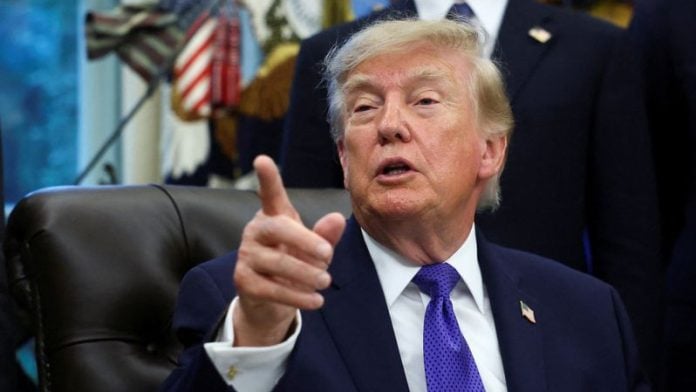

The retreat from globalisation has led to increasing restrictions on the cross-border movement of people, reshaping the global landscape of migration, labour and travel. Since Donald Trump’s return to the US presidency and the advent of tariffs as a coercive instrument of policy, global trade in goods and services will also take a hit.
What may come next are restrictions by the rich countries on the international movement of capital (capital controls have long been the norm in developing countries).
The primary provocation for such a radical move (unthinkable till just the other day) lies in the US, where the irresistible force of growing corporate borrowings is up against the immovable object of the US budget deficit. The big corporations leading the tech and AI race were until recently financing their capital budgets out of their earnings. No longer, as investment plans have ballooned.
Now they are borrowing in the market, and borrowing big as corporate bond issuances in the US have grown 80 per cent in two years. At the same time, the federal deficit has grown to 7 per cent of GDP, and shows no sign of coming under control.
US savings aren’t anywhere near enough to feed these hungry beasts, which is why the US has been for decades the world’s biggest borrower. But its growing need for capital from other countries is up against the fact that almost all large countries are turning away from US securities.
China has halved its US holdings in the last few years, while Japan (now the largest holder of US securities) has started moving away too. The total foreign holdings of marketable US treasuries are down to 30 per cent of the total, from 50 per cent in 2015. Even as central banks reduce their dollar holdings, they have increased the share of gold in their reserves. Last year, gold replaced US government bonds as the largest reserve asset; the price of gold has increased by 25 per cent in a year (and Indians are still big-time buyers).
Inflation wars to control debt
With increasing dollar debt issuances in the face of fading appetite for such debt, the inevitable has happened: interest rates have gone up. US Treasury rates are now the highest in two decades, and climbing. Yet international bidders for fresh US debt now account for a smaller part of the market than before. Five-year treasury interest rates have gone up by 0.64 per cent in just one month. The US Treasury Secretary, Scott Bessent, has spent the past few weeks trying a variety of gambits to talk the market down, to no effect.
If, despite higher rates, the US doesn’t get the capital that it wants from other countries, it could simply print dollars, cause inflation as more money chases the same goods, and thereby reduce the debt burden in real (ie inflation-adjusted) terms.
India has done this for decades. In fact, as Western countries’ debts have grown, inflation in the last five years in the US has been more than twice as high as in the previous decade, in Europe three times as high, and in Japan five times as high. Inflation wars to control debt, you might say.
There is also the possibility (still remote but real) that the US might turn coercive on capital, as it has on trade. Already, Trump has made investment commitments a part of some of his bilateral trade deals. Today, he is coercing inflow. Tomorrow, he may squeeze outflow.
In anticipation, some countries have started taking defensive measures. The Netherlands moved 78 tonnes of gold from New York to London in the last few months. The explanation was possible “geopolitical unrest”. Shortly before that, France moved all its gold out of the US. There are calls in Germany to do the same. Unthinkable as it may have been not long ago, trust in the continued openness of the US capital market has begun to chip away at the margins.
Meanwhile, expert voices in Europe have called for disincentivising the movement of European capital to the US, since Europe needs to invest in itself. Any such move by Europe will almost certainly be met by a counter-move from Washington. It is not for nothing that a headline in the Financial Times said in early September that “The capital wars are coming”.
All this should be of serious concern to India. Portfolio capital has been moving out of the country for the last couple of years, and the rupee has taken a tumble, falling 13 per cent in value despite active Reserve Bank of India (RBI) intervention, even as rising energy prices affect the trade balance. It is not for nothing that the main stock market indices are back to where they were two-and-a-half years ago. The last time the market disappointed investors over an extended period was in the wake of the 2008 financial crisis.
The biggest RBI initiative in the face of these trends was to offer a huge free lunch to non-resident Indians: deposits at attractive interest rates along with currency protection. It may have overplayed its hand, because the scheme brought in twice as much money as was expected, more than $130 billion. NRIs can obviously recognise a free lunch when they are offered one. The cost of the scheme to the RBI will depend on how currency rates move, and could be between $10 billion and $20 billion over the course of the scheme.
Also read: Trump-Xi Summit shows limits of US power. Grammar of great-power competition is changing
India needs a bigger cushion
Naturally, critics have made two arguments.
First, the foreign exchange reserves position is comfortable, which was not the case when attractive deposit terms were offered to NRIs in the past through the Millennium Bonds and Resurgent India Bonds.
Second, the terms of the offer were needlessly generous. The second argument holds more water than the first, because uncertainty and tensions in international capital markets warranted a precautionary move of some kind.
Consider that, in the six months between the end of February (when the US attacked Iran) and the end of August, the RBI’s foreign exchange reserves went up by a little over $50 billion, though about $130 billion came in as Foreign Currency Non-Resident (Bank), or FCNR(B), deposits during this period.
Neither the current account deficit nor net capital flows can fully explain the missing $80 billion. RBI has spent a lot of dollars shoring up the rupee as capital has gone out of the country. So getting some extra dollars as a cushion can do no harm.
Two scenarios are now possible. If the AI investment bubble bursts, there will be a global tsunami, since the US stock market accounts for more than two-thirds of global market capitalisation. If not, and the borrowing binge by governments and companies continues, there will be unprecedented competition for capital, leading to possibly higher inflation and/or restrictions on cross-country capital flows.
It makes sense, therefore, to shore up reserves, increase economic security by reducing the budget deficit and government debt, and make the country more attractive to investors. The additional reserves can be used to fight currency volatility and to fund any capital outflows. It can also be used to boost confidence in the economy’s external solvency at a time when no one knows exactly how the cards will fall.
TN Ninan is a former editor of Business Standard. Views are personal.
(Edited by Saptak Datta)