




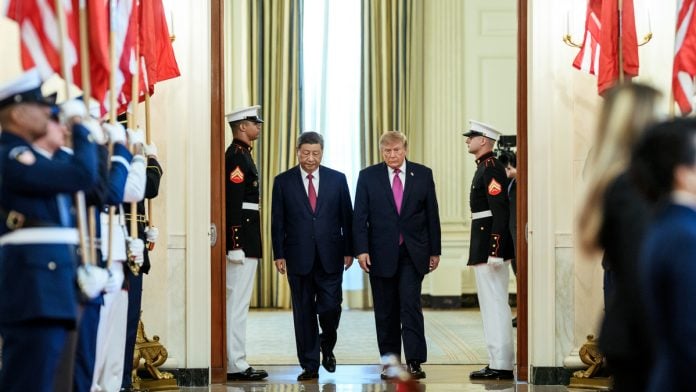

The Trump-Xi Summit in Washington last week exposed a central challenge for American strategy: the United States can impose costs on China, but its vast national power cannot, by itself, compel Beijing to accept Washington’s terms.
Ahead of the summit, Washington and Beijing extended their trade truce by two months, to 10 January 2027, as negotiations continued over tariffs, Chinese purchases and rare-earth supplies. The display of stability did little to resolve differences over Taiwan, Iran or artificial intelligence. The summit helped keep competition manageable for now, but also showed how difficult it has become to turn American power into lasting leverage.
America retains formidable military, technological and financial advantages, backed by an alliance network China cannot replicate. Yet Beijing’s industrial scale, its place in global supply chains and its commercial reach allow it to absorb pressure, retaliate and raise the costs for countries asked to take sides. Tariffs, export controls and military superiority can all shape the contest, but none can guarantee the political outcome.
Also Read: The 2026 midterms will test the political foundations of American power abroad
From national power to negotiating leverage
The brief trade extension illustrates Washington’s problem. It preserves the truce while postponing the harder bargain. Reports of disrupted rare-earth shipments and a projected shortfall in Chinese purchases of American farm goods show how trade implementation itself becomes a field of contestation. Washington and Beijing need economic stability even as each seeks to strengthen its position against the other. Negotiation is therefore part of the competition, rather than a departure from it. A two-month reprieve may reassure markets and give officials room to talk, but it leaves businesses uncertain about the rules under which they must invest and trade. Neither side has removed the sources of friction that made the truce necessary.
Iran points to a similar limit outside trade. Washington sought Chinese support to isolate Tehran economically and reopen the Strait of Hormuz. Beijing held back, and the summit yielded no reported breakthrough. Xi instead backed a return to an interim US-Iran arrangement. Even a crisis with global economic consequences could not bring Beijing into line with Washington’s position.
Taiwan poses a more consequential test. According to Chinese state media, Xi asked Trump to oppose Taiwanese independence — a stronger formulation than Washington’s longstanding position that it does not support it. No change in US policy was announced. Yet even the impression that assurances to Taiwan could be traded for concessions elsewhere would alter how partners judge American commitments. The summit may have lowered the temperature of rivalry, but the risks at its centre remain. What Beijing believes it can extract from Washington, and whether Taipei sees clear limits to any shift in US policy, now matter as much as the words exchanged. Uncertainty over a bargain can unsettle those who would live with its consequences.
The leaders also spoke differently about artificial intelligence. Trump emphasised limited new guardrails, while Xi called for managing its development. An interest in dialogue is no agreement on the rules of technological competition. Both governments have reason to prevent a dangerous incident, even as they seek an edge in technologies that could shape their economic and military futures. Crisis dialogue would be useful, but it would leave the larger contest over access, standards and technological leadership intact.
Also Read: Why the Trump-Xi summit just produced a truce, not a breakthrough
Alliances and the changing geometry of competition
America’s alliances remain a major strategic advantage, especially in the Indo-Pacific. But an ally’s support for deterrence does not imply acceptance of every economic restriction on China. European allies, Japan and South Korea have their own security concerns, industries and commercial exposure. They may cooperate on sensitive technologies and resilient supply chains while resisting a comprehensive effort to isolate the Chinese economy. Washington must build agreement around specific risks, share costs credibly and sustain trust in its commitments.
China need not break American alliances to benefit from differences within them. Coalition building is a political exercise, not an arithmetic sum of allied capabilities. A measure that looks effective from Washington may impose unequal costs on its partners. Unless those costs are addressed, apparent unity may falter in practice.
The grammar of great-power competition is changing. Security ties, production networks and technological partnerships overlap without forming two neatly bounded camps. States may work with Washington on maritime security, trade with China and take independent positions on climate or financial stability. Alignment on one issue does not dictate alignment on another. Partners take Chinese power seriously, but their interests cannot be reduced to a choice between Washington and Beijing.
For instance, India has a strong interest in a favourable Indo-Pacific balance and deeper strategic and technological ties with the United States. It also brings its own assessment of China, its continental and maritime priorities, and a commitment to independent judgement. Other states across Asia, Africa and Latin America make different calculations. Their choices will shape which American and Chinese initiatives succeed. Treating them simply as votes in a contest between two powers misses the agency that gives this competition its emerging geometry. India’s partnerships can enhance its ability to act, but their number alone says little about the autonomy or influence they produce. Their value lies in whether they widen access to technology and capital, strengthen national capabilities and offer room to respond to pressure from either major power.
Washington consequently needs to ask what cooperation it actually requires. Preventing coercion may call for shared security measures. Reducing dependence on concentrated supply chains may require investment, technology and viable alternatives. Demanding a common position on every question can make achievable cooperation harder. American influence depends as much on the attractiveness and reliability of what it offers as on its capacity to impose costs.
The summit also raises a wider question about international order. Trump may seek bilateral deals that yield visible gains, while Xi may seek recognition of China’s weight in global commerce and security. Such bargains can reduce danger, but neither leader can settle the interests of countries outside the room. An order emerges through repeated choices about rules, institutions, investment and trust, not through a single summit or a declaration of stability. A temporary accommodation between the two powers may serve a wider interest in stability. However, it may equally raise questions about whose concerns were heard and whose were deferred. The test of any emerging order is whether its terms can command confidence beyond Washington and Beijing.
The likely prospect is a prolonged contest over those terms. The United States can shape China’s choices but cannot dictate them. China can resist American pressure but cannot escape its own need for a stable external environment. Around them, other states will continue to weigh commitments, opportunities and risks on their own terms. The durability of American leadership will depend on whether Washington can turn its considerable power into credible cooperation in a less deferential world.
Monish Tourangbam is a Fellow at the Chintan Research Foundation (CRF), New Delhi. Views are personal.
(Edited by Asavari Singh)
Two summits, awash with pageantry, in four months. A hyphen is getting wedged between China and USA. ( Each September session of the UNGA also shows that it is getting wedged more firmly between India and Pakistan ). When Secretary of State Rubio says that this is the bilateral relationship which will shape the twenty first century, he is being completely truthful, not even very prescient. When President Obama said India – USA would be the defining partnership of the twenty first century, he was being indulgent. Indians, among the smartest people on the planet ( that includes the Editor and me, for sure ) got a little carried away. 2. Asia will observe the unfolding dynamic between China and USA with exceptional interest. Japan. India. No one gains from its veering into conflict. They should also prepare for the contingency of the two superpowers arriving at understandings where their interests are not always heeded.