



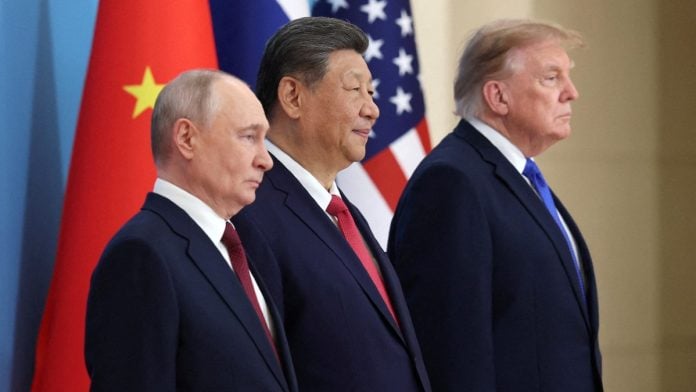
What can three permanent members of the UN Security Council agree on when they sit down to discuss strategic stability? At their first trilateral meeting, held on the sidelines of an Asia-Pacific economic summit in Shenzhen on 19 November 2026, Donald Trump, Xi Jinping and Vladimir Putin agreed on four points. They pledged talks on nuclear risk reduction and non-proliferation, backed UN reform and called for greater production and supply of refined petroleum products. They also stressed state consent and the immunities of state officials in matters involving the jurisdiction of the International Criminal Court and similar bodies. The declaration left the hardest questions open. When would nuclear talks begin? How much more fuel would reach markets? On what terms could the wars in Ukraine and West Asia end?
Trump met Putin first, then Xi, before the three sat down together in Shenzhen. The sequence captured the grammar of great power relations in which adversaries bargain bilaterally, coordinate where their interests overlap and take those bargains into wider multilateral forums. This power can be indispensable in containing one crisis but a source of insecurity in another. Shenzhen has left two questions unanswered. Can the three turn shared language into commitments each is willing to keep? How much say will other governments have in setting the terms?
The Shenzhen triangle: three powers, three calculations
For Washington, Shenzhen opened a channel to discuss nuclear risks with both its principal nuclear competitors. The New Strategic Arms Reduction Treaty, dubbed New START, expired on 5 February 2026, ending the last legally binding limits on US and Russian strategic nuclear forces. Yet moving from a bilateral arms control framework to a three-way conversation brings its own asymmetries. The Stockholm International Peace Research Institute (SIPRI) estimates that China had around 620 nuclear warheads in January 2026, while the United States and Russia had total inventories of more than 5,000 each. Trump raised the prospect of reductions, while the declaration committed the three to dialogue on nuclear risk reduction and non-proliferation. Crisis communications and advance notifications could help keep a military encounter from escalating through miscalculation. The harder test of this grammar of great power relations is whether three powers with unequal arsenals can agree on what to count, what to disclose and how to verify any limits they accept.
Trump told Xi that Washington and Beijing could help end the war in Ukraine and had a shared stake in keeping oil flowing through the Strait of Hormuz. Xi publicly addressed neither conflict. Washington can raise the costs for Beijing through sanctions and export controls, but China’s industrial scale and place in global supply chains give it room to absorb pressure. Its ties with Russia may also give it leverage over Moscow. The question for Washington is what Beijing would stand to gain from spending that leverage on a settlement in Ukraine.
The Shenzhen meeting gave Beijing two ways to set the agenda. At the Asia-Pacific Economic Cooperation (APEC), it convened economies with a stake in regional trade and growth. At the trilateral, it put itself at the centre of a conversation on strategic stability with Washington and Moscow. In Beijing’s account of the trilateral, Xi called for regular high-level exchanges, mechanisms to prevent crises and respect for each other’s red lines. In his separate meeting with Trump, Xi paired the language of stability with a warning on Taiwan.
Beijing’s bilateral readout says the two sides agreed to draw up an action plan for a constructive US–China relationship of strategic stability. For Taipei, the stakes lie in who gets to define the terms of that stability. The same channels that could help Washington and Beijing avert a crisis also give Beijing a forum to press for limits on US actions over Taiwan.
Moscow’s place at the Shenzhen table rested on its military and nuclear weight, its permanent seat on the UN Security Council and its role in the war in Ukraine. According to Beijing’s readout, Putin signalled Moscow’s willingness to work with Washington and Beijing on open trade and energy security. The declaration’s emphasis on immunity for state officials carried a more personal significance. The ICC warrant issued against Putin in March 2023 over the alleged unlawful deportation and transfer of children from occupied Ukraine to Russia remains in force. On the subject of Ukraine, Washington and Beijing can shape the terms of a possible settlement, but what Moscow can secure will also depend on what Kyiv is prepared to accept.
Also read: Why the upcoming Trump, Xi, and Putin summit risks repeating the mistakes of Yalta 1945
What happens in Shenzhen won’t stay in Shenzhen
Shenzhen laid bare the limits of great-power bargaining. Washington, Beijing and Moscow could put Ukraine on the agenda, but a ceasefire would depend on Kyiv’s consent. US envoy Jared Kushner said he and Steve Witkoff, the US special envoy to the Middle East, briefed German Chancellor Friedrich Merz on Trump’s discussions in China and efforts to end the war. Both envoys joined talks in Berlin with Ukrainian President Volodymyr Zelenskyy and European leaders. Europe has leverage through sanctions, military aid and security guarantees. Whether they can shape the terms of a settlement depends on how early and how collectively they bring that leverage to bear.
China’s Foreign Ministry said the leaders discussed the Korean Peninsula alongside Ukraine and West Asia. The declaration leaves their approach to North Korea open. For Japan and South Korea, the immediate questions concern North Korea’s nuclear and missile capabilities and the credibility of US extended deterrence. Southeast Asian governments have reason to welcome reduced tensions among major powers when trade and investment depend on predictable relations. They also have reason to ask whether the commitment to strategic stability will affect those powers’ conduct at sea.
For energy importers, the limits of the refined-products pledge are especially apparent. The US Energy Information Administration puts oil flows through Hormuz at 9.1 million barrels per day in the third quarter of 2026, down from 21.6 million in the final quarter of 2025. The declaration sets no volumes or schedule and offers no measures to improve shipping security. Gulf governments would bear the immediate consequences of escalation, while importers across Asia would feel the disruption. A durable arrangement would depend on decisions in Tehran and other Gulf capitals as well as in Washington, Beijing and Moscow.
India’s engagement with the Quad and BRICS gives it room to work with different partners on different issues. The Quad’s functional cooperation continued through the gap in leaders’ meetings, as the May foreign ministers’ meeting in New Delhi showed before leaders met in Manila on 17 November. The harder question is what such relationships enable India to do when the preferences of more powerful states change. Shenzhen’s broad pledge on UN reform offers one such area of the alignment and misalignment between generic positions and the more complicated game of power-sharing and power transition.
India’s market and Indian Ocean geography give other powers reasons to engage it, while exposure to energy shocks and technology restrictions narrows its choices. Southeast Asian governments can diversify economic ties while working with Washington on maritime security. European governments can pool defence financing and coordinate military support through the EU, even as US lawmakers debate NATO’s value to the United States and how allies should share the costs of collective defence. If Washington needs its partners to implement bargains it may strike with its adversaries, the options those partners have elsewhere give them a say in how it plays out.
Shenzhen’s first test will be whether the pledge of nuclear dialogue produces sustained contact and practical measures to reduce risk. Its wider test is whether the three powers can secure the cooperation of governments whose choices will determine whether their bargains hold. In the final analysis, the grammar of great power relations is written as much by Kyiv’s decisions on a ceasefire or Gulf governments’ decisions on shipping security as by the leaders who set the agenda.
Monish Tourangbam is Associate Director and Associate Professor at the Motwani Jadeja Institute for American Studies, OP Jindal Global University.Views are personal.
(Edited by Janaki Pande)